Now based in both the Windy City and Louisville, Kentucky, in Feburary, 2016 the group released Scheherazade (Bloodshot Records), their first new album in over ten years. Recorded by Kevin Ratterman at LaLa Land Studio in Louisville, Kentucky with Kevin Ratterman (My Morning Jacket), Scheherazade marked the band’s first time recording outside of Chicago and features a number of guest talents including the duo’s longtime bassist David Gay, Elkington (Tweedy, Horse’s Ha, Eleventh Dream Day), Warren Ellis (Dirty Three, Nick Cave), Evan Patterson (Young Widows, Jaye Jayle), Sarah Balliet (Murder By Death), and Morgan Geer (Drunken Prayer).
The album is titled for the famed heroine and narrator of the classic One Thousand and One Nights (also known as Arabian Tales), who saves her life and those of countless future victims, from a murderous king who becomes so enchanted by her storytelling he falls in love with her and makes her his queen. “We both identify with Scheherazade, although for Freakwater I think the sense of dread that drives the story is internal, rather than imposed by an external force,” Irwin said. “I’m pretty sure that Janet and I both spend more time wandering off inside our own brains telling ourselves little stories than we spend out in the real world, even if the story is just something like ‘what’s the worst possible thing that could happen next?’”
The album’s opening track, “What the People Want,” certainly addresses that train of thought, pairing ominous, haunting sounds with gritty, violent lyrical imagery detailing a woman’s torture, murder, and abandonment with Irwin and Bean questioning in harmony, “Whose baby are you, anyway?”
For the video for “What the People Want,” Freakwater enlisted the help of director Kathleen Judge. A video and poster artist who regularly works with Neko Case, among other musicians, Judge is also longtime friends with both Bean (her former neighbor) and Irwin (former co-worker a Chicago’s beloved venue, The Hideout), so the band gave her free reign to interpret the video how she saw fit. “The best collaborations happen when you respect another person’s work enough to give up control,” Irwin said.
Scheherezade found power through her voice, but the video for “What the People Want” contrasts this by taking influence from women around the world who have been silenced by gender-based violence. Central in Judge’s mind as she was creating the video included the attacks on women in India (specifically Jyoti Singh, who was gang raped and murdered on a bus in Delhi in 2012), the “Highway of Tears” murders of Indigenous women in Canada, thousands of African American women who have gone missing in the United States, and the women who have been murdered around Ciudad Juázez, Mexico. She explores these different narratives and captures the anxious, haunting vibe of the song with animation in a dark color palette that conjures thoughts of nighttime and shadows, leaving the victims’ large, emotion-filled eyes as the brightest focal point in the frames. Newsprint, missing person signs, and billboards are interspersed throughout, highlighting the fact that society is often apathetic to these horrific crimes, even with full-knowledge that they occured.
“Often these crimes against women go unnoticed, unreported or diluted with terminology made to lessen the crimes (for instance saying a prostitute was murdered—as if that makes it ok),” said Judge. “How these murders and disappearances are often not even in the news made me think women are often treated similar to a discarded newspaper. I wanted the texture of the piece to reiterate that concept.”
Watch “What the People Want” below and purchase the album through Bloodshot Records.
In 1927, hailing from the humble town of Maces Spring, VA, the Carter Family grew to become the most influential family and band in country music’s history. Driven towards the business of music by AP Carter, they rose to fame very quickly and enjoyed a long career of recording, touring and evolving as family members joined and left from the band.
The original Carter Family band consisted of Maybelle Carter (guitar, vocal harmonies), Sarah Carter (lead vocals + autoharp), and Sarah’s husband at the time, AP Carter (songwriter, band manager + occasional vocalist). After Sarah and AP divorced, the matriarch of the band, Maybelle, kept the band going and added her daughters June, Anita, and Helen to the roster. Despite the band’s fame, the far-reaching influence of one of the key members has gone largely unnoticed.
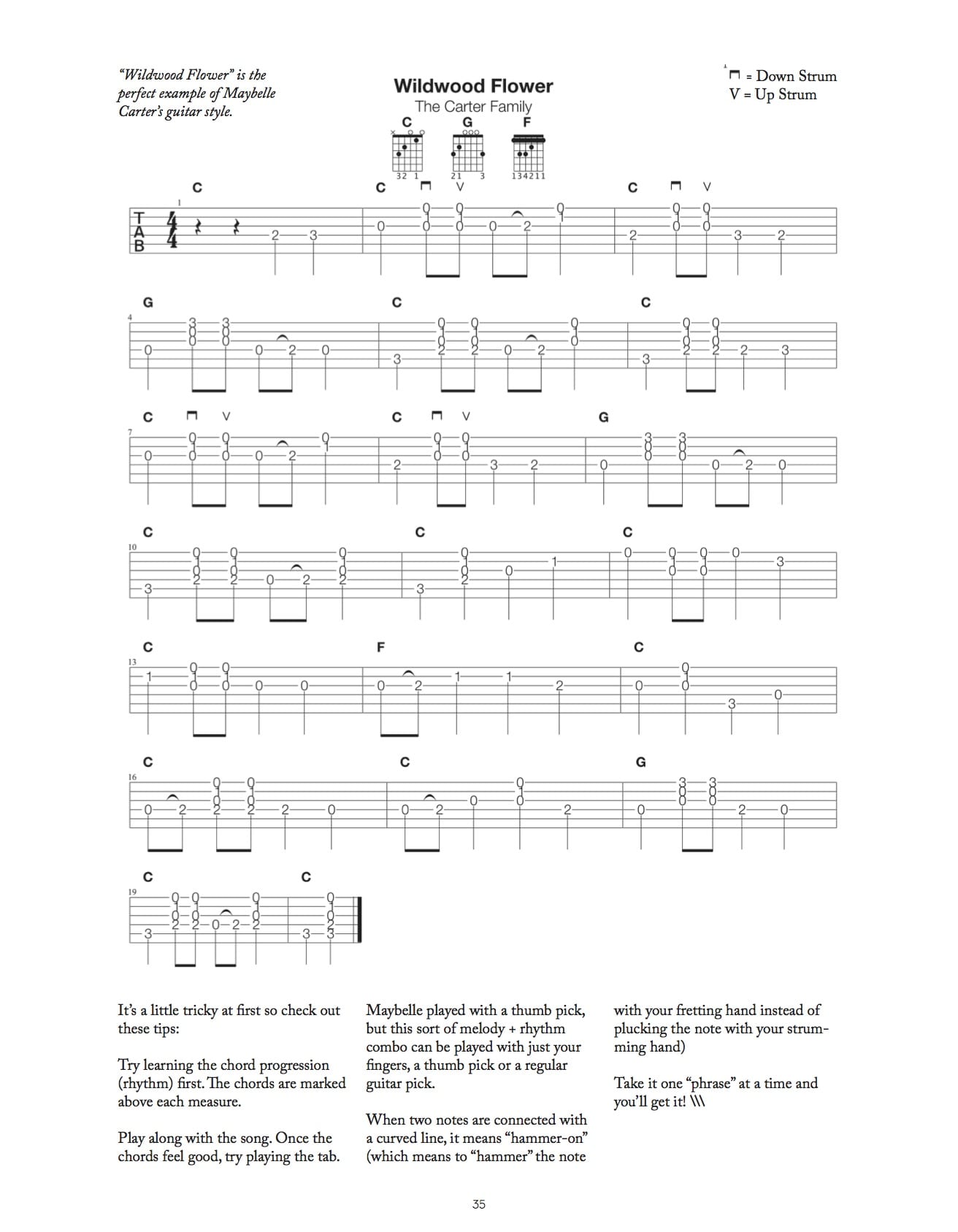
At the core of the Carter Family’s music was “Mother Maybelle’s” utterly unique guitar playing. She played melody on the low E, A, and D strings, while also strumming the rhythm with her index finger. Her background playing banjo and autoharp inspired this kind of pick-strumming. Before Maybelle took the stage, the guitar had only been used as a rhythm instrument (think strumming along in the background of a big jazz band). After she invented this “Carter Scratch” guitar style, lead guitar became a part of almost every country, folk and rock band to follow. She single-handedly got Americans to take the guitar seriously. Legends such as Chet Atkins and Johnny Cash played in her band and took inspiration from her constant innovation. She loved to connect with other musician who were likewise pushing musical boundaries. Also a gear tastemaker, Maybelle’s beloved Gibson L-5 archtop held the tone that became the sought-after sound in country music.
Mostly self-taught, Maybelle was known for being completely dedicated to the pursuit of musical perfection and innovation. In addition to inventing and mastering her own playing style, she also learned blues, slide, and Hawaiian-style guitar. She gained a lot of inspiration from Leslie Riddle, an African-American musician and so-called fourth member of the Carter Family. Riddle traveled throughout the country with AP Carter, seeking out old songs and melodies the Carter Family could rework. AP secured the lyrics and Riddle memorized the melodies. He could remember almost everything he heard and would pass it on to Maybelle, who also soaked it all in by ear. She was a complete road warrior who loved driving the tour van herself and living the musician’s lifestyle – one of the earliest Queen of Country and Rock n’ Roll.
Learn how to play Carter style below:
Want to read more from Issue #2? Head over to shop.sheshreds-staging.jzck3hem-liquidwebsites.com and order your issue today!
The tour will be her most ambitious in 25 years, with dates in cities across the country and will feature tracks from Pure & Simple, along with classics throughout her catalog. Full details have yet to be announced, but keep your eye on her website for the full scoop. As always, tickets are expected to sell out quickly once they go on sale.
In anticipation for what is likely to be one of the most exciting major tours of the summer, She Shreds has rounded up some of our favorite Dolly moments from throughout her prolific career:
“Joshua,” live from the Grand Ole’ Opry (1967)
“Bury Me Beneath the Willow” with Linda Rondstant and Emmylou Harris (1976)
“Coat of Many Colors” (1983)
“Applejack” / “Do I Ever Cross Your Mind” (1986)
“Train, Train” (2002)
“Jolene,” at Glastonbury Festival (2014)
Now screening across the United States, the film features interviews not just with the legendary Ms. Carter, but with multiple members of the Carter/Cash family, including Johnny Cash himself. Not only a fascinating historical excavation of a family’s enormous contribution to American music, The Winding Stream is also visually stunning.
Beth Harrington: About 14 years ago, I’d made a film about women rockabilly artists called Welcome to the Club, and many of the women featured in that film spoke of the Carter family as an influence, as the makers of music they’d been raised on. I realized that a lot of people knew about Johnny Cash and knew something about his wife June Carter Cash, but many didn’t know June’s musical heritage and how important that was to music history. I saw that there were dots that could be connected in a film. So I decided to make The Winding Stream.
I think it means that we have “permission” to be as inventive as we want to be! Maybelle invented a style of guitar playing—playing rhythm and lead at the same time—out of necessity. The original Carter family—A.P., Sara, and Maybelle—needed to be a band. Sara’s husband A.P. was a kind of musical arranger for the group, but he didn’t play or sing very much. So, largely, it was just Maybelle and Sara playing instruments. Sara mostly played autoharp and did the lead singing. Maybelle took some things she learned on banjo and adapted them to the guitar. Voila! The “Carter scratch” was born!
Johnny Cash, because I believe he consented to [be interviewed] so he could talk about the two most influential women in his life: his wife June Carter Cash and his mother-in-law Maybelle Carter. He loved June fiercely, and he revered Maybelle. His purpose in granting us the interview was to talk about them and help secure their place in music history. I thought that was so great that this big music star would turn the focus on his wife and mother-in-law in such a loving and respectful way. He told me that Maybelle Carter was the “biggest star I’ve ever known.”
I would say that’s pretty close to it. She invented a style of playing (the aforementioned “Carter scratch”) that most American guitarists learn now, and until Maybelle, the guitar had been thought of almost as a percussion instrument, just background rhythm. Banjo and fiddle were the lead instruments back then. She made guitar a focal point for old time/hillbilly/country music (whatever you wanted to call it back then), and that paved the way for it in rockabilly. When you combine that with what the blues guitarists were doing, you have the makings of rock and roll guitar!
I think those of us who can tell these stories––you women at She Shreds, me and other colleagues in filmmaking, the various music writers and critics I know and anyone else who cares to join us––are responsible for uncovering and telling them. They won’t get told if we don’t do it. Most people are receptive when the tales are told. But it’s up to us to do it!
I know for a fact that it reminded me that back when the Carters started, music was not a spectator sport! It was about playing! And partway through the making of this film, I dusted off my Telecaster and started to take guitar lessons and play again, after many years of not playing. And that led to me being in the band I’m in now, Spiricles, which is a Portland-based alternative rock band. That’s a gift I couldn’t have foreseen.