Founded in 1901 as a way to solve trading problems in the music industry, NAMM has grown into a four-story conglomerate of hundreds of manufacturers, distributors and affiliates from all over the world that come together to showcase the latest products to almost 100,000 private attendees. Historically, the NAMM show is meant to foster relationships for trading purposes between those in the instrument manufacturing industry while also giving general attendees and media partners a sneak peak into the evolution and innovation of music gear.
With the rise of rock ‘n’ roll, and later hair metal, the last 40 years of NAAM shows reflected a shift in guitar culture which can be seen through advertisements depicting half-to fully-naked women straddling instruments—a marketing move that was extremely popular and effective with men up through the 21st century. While guitar culture may have once perhaps been silently and privately sexist, now it was aggressively, publicly and shamelessly misogynist. Subsequently millions of gear nerds, enthusiasts and fans followed suit, and women musicians and consumers were largely ignored.
And now we’re here—trying to shift the industry once again by burying old marketing ploys, and ideals while creating new ones that speak to both men and women.
As a convention that hosts those companies who move the industry into what is and isn’t guitar culture—through advertising, language, and product display—NAMM also plays a pivotal role in answering questions like, “What are companies doing to ensure that their products, and the way they advertise those products, aren’t geared for men only?” and, “What kind of efforts are these companies making to represent women within their companies?”
These results are answered by the amount of banners seen showcasing actual women musicians, the amount of women demoing at booths, and the kinds of discussions that are being held through panels and between companies.
While the guitar industry has shown leaps of progress evident in just the four short years She Shreds has attended, it also has a lot of work to do to implement the simple idea that women are musicians too.
2016 saw Ernie Ball and St. Vincent’s new STV guitar model, The Evolution of the Producer hosted by Women’s Audio Mission and featuring an all star line-up of women including tune-yards’ Merrill Garbus, not to mention our partnership with companies such as EarthQuaker Devices, Reverb.com, Dwarfcraft Devices, PRS guitars, Loog guitars, and Catalinbread to bring in as many women as possible and demo all over the building. To say the least, it was nuts and wonderful and clearly a breath of fresh air to us and those seeing the industry shift for the past 40 years.
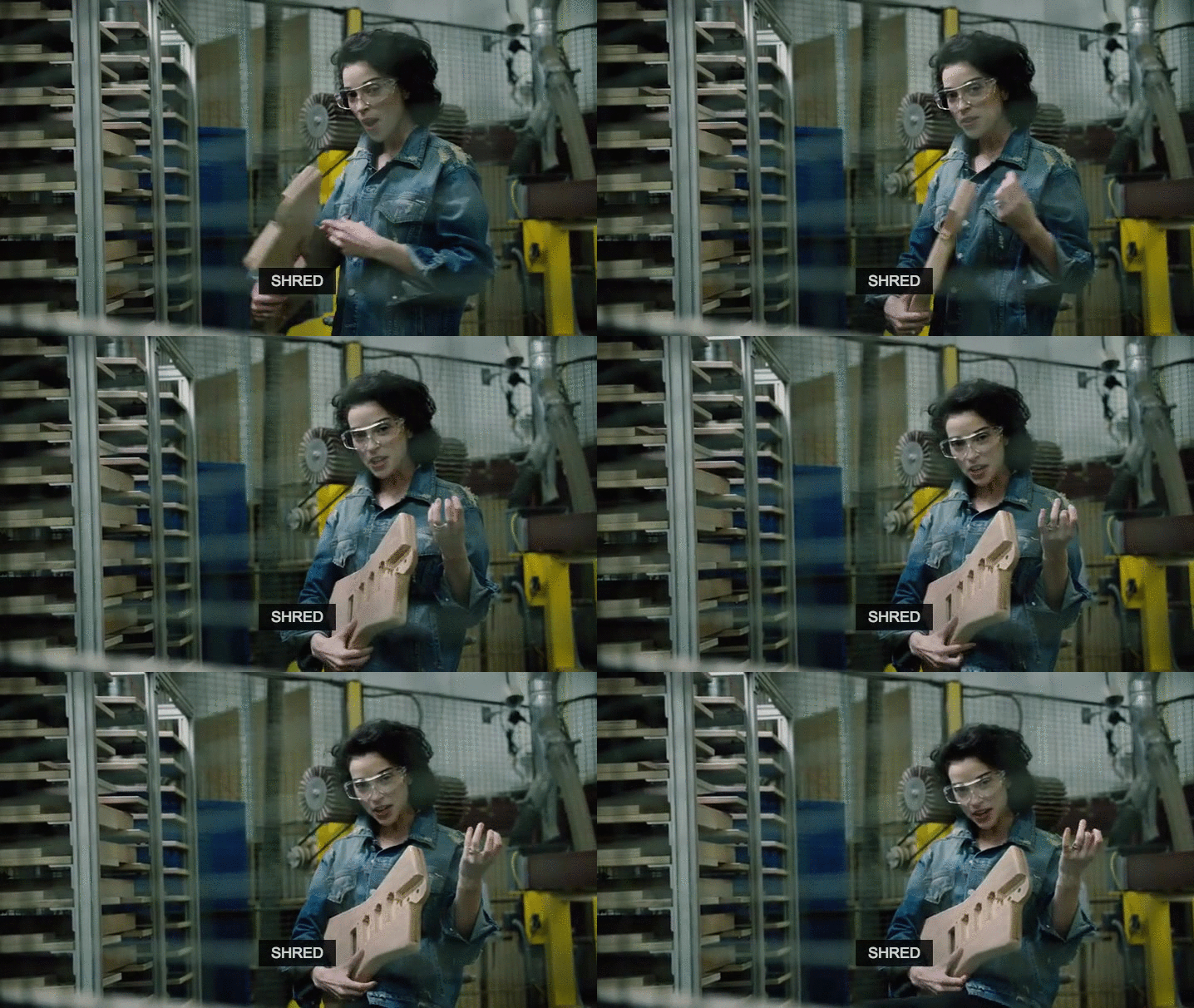
We asked LG from Thelma and the Sleaze to take us around the four story convention and show us some of her favorite products. Check out the video to find out some of the other weirdness she found!
Yes, in part because Annie Clark is a guitar icon for myself and many aspiring women (and men) guitarists—plus she herself mentioned that “there is room for breast(s)” which I have, so that’s perfect—but also because, based off of everything she’s created, Clark is only capable of creating masterpieces.
Since August we’ve been counting the weeks and months until the chance to get insight on the sound, weight, tone, and overall thought behind the creation of what, in our opinion, is one of the most likely signature guitars to bridge the gap between music lovers and gear heads—a guitar that might invite aspiring musicians to become well acquainted with the guitar world while experienced players will have something to look forward to as well.
In the video, Clark starts off paying tribute to the guitar and what it means to her saying, “The guitar can be so many things. For me, in my life, it’s been a shield, it’s been a weapon and the vehicle by which I’ve gotten to have an incredible artistic and emotional life.” Watch the rest below.
[youtube id=”5M5qpaQ1h9o”]
Earlier this morning, St. Vincent officially announced that she has partnered with Ernie Ball Music Man to release a guitar specifically designed by Annie Clark herself:
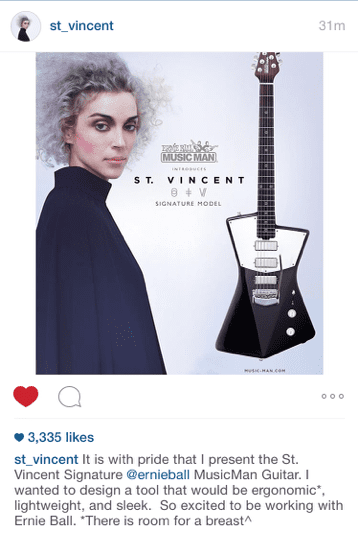
In her caption on Instagram Clark mentions that “there is room for breast(s)” which is pretty freaking awesome—because many of us have those. Additionally, the guitar is definitely designed with her own body in mind, “I sought to create a tool that would help and inspire those who share my priorities in a guitar, namely that it be comfortable and lightweight and that it exhibit clean lines, all without sacrificing tone flexibility.”
Ernie Ball adds that “developing the St. Vincent model with Annie has been a highlight of my career,” and goes on to say, “In addition to being one of the finest guitar players I’ve worked with over the past 30 years, she’s equally, if not more, gifted as a guitar designer. I’m incredibly proud Annie chose us to help realize her vision. We’re honored to have her as part of our family.”
Congratulations Ernie Ball Music Man! You are a great example of where the music industry should be heading and the fact that you were smart enough to seek out one of the best guitar players of this time says a lot.
This is the final installation of our collaboration and giveaway series with She Shreds Magazine. For this video we featured our friend Mandii Larsen of Tulsa, OK. She stacks two Old Blood Reflector Chorus’ pedals, two Old Blood Processions, an Old Blood Black Fountain, and starts of the signal chain with a Caroline Guitar Co. Haymaker, finishing with the TC Electronics Ditto X2. I got chills a few times while we were shooting this and while I was putting this edit together, Mandii has a way of summoning sounds that conjure a lot of feels. Or, at least for me, anyway, you should decide for yourself.
And thus we enter week three of the She Shreds and Old Blood Noise Endeavors collaboration/ giveaway. This week our friend Penny came down from Tulsa and used a bass, a guitar, and her voice to make a tasteful and compelling menagerie of sounds. Penny is involved in a lot of musical things but chiefly plays in Broncho, Low Litas, and Penny Hill. We’ve known Penny for a number of years, so it is such a wonderful treat to get to hang out and make some noise and videos with her. Thank you, Penny!
We’re happy to carry on our custom color scheme giveaway and collaboration with She Shreds. This week Rachel Brashear came by OBNE HQ and made some killer sounds happen. Rachel lives in Oklahoma City where she teaches piano and attends the Academy of Contemporary Music. Check her out her new album at rachelbrashear.com
We are honored to announce that we’re collaborating with Old Blood Noise on a giveaway and short video series. Sarah Reid came in and showed us how she uses her effects chain and violin to make her lush soundscapes. You can find some of Sarah’s music at sarahreid.bandcamp.com.
[youtube id=”AjsakgfC6tk”]
The development and integration of various audio recording software made the number of tracks available to us today essentially unlimited. If you’re interested in digital recording, let’s start at the beginning: What is an audio interface?
An audio interface is the hardware that connects your microphones and/or instrument inputs to your computer and recording software. This is a critical part of your Digital Audio Workstation because it performs several key tasks.
 Conversion
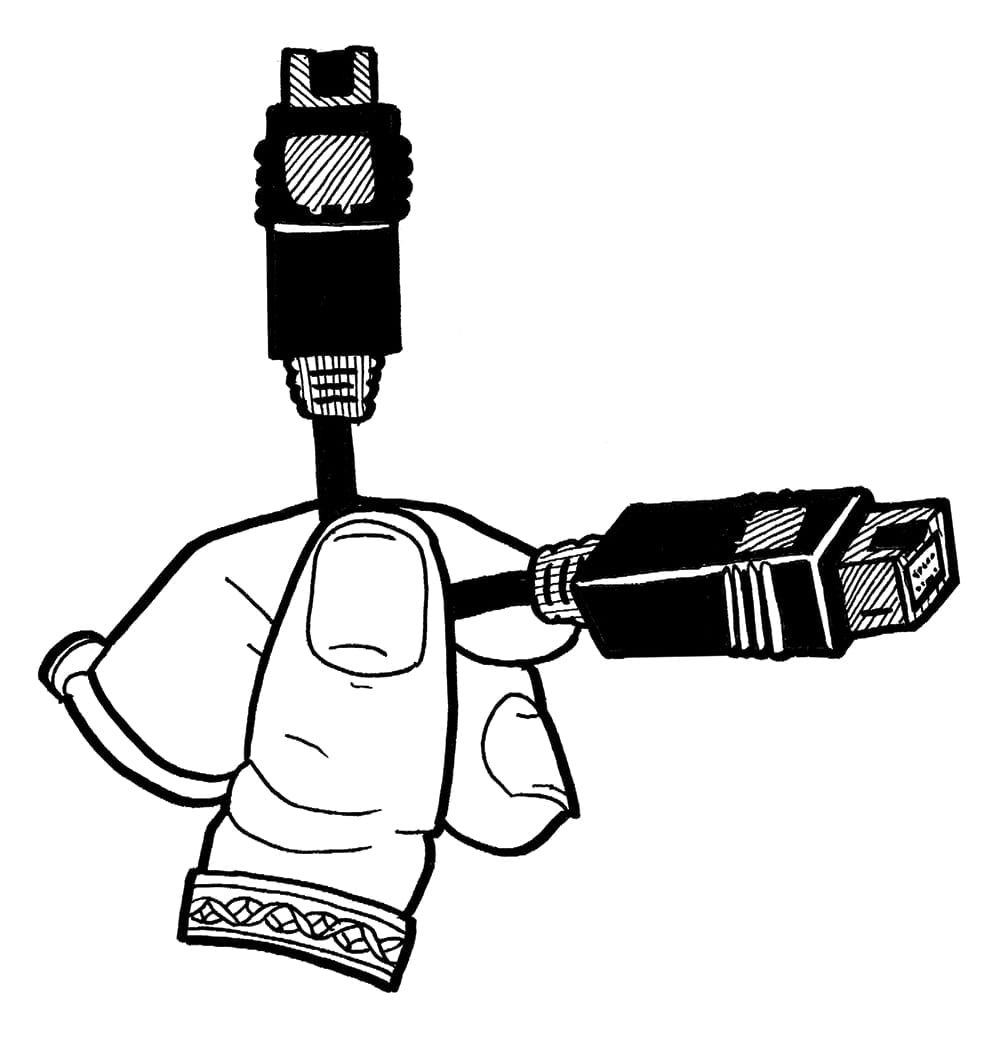
When audio is recorded, most interfaces will convert analog signal (current/voltage) into the digital language a computer can process (binary code). This digital information is sent to your computer through whatever kind of connection and cabling your interface utilizes. This may be any variation of USB or FireWire 400/800, for example. Interfaces perform this function in reverse, converting the previously received digital information back into analog signal that you can hear through your headphones or speakers for playback.
 Amplification
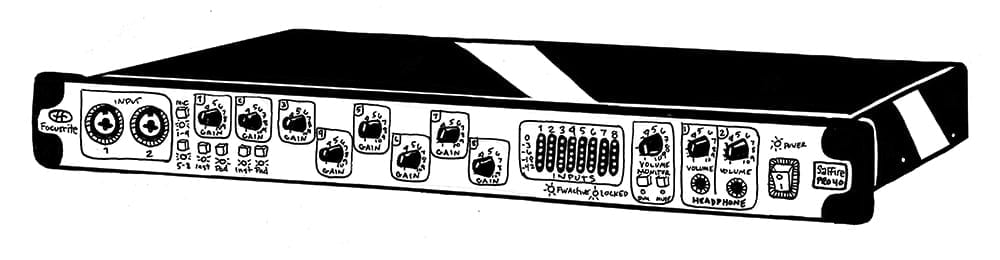
Another key task of many digital audio interfaces is amplifying your initial audio signal for processing and playback–this happens with a preamplifier. When you speak into a microphone, the signal generated by your voice is very small; the preamplifier brings it up to a workable level that can be processed for playback. The quality and sonic characteristics of preamps widely range and can affect your recorded sound. Most USB/FireWire audio interfaces have internal preamplifiers, but in more developed home recording setups and professional studio spaces, you may find an assortment of external preamps. For example, I may use a different preamp to record a thrashing electric guitar than I would to record a delicate mandolin or banjo melody.
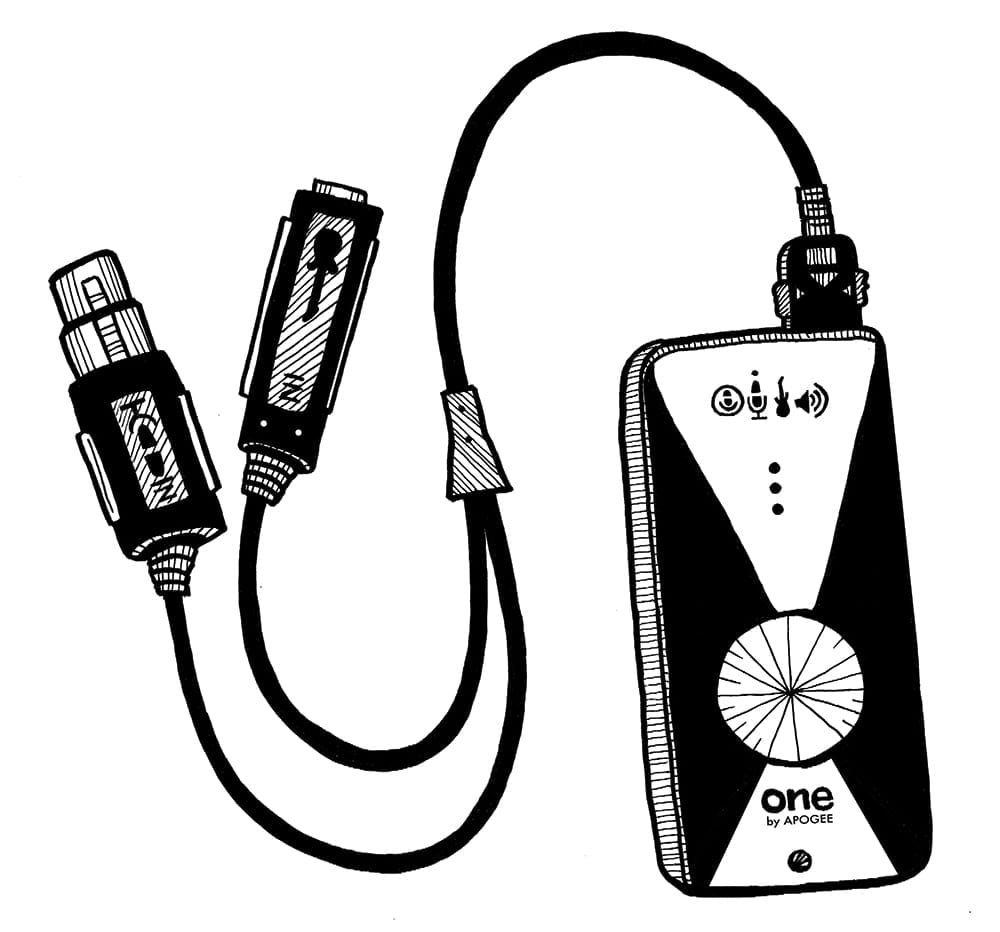 Input
InputMany commercial USB/FireWire interfaces feature somewhere between one and 16 channels or inputs. If you only need one or two tracks at a time, consider trying Apogee’s One and/or Duet. They have world-class preamps and converters, ¼”and balanced XLR inputs allowing you to record either directly with your instrument or your microphone of choice, optional 48V phantom power for condenser microphones, an 1/8”output to connect headphones or a stereo ¼” adapter cable for speakers, and they’re both small enough to fit in your pocket making them great for mobile recording.
Audio interfaces can get extremely expensive and are constantly evolving and being updated. Don’t let this stress you out too much. There is great sounding gear in every price point. Give yourself time to experiment and figure out what works best for you.
Let’s start with the basic functions. Microphones are acoustic-to-electric transducers that convert sound waves into an electric signal that is able to be amplified, recorded and played back. All microphones have a diaphragm. This is a thin piece of material suspended within the microphone that vibrates when struck by a sound wave. This causes other internal components to vibrate and induce a small electric signal.
Microphones are commonly categorized by their transducer principle – how they convert acoustic sound waves into an electric signal. In this installment, we’ll discuss a few of these types and how they differ.
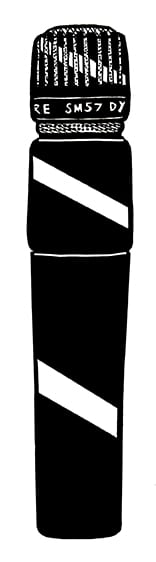
Dynamic mics work by electromagnetic induction.Simply put, the diaphragm is attached to a small wire coil that is fixed around a permanently placed magnet. As sound waves enter the mic, the diaphragm vibrates causing the attached coil to move around the magnet. This produces electric signal within the coil. Dynamic mics are the most rugged and durable of all. They handle high levels of signal and are often used to record drums or loud amplifiers. In general, they are less expensive than ribbon or condenser mics (read below). If you’re looking for something solid, versatile and dynamic, try the Shure SM57 as a starting point. It costs about $100 and can be used in a huge variety of recording situations. For drums, the 57 is a standard snare mic. Throw one on your amp speaker and move it around to see how it picks up sound in different positions relative to the center. If your amp has two speakers, try pointing one towards each for a thicker sound. Several manufacturers make low cost dynamic mics, such as the Audio-Technica ATR2100USB and the Nady SP4C, which run for less than $15, and are great for experimenting on a budget.
Ribbon microphones also work by electromagnetic induction. The diaphragm is a small piece of extremely thin ribbon that is corrugated and suspended into a magnetic field. As sound waves enter the mic, they cut across the ribbon’s slits and cause it to move back and forth. This creates an electric signal within the magnetic field. Because of this fragile design, generally ribbon microphones are more sensitive than dynamic mics and have a lower output (lower sound/signal). If used on a guitar or bass amp, make sure to either point it off-axis (not directly on the speaker) or keep the gain level at a reasonable level. Many ribbon mics offer a darker, warmer sound and can sound great on certain acoustic guitars, as drum room microphones or on reed instruments. Historically, ribbon microphones feature a bi-directional polar pattern, meaning they pick up sound from the front and back but reject it from either side. However, innovations in ribbon design mean modern ribbon mics are now able to handle more signal and feature alternative pickup patterns. The Beyerdynamic M160 is a perfect example of this. It features a hypercardioid pattern, meaning it picks up sound from the front and sides and rejecting sound from the back.
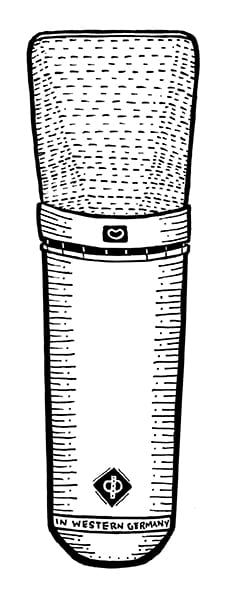
Condenser microphones function differently than dynamics and ribbons. These mics have two plates inside. One is stationary and one fluctuates as it responds to changes in pressure from sound waves entering the mic. These movements between the plates induce an electric signal. Because they are generally more sensitive to the nuances of sound than dynamic mics, condensers are often used on string instruments and vocals. They require an external power source, usually in the form of 48V phantom power which can be activated on most audio interfaces and recording consoles. Neumann’s U87 and KM184 stereo pair, as well as AKG’s C414, are all notable condenser mics found in many professional studios.
Slight variations in mic placement can alter the captured sound, however there is no right or wrong way to mic your instrument or amp. Finding out the best sound for you may take time. Don’t be afraid to try something outside of the box! It may lead to something we haven’t heard before.

Julie Slick and Shauney Baby Recke, the bassist and drummer who had been recruited earlier in the day, had been standing on alert by the towering glass case nearby and now headed inside, where GoPro staff began strapping their tiny signature video cameras to the musicians’ instruments and—in Recke’s case—torso. It was the third day of the 112th annual NAMM convention, and we were teaming up with Tom Tom to bring visitors a whole new kind of music experience.
NAMM is the colossal business buffet of the music industry. For four days, three floors of the largest exhibit space on the West Coast gets packed wall to wall with a grid of exhibits representing nearly every music product retailer, through which a river of nearly 100,000 distributors, performers, gear enthusiasts, and industry leaders continuously flow. For She Shreds, the convention isn’t just a showcase of new music technology and craftsmanship; it’s an opportunity for us to really feel the pulse of the music industry. We already know that women’s representation in the industry (and consequently NAMM) sucks, frankly. But here are four things we saw at this year’s show that didn’t remind us of the Stone Age:
We can’t believe this is a big deal in 2014. But it is. From huge instrument manufacturers Fender and Peavey to string companies Elixir and DR to smaller boutique businesses like Loog and U-Bass, the companies at this year’s NAMM appeared to have somewhat expanded their horizons when it came to who they thought could represent their products.
Old trade show strategies include trying to bait assumably straight, male gear heads with female models before actual company representatives step in to talk shop. From the looks of this year’s convention, the practice is heading towards long-deserved obsoletism as an increased focus on the actual product and a consequential decreased emphasis on completely irrelevant and embarrassing baiting techniques sets in.
Not only was there a noteworthy decline in gross visuals at this year’s NAMM, there also appeared to be more actual women musicians hired to represent companies by performing with their products. We spotted the Iron Maidens on Peavey’s stage, London bassist Yolanda Charles at Elixir, industry veteran Jane Getter at GHS Strings, acoustic virtuoso Vicki Genfan at (we kid you not) Dean Guitars, and—probably our favorite discovery this year—Colombian shredder Laura Jaramillo at Gruv Gear. And those are just a few examples.
We were stoked to talk shop with 30-year superstar pickup winder Maricela Juarez and Gretsch’s CFO Dinah Gretsch at their companies’ respective booths. Both of these women being honored at the convention’s second annual She Rocks Awards may have played a role. Stay tuned for full-length interviews with these industry vets.
Once again, NAMM gave us the ability to definitively point at what we all sort of know: that there’s a long way to go for equity in the music industry, but that things really are improving. And until the industry reflects the multiplicity of talent that people of all kinds possess, we’ll keep pushing them in the right direction. It’s why we not only report on high-profile women who have made it in the music industry but also create platforms like Shred Fest and She Shreds Sessions to elevate those who deserve a spotlight. So as day three of the NAMM show wound down, we couldn’t resist creating a little spectacle of our own: a collaborative She Shreds/Tom Tom GoPro shred session featuring three killer musicians we’d recruited from their booths throughout the day. Watch the video below.