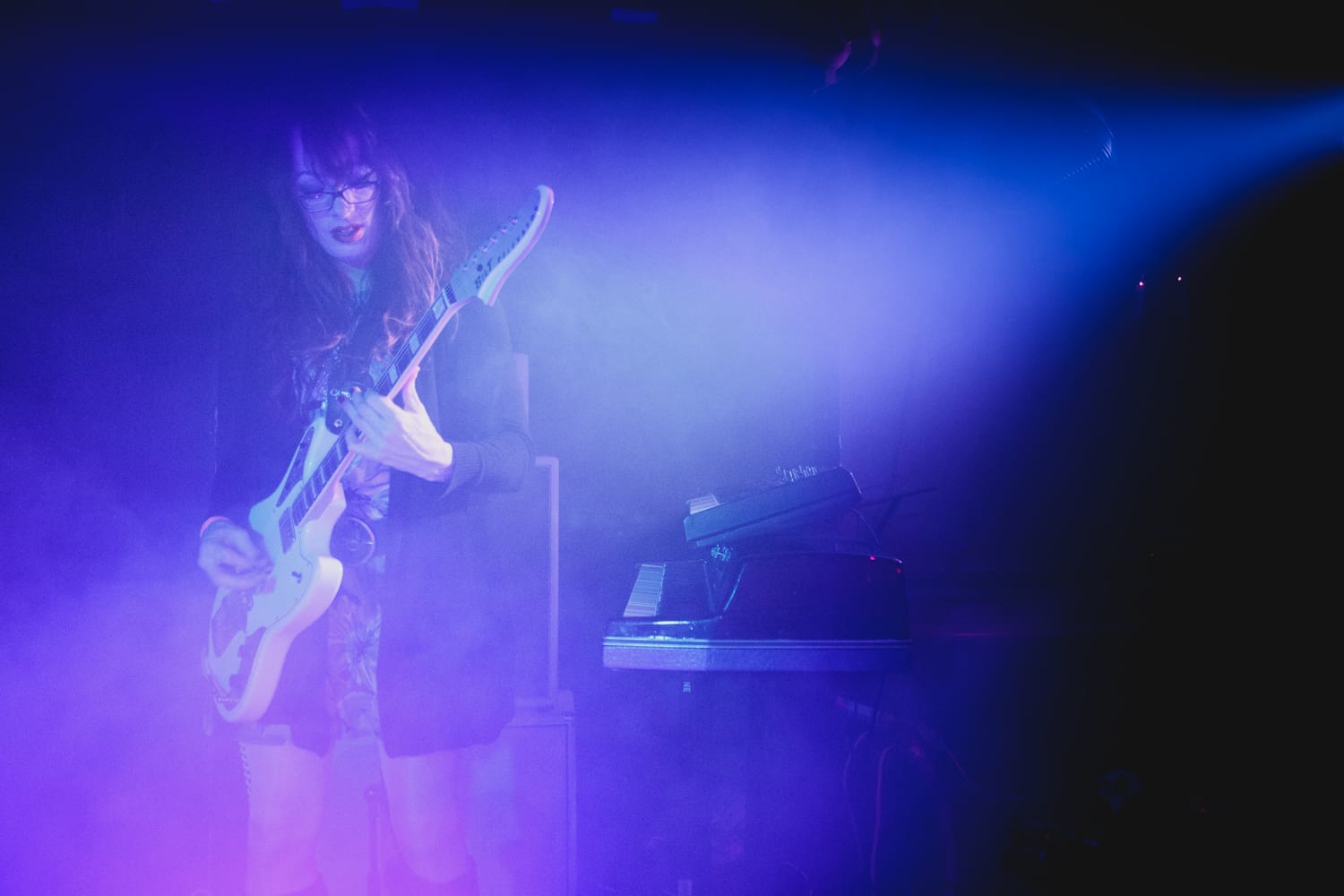
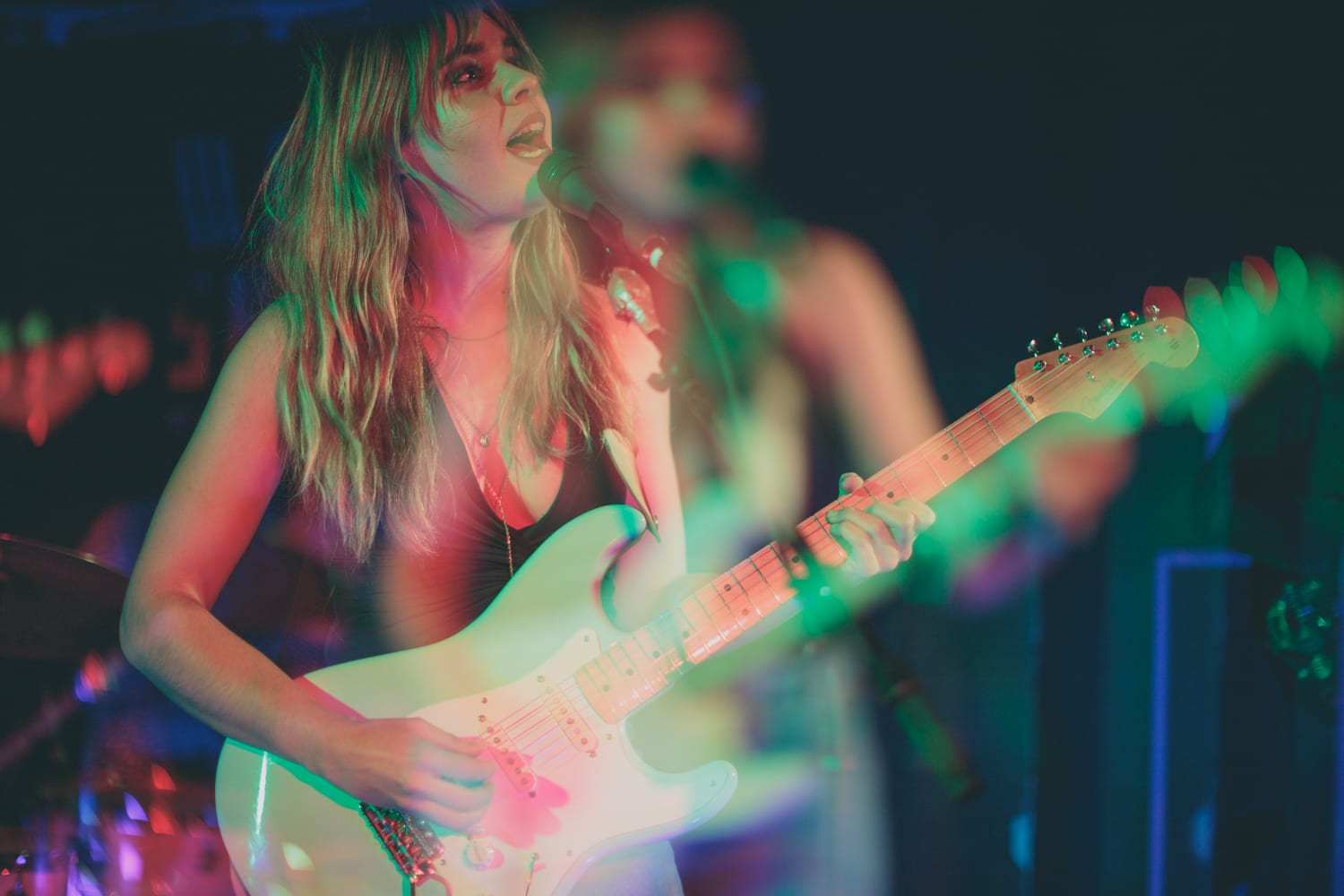
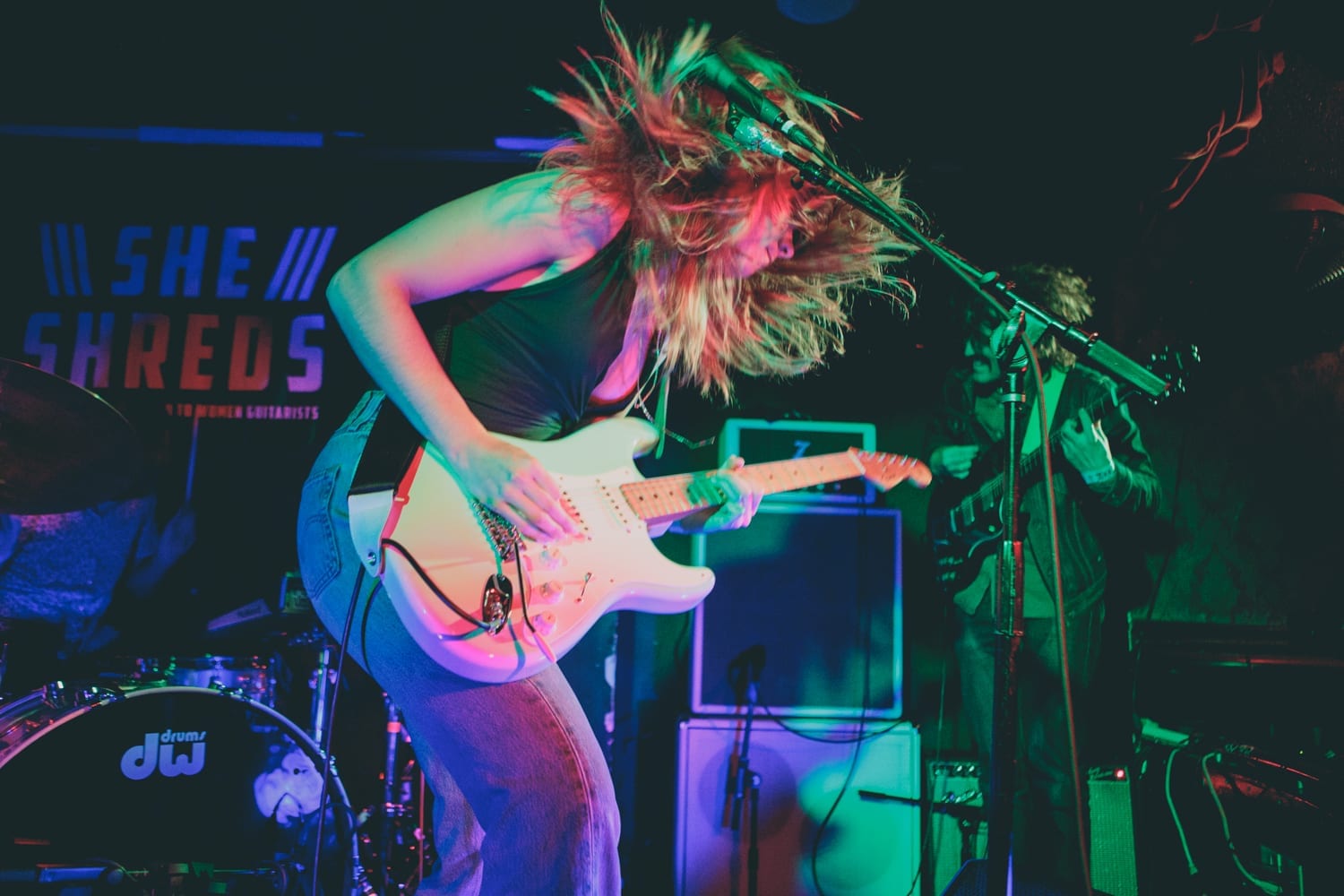
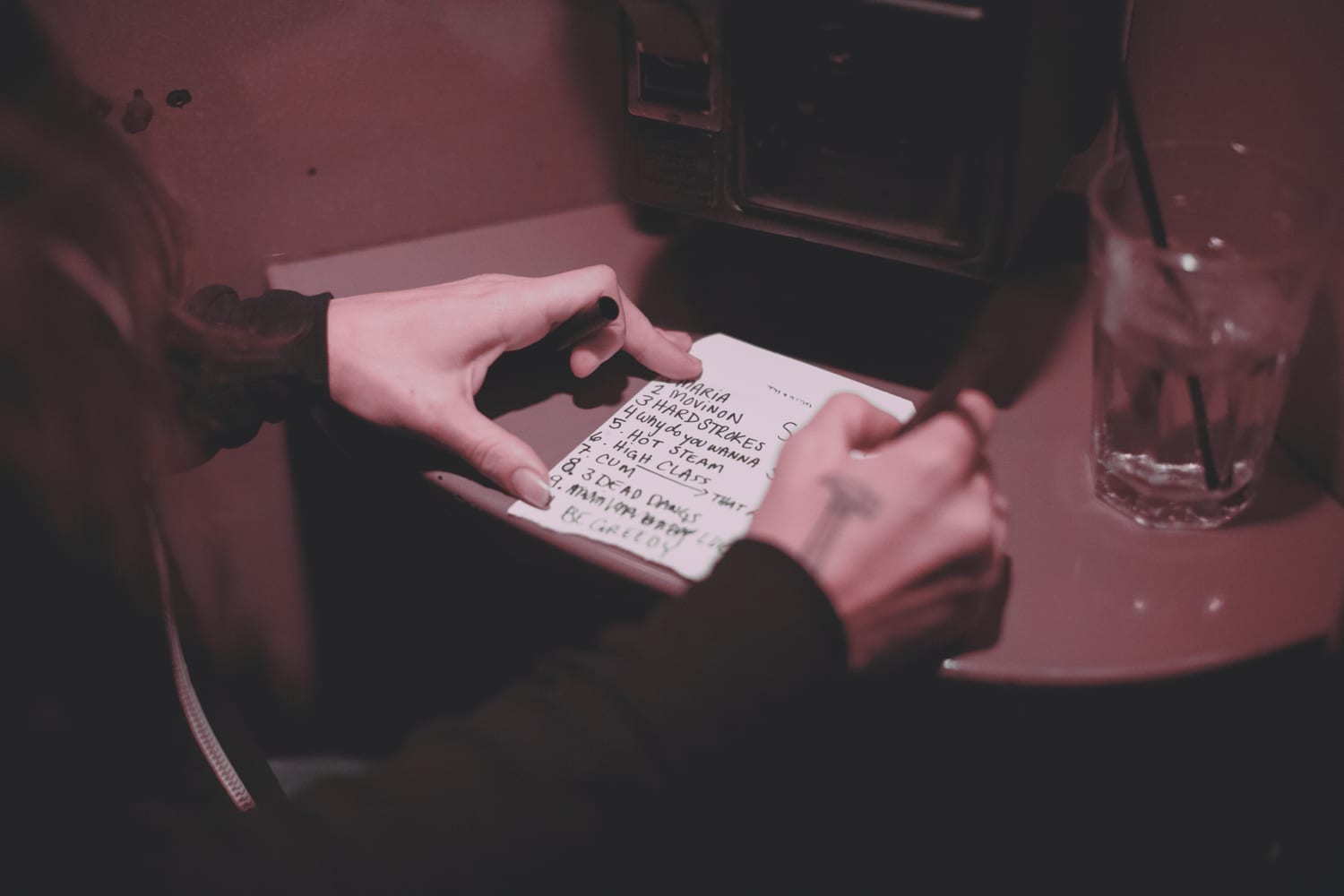
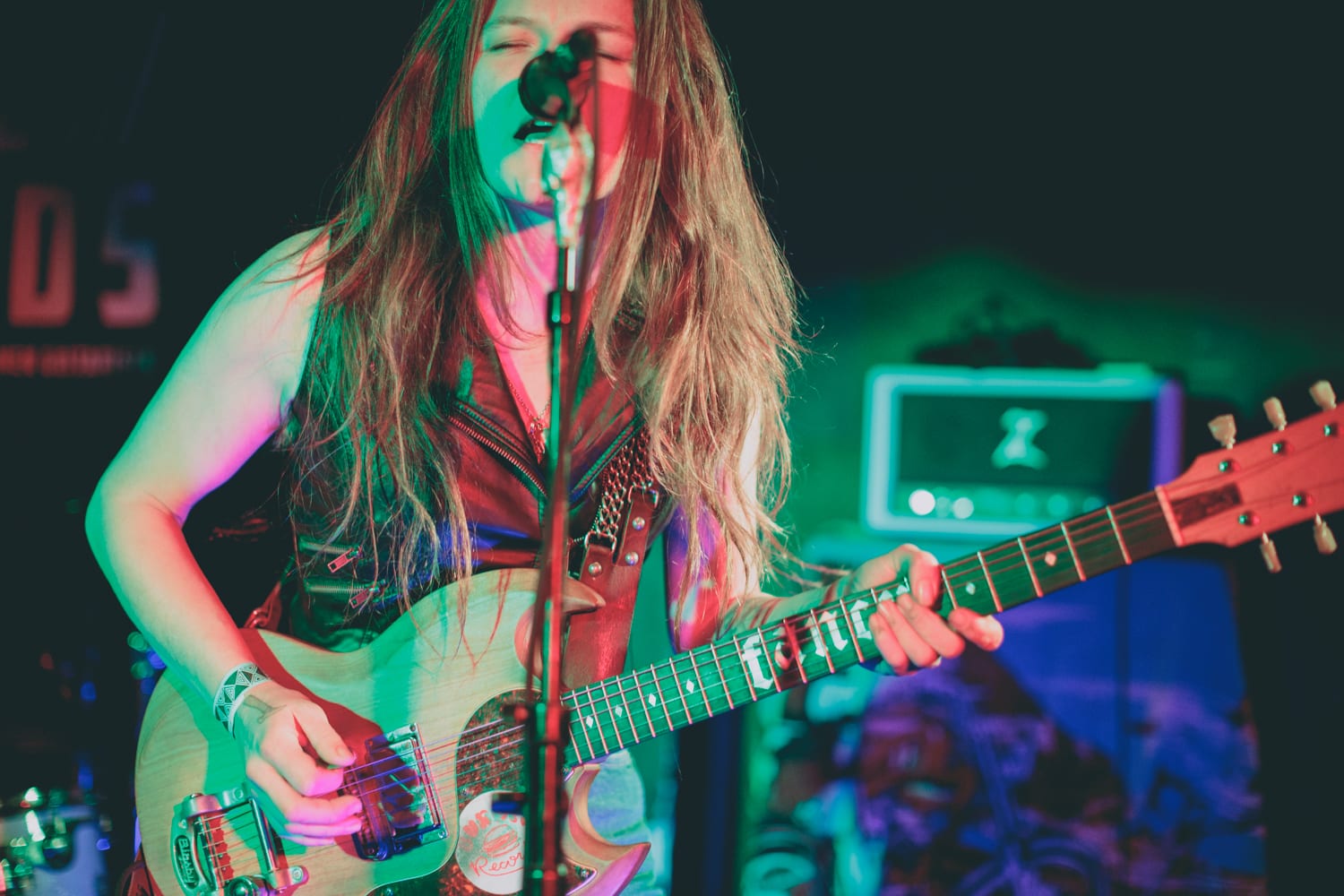
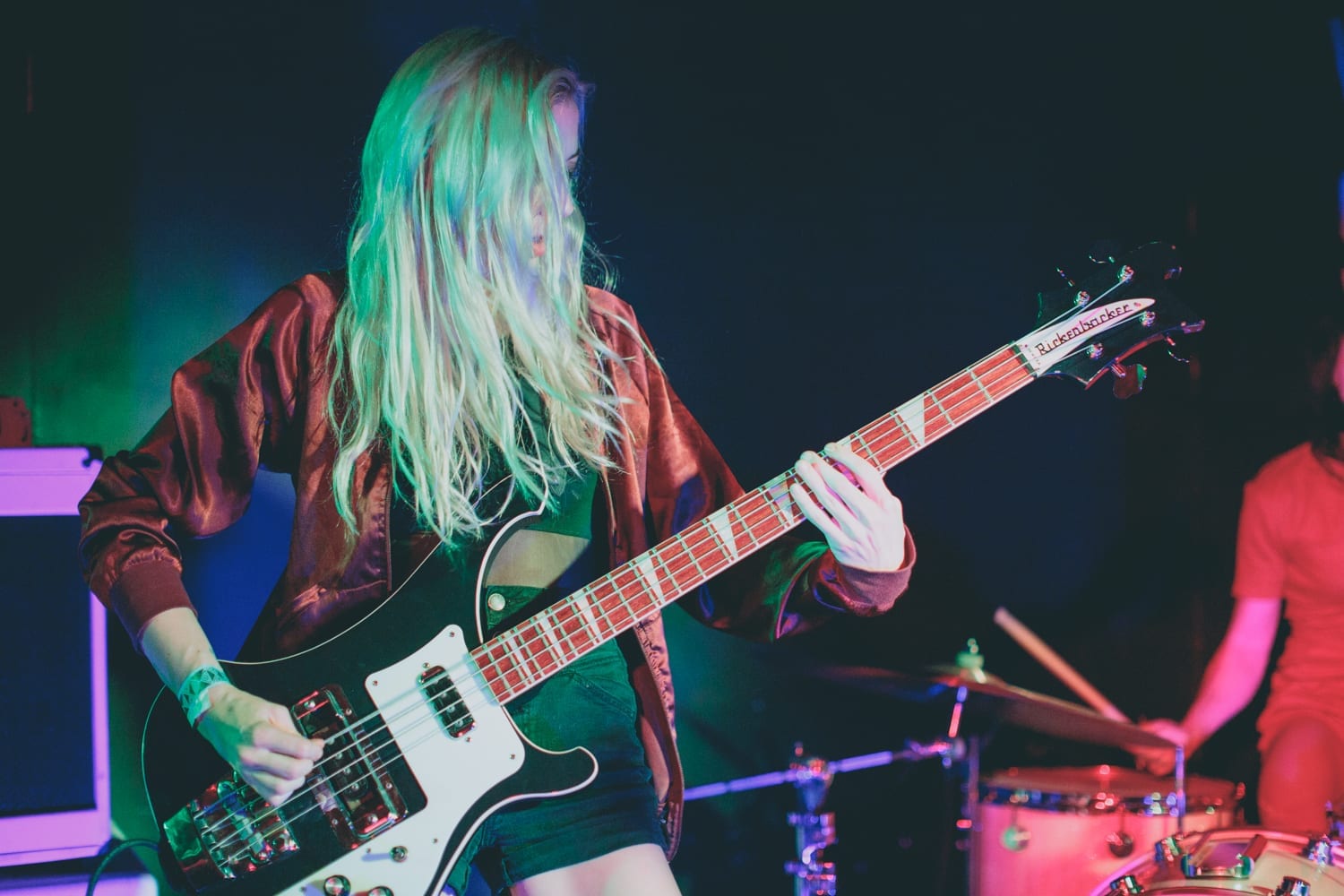
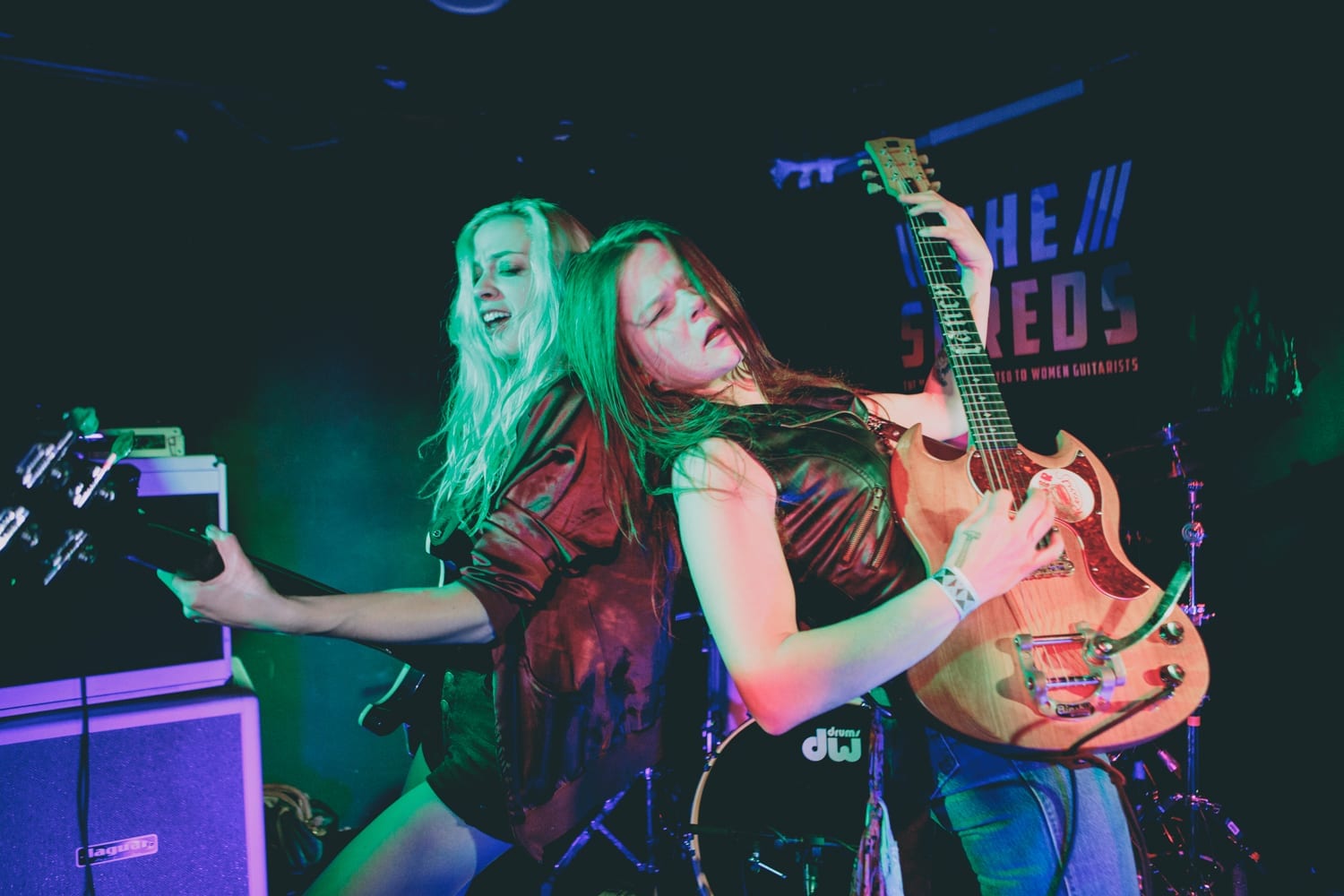
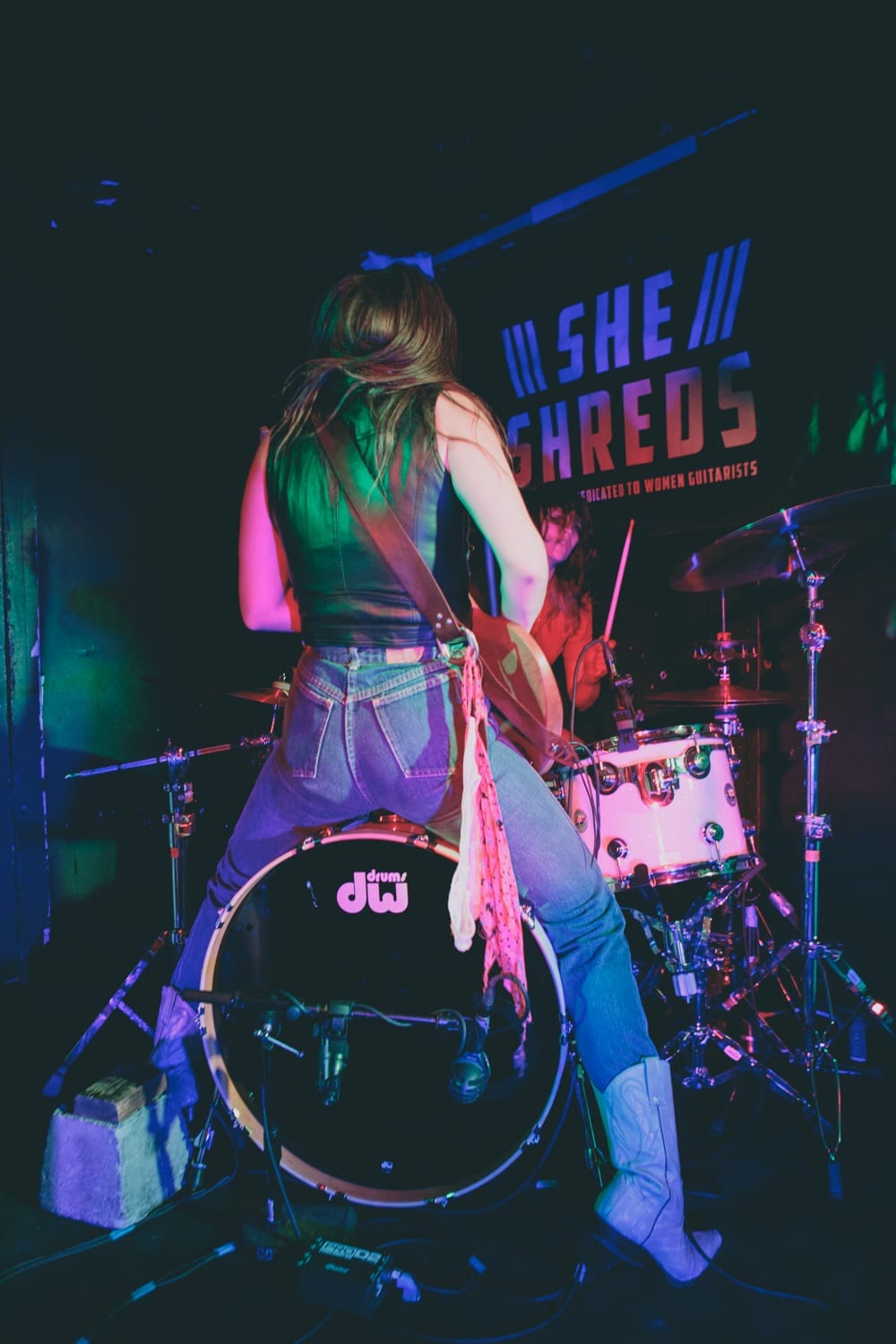
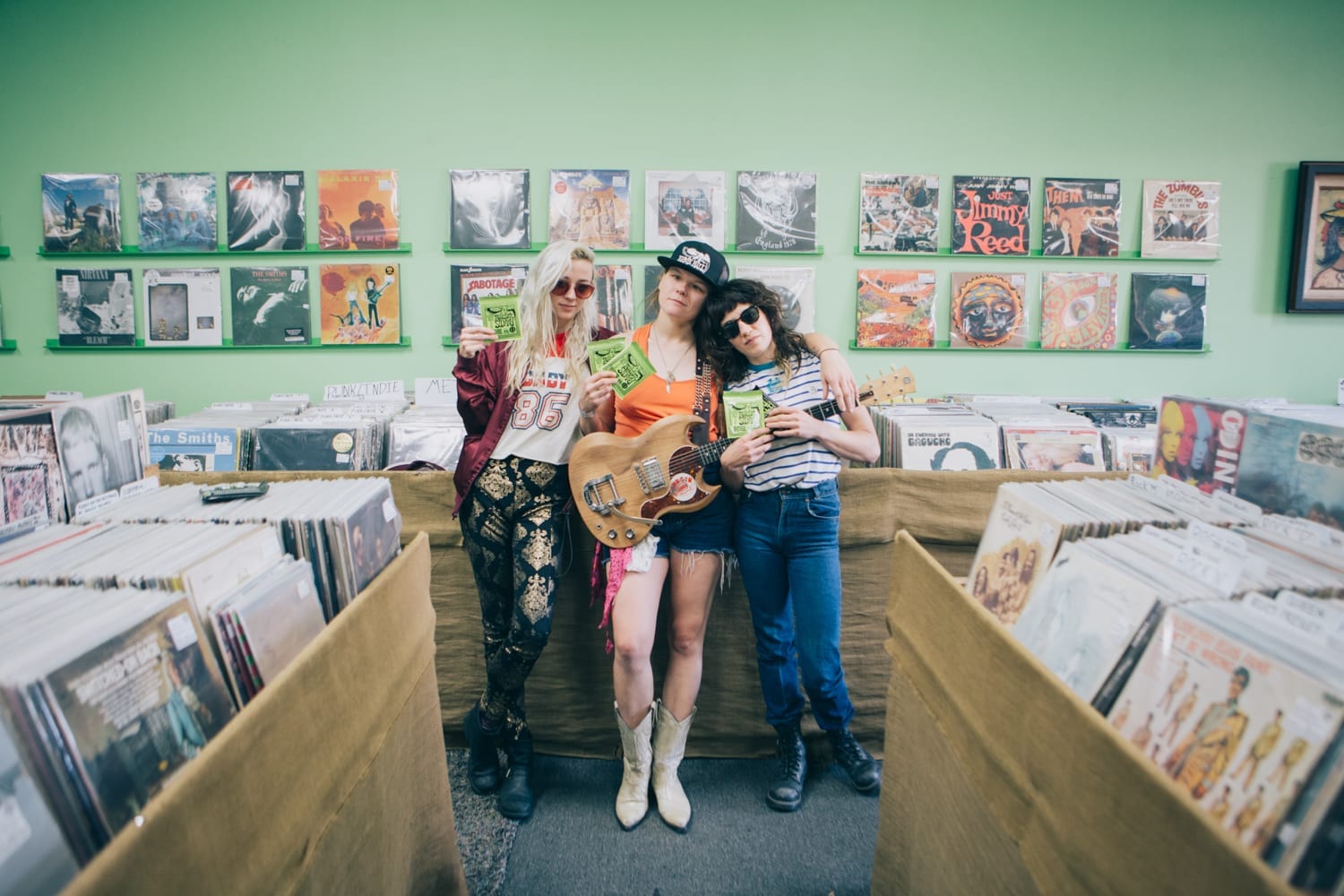
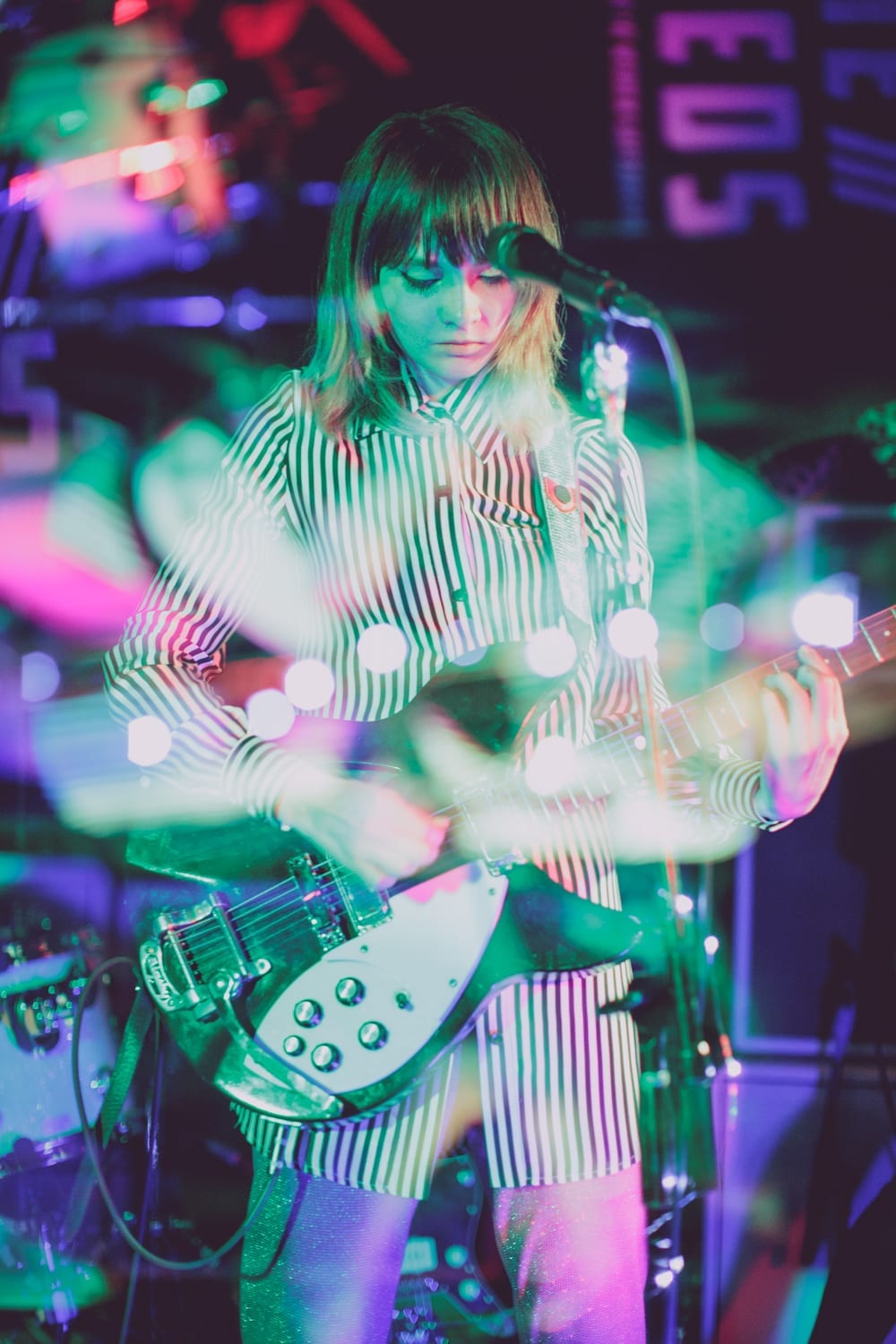
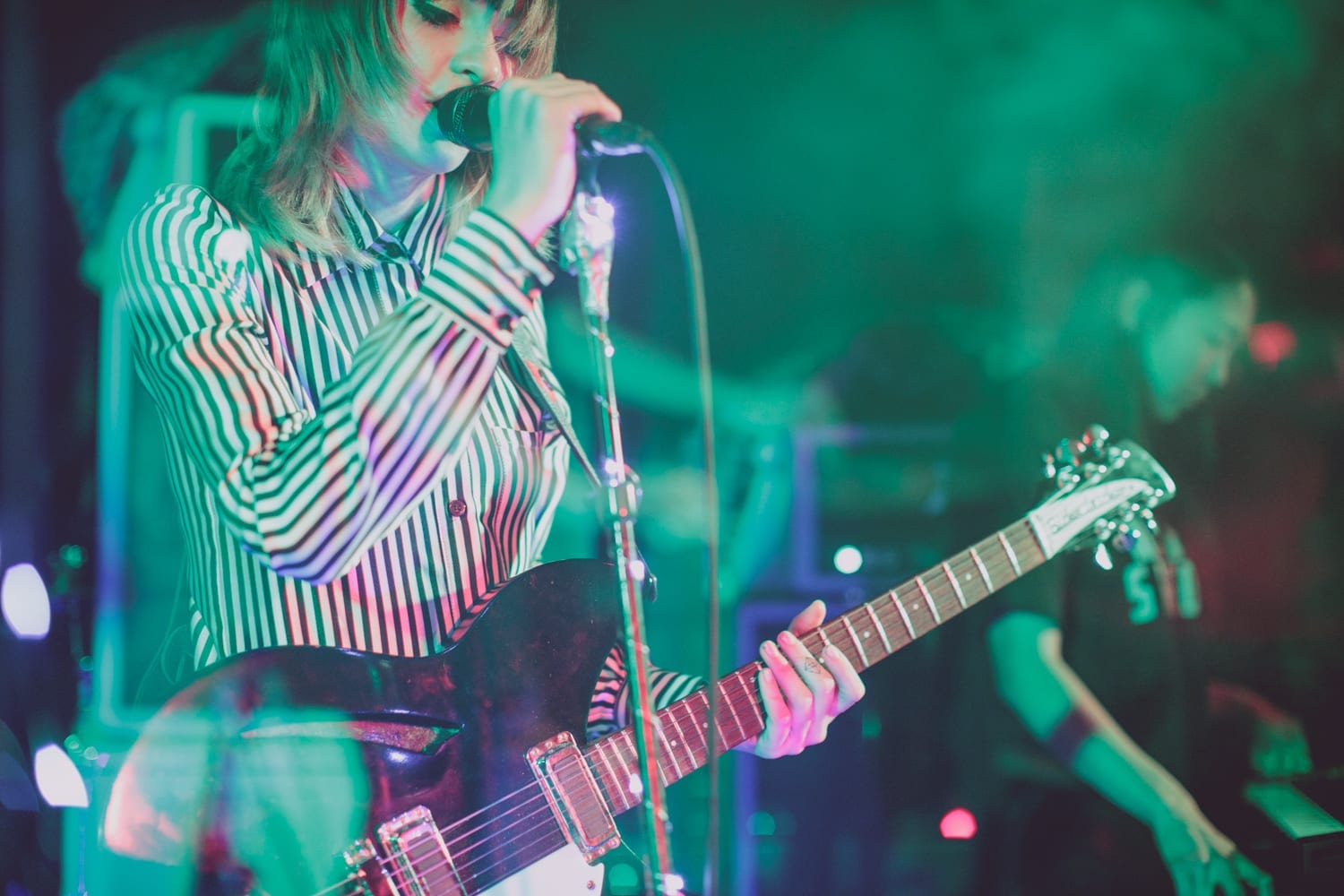
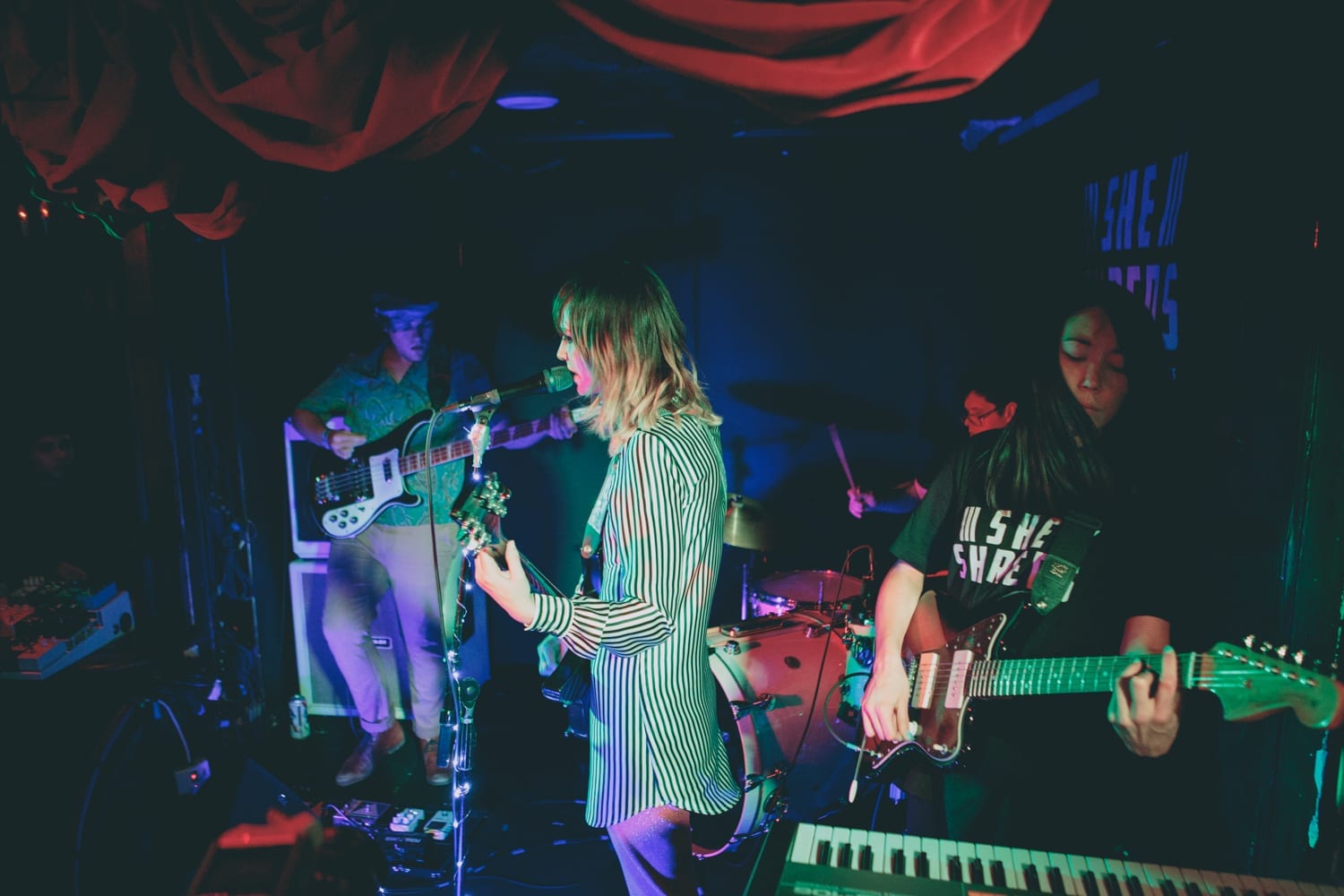
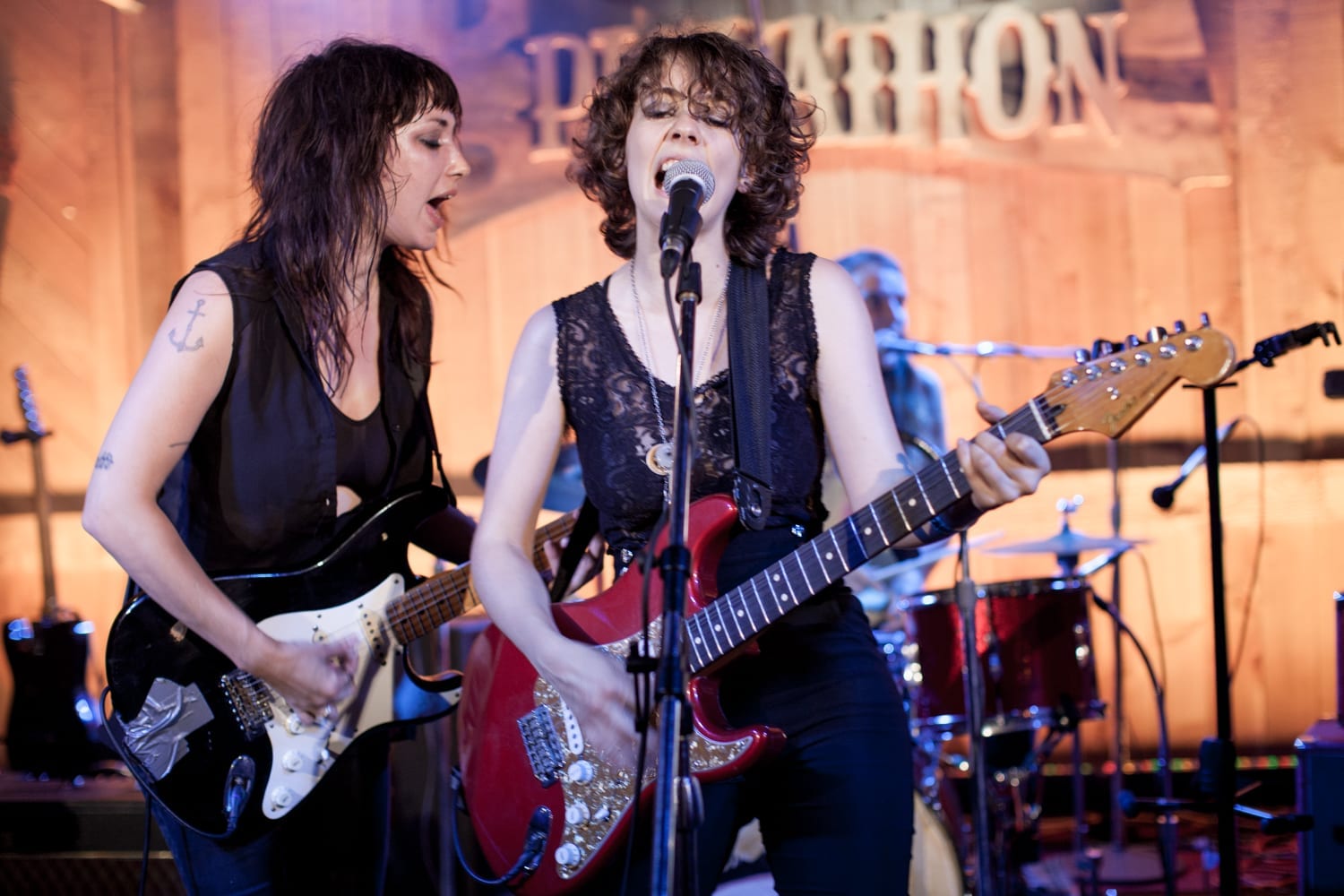
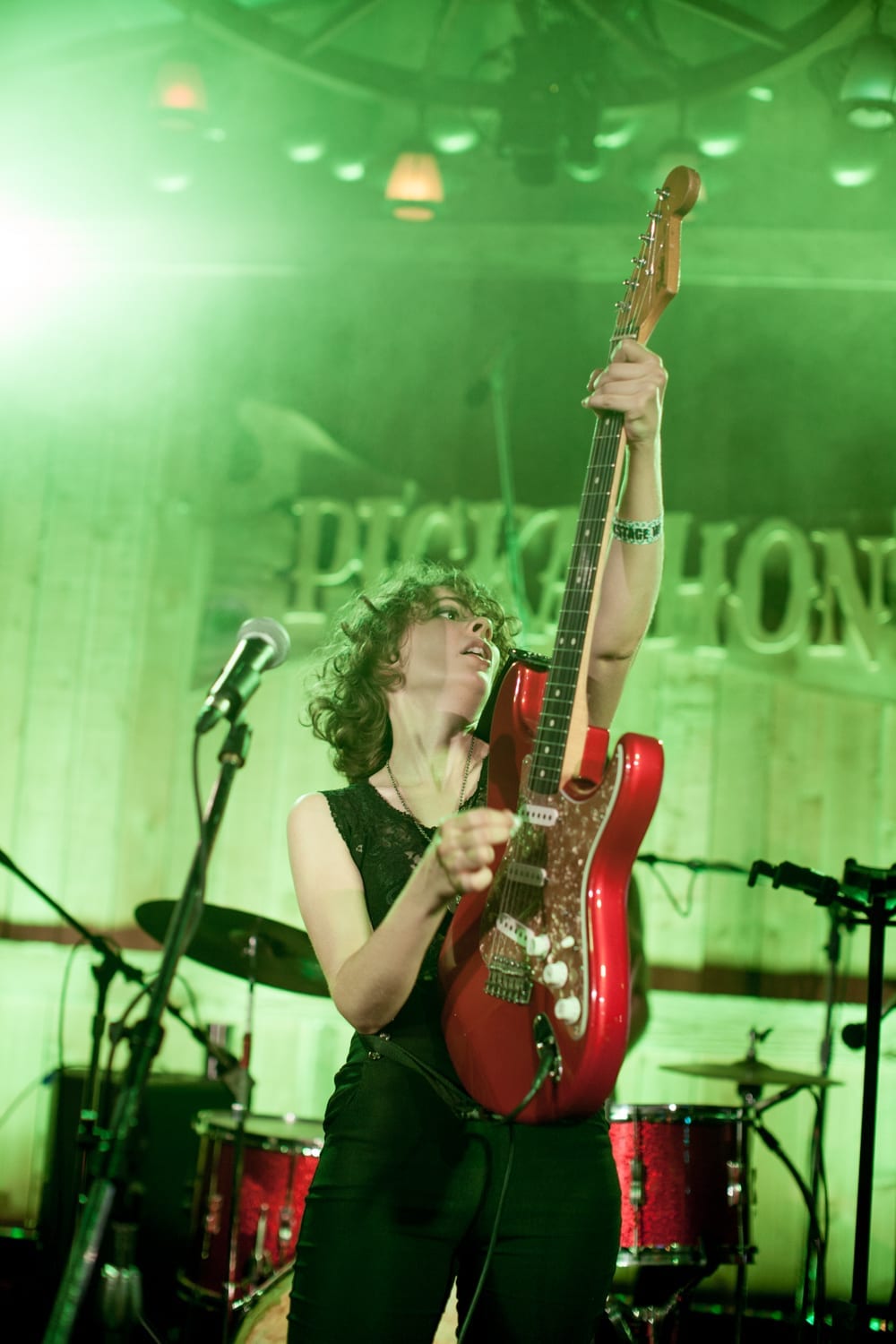
Longtime musical collaborators Lucinda Livingstone and drummer Conor Dawson, reinvented themselves into Kamikaze Girls in 2014, and set to work creating a huge wash of sound that combines 90s alt-rock, pop, riot girl-inspired punk, and more.
Last month, the Leeds and London-based duo released their debut EP, “SAD,” a powerful listen that is aimed at destroying the stigmas surrounding mental health and give support to those who are suffering from conditions including depression, anxiety, and addiction.
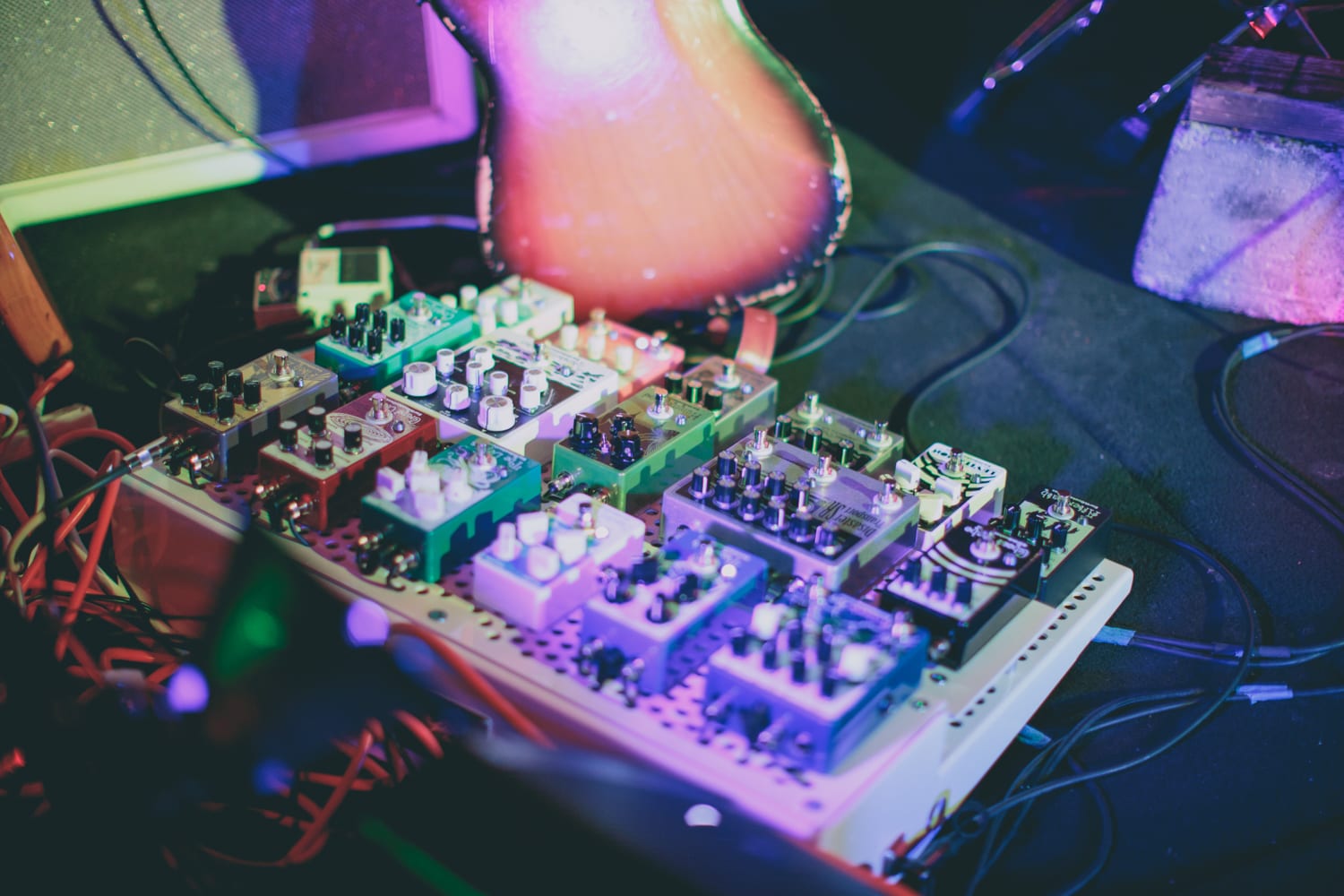
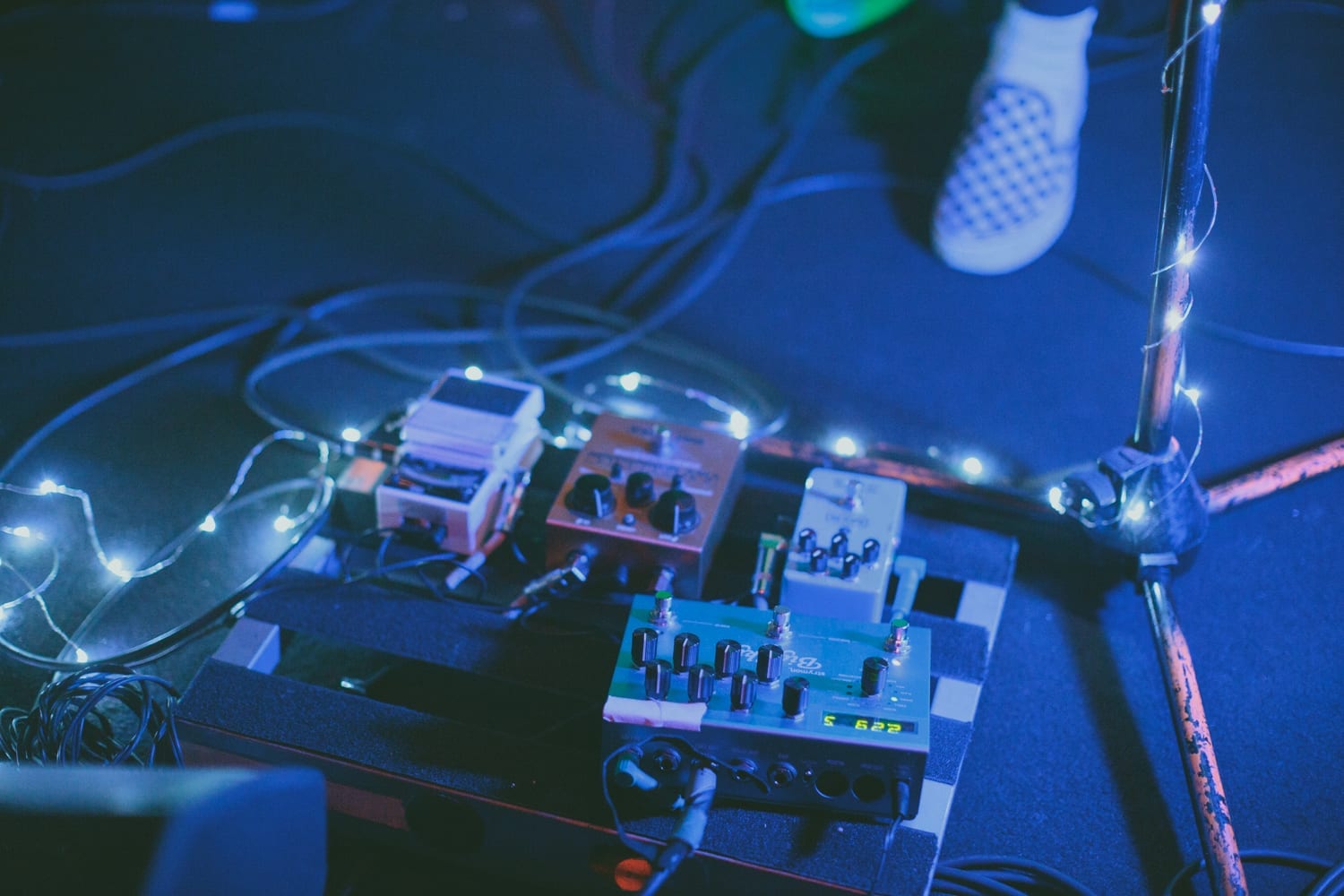
Along with the potential of music to bring people together and create social change, one of Livingstone’s greatest musical passions is for guitar pedals. Her interest started when she and Dawson played in a trio called Hearts & Souls with guitarist Andy Castle, whose own love of pedals rubbed off on her. “I used to show up to shows with a TU-2 tuner and nothing else,” Livingstone says. “Eventually I grabbed a compressor for my bass, and then one day Andy, Conor and myself went into a music store and I tried out my bass with an Electro Harmonix Pog 2 and a DD7 Delay. I left the store with both and then our shows and sound got a lot more interesting. Eventually I expanded A LOT as a bass player and built a board. It’s an addiction, once you start getting into pedals you can’t stop. You’re always searching for the perfect setup for your sound and you can always build on that.”
Her love of pedals, especially fuzz pedals, led her bandmates to dub her “Ladyfuzz,” and, as Hearts & Souls morphed into Kamikaze Girls, the nickname inspired a song, and then a zine of the same name (though she notes, “There was also a great band called Ladyfuzz too though!”). The zine was originally intended to be released with the band’s EP, but when Livingstone found herself in Brighton and out of work for a few weeks, it turned into something more. “I started making this zine, and I realised that I had a bunch of really talented friends all over the UK whose work needed way more recognition and exposure then it was getting. At that point I sent a bunch of emails around and got a really positive response and before I knew it the first issue of Ladyfuzz was born.”
As a two-piece, Livingstone’s pedals play a major role in filling out Kamikaze Girls’ full-bodied sound. “When we recorded the record, myself and Bob [Cooper, producer] spend a long time getting the crunchy, fuzzy sound you hear in most of the songs. The pedal chain we used was an OCD, a Fuzzrocious, and a Blues Driver. We layered up this sound however there are very few places on the records where there will be two different guitar parts at the same time. I think that happens once on the whole record (“Hexes”) with the exception of feedback running over things which does happen a lot.”
Due to comparative limitations of performing versus the studio, Livingstone has developed a different live setup. “I have a splitter at the end of my pedal chain that splits my signal between a guitar amp and a bass amp. I then have my Electro Harmonix POG 2 turned on 90% of our set which gives me a lower octave of everything I play for the bass, and a very subtle higher octave that isn’t hugely obvious but if it wasn’t there I would miss it.” She also counts a Freeze Pedal, a Fulltone Full Drive, two delay effects, and a chorus among her live essentials. “I used to have a bigger pedalboard but I had to force myself to scale it back a bit and try and be way more consistent with my sound. It’s so easy to overdo it, I guess.”
Check out a few of Livingstone’s favorite pedals below and see Kamikaze Girls when they tour the US this month. “SAD” is available for purchase now.
Colorsound Bass Fuzz: Colorsound is a little company based out of Macari’s, a music store in London. Their pedals are used by Smashing Pumpkins, The Cure, and a bunch more great bands. The Bass Fuzz they have is next level and it was also the first fuzz pedal I ever bought. It doesn’t translate to guitar too well but it’s easily the best bass fuzz pedal I’ve ever heard.
Electro-Harmonix POG 2: This is the pedal that fills out my guitar sound and as a two-piece that’s so important. It’s basically our bassist. The other great thing about the Pog 2 is that you can make incredible organ and theremin sounds from it as well. There’s definitely been times where I’ve hit the wrong preset during a show and some incredible noise has come out of it instead of what I initially wanted. It’s great!
Third Man Records – Bumble Buzz: Another fuzz pedal. I bought this pedal from Jack White’s Third Man Records store in Nashville last year when we were on tour. This pedal isn’t great for playing more than one note, but it’s fantastic for riffs made up of single notes or guitar melodies and solos that you want drenched in fuzz. When we went into the store and I saw that pedal I was a goner. They have an amp / guitar and test pedal set up in the shop and as soon as I plugged in there was no going back. There’s just on and off, there are no tone or level controls on it so you can’t change it at all, it’s just fuzz or no fuzz and that’s why I love it.
Blue Ocean Delay: This pedal only costs $20 and is just your run of the mill delay, but I just use it for making weird noises live. Tyler [Bussey] from The World Is a Beautiful Place and I Am No Longer Afraid to Die recommended me this. I went to one of their shows in London, and after the show we nerded out about pedals for a bit and looked at his board together. I was asking him about a specific part in their set where he made a very drawn-out sound that went on forever. It turned out to be a $20 pedal and I ordered it as soon as I got back from the show. Pedals don’t always have to be expensive to be great and this is a solid example of that.
RE20 Space Echo: I don’t own this pedal but I’ve used one on a few occasions. This is a space echo pedal and again it’s just incredible to making some really unique sounds. By now you might have realised I’m into making very strange and eerie noises. On our record we have a lot of weird feedback under and over my guitar parts in a bunch of places. The thing I like about this space echo is it has two main stomp controls and you can really customise the type of echo you’re getting out of it. You can also completely just go off on one and make horrible (but brilliant) shrill, loud, delayed feedback, which I love.
The electric guitar and amplifier first became popular in the 1930s, and in the nearly 90 years since, guitarists have been experimenting with unique ways to manipulate the sounds that these revolutionary instruments produce.
One of the most famous manipulations of the electric guitar tone is distortion. Distortion is the overdriving of the guitar signal to create a sound that is dirtier and crunchier than it would otherwise be in its unaltered, “clean” state. It can be heard in popular music starting with early blues and is still a well-used guitar sound to this very day. Turn on the radio and you are likely to hear a fuzzy or distorted guitar.
The early blues players were the first to be known for using distorted tones. They played heavy strings and they played hard, which would distort the small speakers with the powerful resonance of the lower strings, creating speaker distortion.The first amps were low fidelity and would often distort when their volume was increased beyond their design limit, or if they sustained minor damage. You can hear this distorted guitar sound in early Muddy Waters, Buddy Guy, Sister Rosetta Tharpe, and Howlin’ Wolf recordings. Chuck Berry had great success using these dirty tones on songs like “Maybellene” and “Johnny B. Goode”. In the 1950s, guitarist Link Wray found his distortion by poking holes in the speakers of his amp (check out his instrumentals “Rumble” and “Rawhide” to hear his signature tone). These days we don’t have to use damaged amps or take a razorblade to the speakers to achieve these fuzzy sounds.
Tube amps are now made with a master volume knob and a gain knob. Gain is the input volume, which means how much signal the preamp is receiving. Drive is another label for gain, as turning up the input volume (gain) drives the preamp harder. Overdrive is when you run out of headroom and the signal, a sine wave, is no longer clean and it clips at the top and bottom before going to the speakers. If the master knob is up higher than the gain you get a clean, glassy sound. If you crank the gain up higher than the master you start to hear the tone break up or distort. This is a desirable effect for certain applications. In order to go between the two settings you will either need an amp with a footswitch to switch between two channels on the amp, or you will need a distortion pedal that goes between your guitar and the amp.
For the last few years, my main distortion pedal has been the Reissued Electro-Harmonix Big Muff “Pi” pedal. Designed in 1969, it was a favorite pedal of first wave guitar heroes like Jimi Hendrix and Carlos Santana, and later became popular with rock bands and grunge bands of the ‘80s and ‘90s.
The Big Muff’s high distortion cut, violin-like sustain, low boost, and beautiful break up is perfect for my playing style with The Ghost Wolves, my drum & guitar duo, where I am the only chordal instrument on stage.
Recently, I have also been experimenting with another distortion pedal called The Talons, made by Akron, Ohio based pedal company EarthQuaker Devices. The Talons isn’t modeled off a particular era in distortion pedals, but instead is designed to give the user more flexibility in finding their own flavor of distortion. I am a big fan of their company and especially their Organizer pedal, and their distortion box lives up to their reputation as a purveyor of fine guitar pedals and electronics.
I recently compared these two pedals against one another, testing them on a 1970’s Music Man HD-130 Reverb amp through a 4×12 Fender cabinet wired with Eminence Speakers. I had the volume set at a medium level and the EQ arranged in their middle settings when testing both pedals.
Read below to see how the Reissued Big Muff and The Talons stack up against each other:
POWER
Let’s first address the power situation. I power my pedal chain with a Truetone 1 Spot 9 volt DC adapter. The Big Muff is slightly annoying in this instance because it doesn’t work with this setup without an extra adapter cable. On the other hand, the Talons pedal works out of the box with my power supply, no extra adapter needed. This would be nice when you’re on stage and have to troubleshoot a bad connection in the chain – the simpler your set up, the easier it is to find issues. You can also use an 18 volt power supply with the Talons for greater headroom and more volume.
CONTROL
One of the most immediate physical differences between these two pedals is the level of complexity in their control system.
The Talons has 5 separate control knobs:
LEVEL is the master volume control.
PRESENCE: turns clockwise for a brighter tone, counterclockwise to mellow out.
GAIN: pre-amp volume control, controls the amount of dirt available from clean to heavy dirt crunch.
There is a powerful active three-band equalization sector – TREBLE, BASS AND MIDDLE. The noon position is flat, boost is clockwise from noon, and cut is counter-clockwise from noon. I find this to be an intuitive cut and boost control system.
GAIN control gives you extra flexibility that allows you to go from clean to crunch and all points in between with a swift turn of the knob.
The Big Muff has three controls, a much simpler system:
VOLUME sets the output level.
SUSTAIN adjusts the amount of sustain and distortion.
TONE provides a range of sounds from high treble to deep bass. The control knobs are much bigger than the Talons which makes adjusting in the heat of a live performance a little bit easier.
TONE & FUNCTION
TALONS is described by Earthquaker Devices as “an ultra-flexible dirt machine.” I’d say this is pretty accurate after having played it. The EQ and presence knobs do indeed give you more flexibility over your tone. The gain is very hot on this pedal, and I’d say my overall impression of the sound could best be described as “crunchy”.
BIG MUFF – The Big Muff cuts the distortion in the high end, which sacrifices a small amount of clarity but also prevents an overly raspy tone. I really enjoy the sustain on this pedal, but the wide open tone can occasionally get out of control and cause unwanted feedback. I usually play the tone knob at noon or to the left of noon, which gives me a larger, more bass rich tone. Soloists or shredders might like to turn it up higher than that for a smaller, brighter sound.
FINAL SUMMARY
These pedals both provide wonderful distortion sounds in their own ways. The Big Muff has a slightly more limited scope of tonal possibilities when compared to the Talons, but a simpler control system which is nice for keeping things straight when playing live. The Talons has the crunch and clarity, while the Big Muff has a wider, fatter sound. They’re both fine pedals. We’re lucky to have such excellent choices in foot gear these days.
I’m a guitarist. My guitar, my amp and my pedals are the tools of my trade. I understand how to manipulate them to get the sounds I hear in my head. So far, typical of any gigging musician.
Why, then, did I feel so out of place when I overheard the guitarist (Jon Tufnell) and bass player (Ben Chernett) in my band talking about the fuzz pedal Ben recently designed and built? It’s a custom Saint Agnes pedal he made as an experiment that we’re now selling as merch. I use it alongside my Fuzz Face and my cloned Soda Meiser for a fuzz with decent note articulation (yes, all three fuzz pedals are strictly necessary).
Ben and Jon were talking about silicon and germanium transistors, trim pots, potentiometers, capacitors and so on. I’m rarely short of something to say in any conversation but on this rare occasion I genuinely had nothing to contribute. It’s not that I’m not interested. I work hard on my tone. I am obsessed with pedals. As well as regularly spending money I don’t have on my own pedals, I also “borrow” them to “try out” from both Ben and Jon on a regular basis. Much to their irritation, they often end up stuck down to my board (the ultra strength Velcro means they’re not going anywhere! 3M Dual Lock is mighty stuff!) Now Ben and Jon don’t have engineering degrees so why did they have a seemingly inherent, working understanding of the mechanics of their gear? And why didn’t I?
It’s strange to me, as someone who has been playing guitar since I was seven years old, that I have actually had very few conversations about the inner mechanics of my beloved gear. If something is broken, I take it to the menders. It never even occurred to me that I could make a pedal. Or fix a pedal. Ben just went ahead and did it.
This bothers me a lot. I’m a feminist. I fight everyday against societal expectations of what men and women historically “ought” to do and how we ought to behave. I’m in a rock band. From the studio to the road, it’s a notoriously male-dominated industry and I regularly encounter, and rebel against, sexist arseholes with warped world views. It really, really bothers me that I’ve got a blank space where my contemporary males seem to have knowledge.
Reader, I did a Google search on female pedal builders. These were my findings: lots of people on pedal forums asking, ‘‘are there more female pedal builders than Frantone and Devi Ever?” and an endless stream of misogynistic bullshit (“Big Muff” jokes were plentiful), before Google started doing that thing where it can’t find enough results so started crossing out the word “female.” I found very little information on women engineering or designing musical equipment.
I thought, perhaps, that attaching “female” to my search wasn’t yielding results because it’s often used as an unnecessary and derogatory prefix. I can tell you that when my gender has been linked to my instrument, for example “female guitarist” as opposed to “guitarist,” it’s pretty much always a demeaning experience, a surprised exclamation of “you can really play for a girl or “you don’t just play chords” blah, blah, blah. Maybe there was no need to label pedal builders by gender? Maybe it’s offensive to do so. But it seems strange to me that my research was so completely unfruitful.
Whilst I could find very few leads on the Internet, I want to make it clear that I am aware that there are women out there building gear. I’ve learnt a lot from Kirk Hammett in my life but maybe the most important thing I’ve learnt is that sweeping statements are unhelpful (I’m referring of course to thattweet where Kirk intimated that he was the only actual guitarist to make a pedal in the history of time.) I’m not saying there are no women building gear; I’m saying that the industry is male-dominated. It’s apparent that most of the big-name pedal/amp/guitar companies are made up of males designing and males building.
This points to a wider issue at play. It is a widely-recognised fact that there is huge gender disparity in fields like engineering, science, and technology. I read an interview with this badass Professor of Electrical Engineering called Kathleen Kramer who thinks the gender problem starts young. Engineering is a career choice rarely advertised to young women and there are few female role models.
From my own experience this was patently the case. My brother was gifted Meccano, Lego and model airplanes. I was always given china dolls, jewellery, and books. And I did really love those things, but it’s not as if I wasn’t interested in mechanical things too. When I was little my brilliant old grandad had a drawer he used to keep old, broken electrical appliances in ready for me to take apart, investigate and put back together. Screwdriver in hand, I would set about unscrewing an old plug or a broken doorbell with intense concentration. I would be fascinated by the innards and have him explain to me how each component worked. But the idea of being an electrician, for example, was something that I never even considered could be an option for me. My brother had, “electrician,” “plumber,” “mechanic,” constantly directed toward him as potential career options (fun fact: my nan really wanted me to be a newsreader) but those professions, and technical talk in general, weren’t included in the language used to speak to me about what I might want to do with my life. This has meant, I guess, that I [learned to] tune out of any tech speak because it never seemed relevant. Having spoken to female friends in the wake of writing this article, this seems to be a fairly common, shared experience.
Starting now, I’m going to do a number of things differently. I’m going to learn how my pedals are put together. I’m going to find out exactly what mechanism it is that makes my three fuzz pedals distinct (and necessary!). I’m going to learn how to solder. I’m going to research what the problem with my reverb tank on my amp is before I just hand it over to my amp repair(man). I’m also going to buy my niece Lego and Mechano and when she’s old enough I’m going to tell her she can be an aerospace engineer, an electrician or a guitar builder if she wants to be. To be honest I’m quite probably not going to start my own pedal range, but I want that intuitive technical knowledge that seems to have passed me by. I have, once again, been reminded that it’s not good enough to allow societal gender norms to influence the shape of my life, or the shape of my circuit board.
Guest columnist Kitty Arabella Austen is a guitarist/vocalist for London blues rock band Saint Agnes. Hear her rock the hell out of those three fuzz pedals here.
For over a decade, New York’s White Hills have been at the forefront of modern psychedelic rock.
Comprised of bassist/vocalist Ego Sensation and guitarist/vocalist Dave W., along with a revolving cast of drummers and additional musicians, the group has over 40 releases to their name, including most recently, its 2015 LP, Walks for Motorists (Thrill Jockey). In addition to their prolific recorded output, the band is a staple on the touring circuit where their explosive fusion of psychedelic, space rock, post-punk, krautrock, and ambient experimentation makes their performances feel less like traditional rock shows and more like full body and mind experiences. And when it comes to this area of music, that’s the best litmus test for knowing if shit is good.
White Hills is currently on the road with Vancouver-based psych collective Black Mountain before heading to Europe for a month-long tour, which will include an appearance at Eindhoven Psych Fest. This summer will find the group back in the studio recording a new album and working on a collaborative project with video artists Rachel Rampleman and Vanessa Albury on a sound installation for a gallery show in New York’s Hudson Valley.
With the current tour underway, we asked Ego about White Hills’ latest incarnation, the creative flow that can come from changing things up, and got the lowdown on her five favorite pieces of gear. Check it all out below and get your brain melted by White Hills in a venue near you.
She Shreds: This tour marks White Hills’ first time touring as a duo. What have you been doing differently to fill out the band’s sound? The band is known for changing things up a lot, but do you think you will keep this version of the band for the foreseeable future?
Ego Sensation: For these duo shows we’ve been exploring more of our atmospheric material. We use some drum loops but mainly the sound is filled out the way we usually do it with the bass and guitar. We aren’t tied to any one version of the band so it probably will continue to shift depending on the type of new material we’re working on. The other great thing about doing these shows as just the two of us is that we have one less person to share the booze with.
Psychedelic music is special in part for its “anything goes” mindset as far as experimentation is concerned, and although it is often associated with the 60s and 70s there is no shortage of musicians or listeners drawn to it. What keeps it fresh for you? What are some tips you would give to musicians looking to incorporate psychedelic sounds into their art?
Try different things all the time! True psychedelic music is disorienting in some way, so the best way to get there is to throw yourself for a loop. Whenever I feel stuck I use a technique similar to Brian Eno’s Oblique Strategies. I’ll give myself a different task as a starting point for a song. It could be using an instrument I’m not as familiar with, using an awkward chord structure, anything that forces me to mix up my habits. Changing your habits allows for real exploration and discovery.
Do you prefer vintage or modern gear, or a combination? Why?
There are benefits and drawbacks to both. I do prefer the sound of older/analog effects and synths but at the same time, modern technology has provided us with so many portable, great sounding options. The possibilities are too vast to naysay.
Can you please share a list of 5-6 of your favorite pieces of gear and how they affect the sound of your instrument?
1) Ampeg Dan Armstrong Bass: I love this bass and don’t like to play anything else right now. It was made in the ’90s as part of a limited run of copies of the original 1969 version. It has a clear, Lucite body, a medium scale, and it comes with two quick change pick-ups: Broad Bass and Deep Bass. It’s funny because I get complimented all the time on how beautiful it is but when I first saw it I thought it was hideous. My friend Jeff from Caveman was selling it and convinced me to give it a try and I ending up really loving the way it sounded and felt in my hands. On the downside, it’s pretty heavy.
2) Homebrew Electronics Hematoma 2 Channel Bass Overdrive/PreAmp: I use the preamp on everything. It gives my sound a huge boost. Because we tour in so many different situations, I’m often using amps that aren’t my first choice and this pedal helps me keep my sound consistent. The overdrive is gritty which is perfect for my taste.
4) Moog Cluster Flux Chorus/Flange: This is a fantastic pedal I got directly at Moog headquarters. You can switch between the flange and chorus settings and adjust the waveform, delay, rate and mix. I use it as an instrument with the Freeze to create spacey landscapes and also as a straight effect pedal on the bass.
5) Moog Bass MuRF: This has a 7-band array of resonant bandpass filters, a shelving (lowpass) filter and an animation module that generates sequences of envelopes that modulate the levels of the 8 filters. I use this with the Freeze pedal to create sequences to play against.
.
[In celebration of the 10th issue of She Shreds, we will be posting some of our favorite selections from across our print catalog throughout April. The feature was originally published in the second issue of She Shreds Magazine, October 2012 and has been edited for timely accuracy.]
So many pedals, so many variations for connecting them, and so many sounds to be made. Yet sadly, often there’s so little breathing room in guitar shops to test a stomp box out. And pedals usually live in glass counters with hardly any explanation as to what each has in store for your tone.
Here’s a list of the more popular and general types of pedals, in the conventional order that they go in your signal chain (the order from guitar input to amp output). However, don’t let convention hold you back! And definitely don’t be afraid to experiment until you find your signature sound. Let this glossary be a reminder of what happens to your guitar signal when you turn a given pedal on.
Filters and EQs
EQ pedals shift and filter the tone (how the guitar sounds) of the incoming signal to emphasize certain frequency ranges. These pedals make your guitar sound more bassy, trebly, or mid-range.
The WAH pedal looks similar to a kick pedal, and instead of just turning on a button, you’re actually moving the foot treadle up and down. The pedal forward (more flat) makes your sound more trebly, as the pedal moves up, sound becomes brassy and thick. Back and forth gives you that ‘wah-wah’ sound (think the opening of Liz Phair’s Supernova).
COMPRESSORS even out your volume to create a smoother, thicker sound. If you test out a compressor, your guitar sound may not seem so different, but the pedal is increasing the sustain of your notes, cutting down any sharp strum sounds, and outputting everything you play at the same volume.
Boosters and Overdrives
OVERDRIVES give you that crunchy sound like a tube amp is about to get blown out.
DISTORTION is very similar to overdrive, but with a harder crunch and more sustain. Distortion pedals vary a lot, so be sure to test yours out before purchase.
FUZZ pedals have a thick, ‘fuzzy’ effect which mirrors distortion, but without the hardness (Big Muff pedal is the classic example). This is a fun one for solos.
Modulation
CHORUS pedals create a doubling effect for a rich and thick sound, used often in rhythm playing.
PHASERS are groovy and swirly like a B-3 Leslie Organ.
FLANGERS are on the more extreme side of the modulation spectrum, creating a swishing and swooping sound by speeding up and slowing down your signal.
TREMELO modulates volume (loud to soft / soft to loud / repeat) and makes your sound all spacey (think the Twin Peaks theme).
VIBRATO raises and lowers the pitch of your notes as if you were pressing the whammy bar on a guitar. Your notes can sound a little out of tune with this pedal.
Time Based Effects
Time based effects are similar to modulation, but sound more natural and less manipulative of the signal.
ECHO pedals make the guitar sound like you’re playing in a cave.
DELAY splits your guitar into two identical signals, and then holds one signal back for a bouncing, doubling, delayed effect, which can be exaggerated depending on your settings.
REVERB, ever so popular, thickens your sound as if you’re playing in a large empty room, but without the pronouncement of an echo.
New Mexico by-way-of Texas psych rock trio Mirror Travel was born out of a high school friendship between Lauren Green and drummer Tiffanie Lanmon.
After several years and lineup changes, and having generated a buzz under the moniker Follow That Bird, the group renamed itself Mirror Travel to signify a new chapter in their musical journey. Armed with bassist Paul Brinkley, they released their debut full-length, Mexico, in 2013.
With its second and latest album, Cruise Deal(out 3/11 via Modern Outsider), Mirror Travel trades some of the uptempo, garage-y vibes of its previous record for a dynamic mix of sun-soaked psychedelics, desert folk, and dreamy, crushing, Disintegration-era Gothic rock. Recorded primarily in a storage unit-turned-studio with Rory Taylor (known for his work with Emmylou Harris and Patty Griffin, among others), with another two tracks (“Aasim” and “Yesca”) recorded with Aaron Bastinelli at Big Orange in Austin, the album offers a snapshot of a band in the midst of transition as two of its members grappled with the idea of leaving town. Soon after the album’s completion, the group did scattered across the country, only to reconvene in New Mexico with new bassist Meredith Stoner.
She Shreds caught up with Mirror Travel to learn more about Cruise Deal and life after Texas, although they’re heading back soon for SXSW where, among other things, they will play at She Shreds’ Day Party at Hotel Vegas on 3/16. Later this spring, they band will release a limited-edition 10” in Europe through Anton Newcombe’s (Brian Jonestown Massacre) label The Committee to Keep Music Evil before launching a full US tour.
Check out our interview and exclusive album premiere of Cruise Deal below.
____
At what point did you decide to reinvent yourselves from Follow That Bird to Mirror Travel?
Lauren Green: We did it about three or four years ago, we had such a long history. Tiffanie and I had played as a two piece and throughout the years we had a few different bassists, including Paul Brinkley who is now in Philadelphia. We had wanted to change the name for a really long time, and get away from a lot of the Sesame Street references and questions. Also, we had outgrown the name. It had so much history and so much associated with it that we didn’t identify with it anymore, either sound-wise and feelings.
Tiffanie Lanmon: I would say it was also musical. Not that we had been all over the map necessarily, but we definitely had a certain sound in the past.
Place seems to be a factor in your albums, whether it’s songs about Mexico, or the fact that Cruise Deal was recorded right before you left town. How do your surroundings influence your music, whether it’s the legacy of Texas psych, the landscape, or anything else?
LG: I would say it is huge lyrically and musically as well. Mexico follows some stories of touring and travel and things like that, and I was in Marfa for some of that time and we recorded in Marfa. So the sound kind of reflected that, and the same with Cruise Deal because we were all kind of scattered. I think the inspiration was drawn from a few different locations and landscapes.
You worked with Rory Taylor on Cruise Deal and recorded [much of] Cruise Deal in your practice space. Was it a storage locker that you used as a practice space, or a building that had been re-oufitted as rehearsal rooms?
LG: It was a storage unit that was re-outfitted as a practice space. It was two rooms and they separated a practice area with a two-way glass partition so you were able to record in there. And there’s a lounge and a couch area in there.
TL: It’s pretty amazing. We rented it from this couple who had a band for a long time. They’d had that space for ten years. The husband had recently passed away, but that was his life. He spent all of his time making this place into a viable practice and recording studio. When he passed away [his wife] held onto it and was ready for someone else to take it on. We really lucked out. It was like a dream. It was fun to see how it did work as a recording studio. It wasn’t perfect, but it was pretty cool to see what they had achieved.
LG: It was in a U-Haul storage area, so the guy next to us had deadly snakes in cages and lawnmowers and stuff, and then there was a practice space. It was funny.
Did you ever get weird traffic coming through there, or people who didn’t expect to see a band there?
TL: Not really. There was another band we’d see when we drove in. It was a 7-piece band and it was really awesome, but the snakes were probably the wildest things we saw. The guy did water purification but in his office, as a hobby, he also collected exotic snakes.
Maybe it’s from being recorded in two different sessions, but one thing that is cool about this record is that while there are a lot of commonalities between the songs there are also a lot of different moods.
LG: Yeah, I think this album was a lot moodier than Mexico in the general length of the songs and the dynamics, and more open space and more room for breathing. “Melt You” is a song that doesn’t belong on Mexico but it is more in that vein. I feel like that was the last song we were working on, which maybe shows.
It sounds like kind of a “goodbye” song.
LG: Yeah, it is actually. It was written when I was living in Marfa and going back and forth between loving the landscape and the people, but not necessarily wanting to be there and not necessarily wanting to be in Austin, either.
It’s hard to be in limbo. What prompted you to leave Texas? If “Melt You” is a goodbye song, is the whole record a bit of a goodbye?
LG: I didn’t really think about it that way, but I can see that. This album was done before I moved and before Tiffanie and Meredith came to town. We were switching lineups and scenery, the whole deal.
TL: Yeah, it was interesting because when we recorded it, a lot of the mood changes seem to be coming from the fact that we had Lauren who knows that she wants to go and is deciding where. Then there is Paul, who wasn’t really thinking about leaving and then he was about to move somewhere really different. At that time I thought I was going to stay [in Texas]. So everyone was kind of recognizing that, thinking we were going to live in three different places and just try to make that work. There are a lot of emotions on here about coming and going. It was also written across spring through winter and then the other side of it. You’re on point with saying there are a lot of different emotions going on. All of the songs all go together because they are from a specific time, but there are a lot of different feelings happening within them.
You were writing this record and picturing yourselves living in different states, but now you’re all in the same place again. In the digital age there are more bands doing this cross-country kind of set up. How did you ultimately decide that that wasn’t the best decision for you?
TL: It kind of came organically. We were prepared to write remotely over long-distance, and then just get together when we could. Meredith and I knew we wanted to move outside of Austin, but were thinking hill country outside of Austin. Then we came to visit Lauren last February, and as we drove away we knew we wanted to live here.
Meredith Stoner: It was more of a life decision than a band decision and the beauty of it is that it ended up really benefitting the band, but that wasn’t the intention. That’s kinda great. Life is full of surprises, and good ones.
Austin is a city that musicians move to every day. You could say the same about Portland or New York, or wherever, but by the time you moved away you’d been there for so long that it was an old game for you. What is it like now, living somewhere without the constant hum of a city that is a total music hub.
LG: I think it’s great, and going back to what you are saying about bands being spread across the country and still being able to communicate and working remotely through the Internet. We’ve realized we don’t have to be playing a show four days a week or whatever. It’s been really fantastic for me to live out in a smaller place with a lot of close mountains and things like that, writing wise and for inspiration. The stuff we’re writing I really like. It’s really different. It feels a little more organic.
Is the new material in the same vein as Cruise Deal or are you moving into new territory?
TL: I have a feeling we’re going to still sound like Mirror Travel, but it’s starting to sound a lot heavier, actually. Cruise Deal is heavier than Mexico and where we are going is heavier still, and that’s really exciting.
MS: It was very unconscious. We just started playing together and see what happens. We’re all just going with it. It was interesting that a heavier sound was coming out of us all playing together.
LG: Yeah, and it’s been interesting playing with Tiffanie for so long, with me on guitar and her and drums, but now there is much more openness and experimentation, with me playing drums and her playing guitar. It could translate to live performances or not, but it is nice to have a new perspective on songwriting.
Thinking about experimentation, what are your favorite pieces of gear for getting these heavy, reverb-soaked sounds? What advice would you give to musicians who are interested in exploring these areas in music but don’t know where to start?
LG: I am a huge nerd about watching a lot of YouTube videos. You can learn so much without even having to try it out. Or you can go to a pawn shop and just buy something and mess around with it. But I really like EarthQuaker [Devices]. Those pedals are awesome as far as reverb and stuff like that goes. I’m also a huge fan of DeArmond guitars. I bought one at a pawnshop in Portland for $70, and I switched it out for another guitar I was playing that was a little pricier. It just has this sound, this deep tone that I love so much. I’m a fan of mixing new and old, and things like that.
MS: I just bought an MXR pedal with direct input, with a preamp and distortion in it. The reason I bought it was that I’m an obsessive person, and I obsess over sound. We have all of these SX shows coming up that are all backlined, which is great for room in your car but it’s so unpredictable when you are trying to get a really precise sound. I bought the pedal to calm my nerves around that I will have a lot more control. It’s just a beautiful pedal.
TL: It has an equalizer on there, you can play with distortion or clean. If you can only get one pedal it is a really great pedal to have.
MS: You can record on there too. I think they just came out with another generation of it. It’s even getting better.
That backline situation is something a lot of people don’t realize about a big festival like SXSW, where there is so much action that sometimes bands are playing three times a day. Do you like that kind atmosphere, or does it give you more nerves about performing?
TL: This year it feels really exciting.
LG: In previous years we’ve been excited to play at SX, but living there is hard when the festival is coming because you’re still living your life, doing all of this festival stuff, and then going to work the next day. This time it feels like a big vacation. We are really excited to see who else we’re playing with, to sit back and watch what happens, and discover. We’re playing with people we know so we’d be at those shows anyway.
MS: I think it will be really inspiring to play with such talent. I’m looking forward to that. So I’ll risk the nerves and lack of control for that.
As Texas natives, what are you looking for the most when you’re back in town? What is the one tip you’d give to musicians coming for the first time to play the festival?
TL: Transportation can be tricky for some people, but I would say that if you’re able, to get out of town for one day. Just drive 30 minutes west and just enjoy the beauty of the Texas country. It’s really marvelous, especially during the spring. And Austin is getting an early spring this year so there should just be flowers and green trees everywhere.
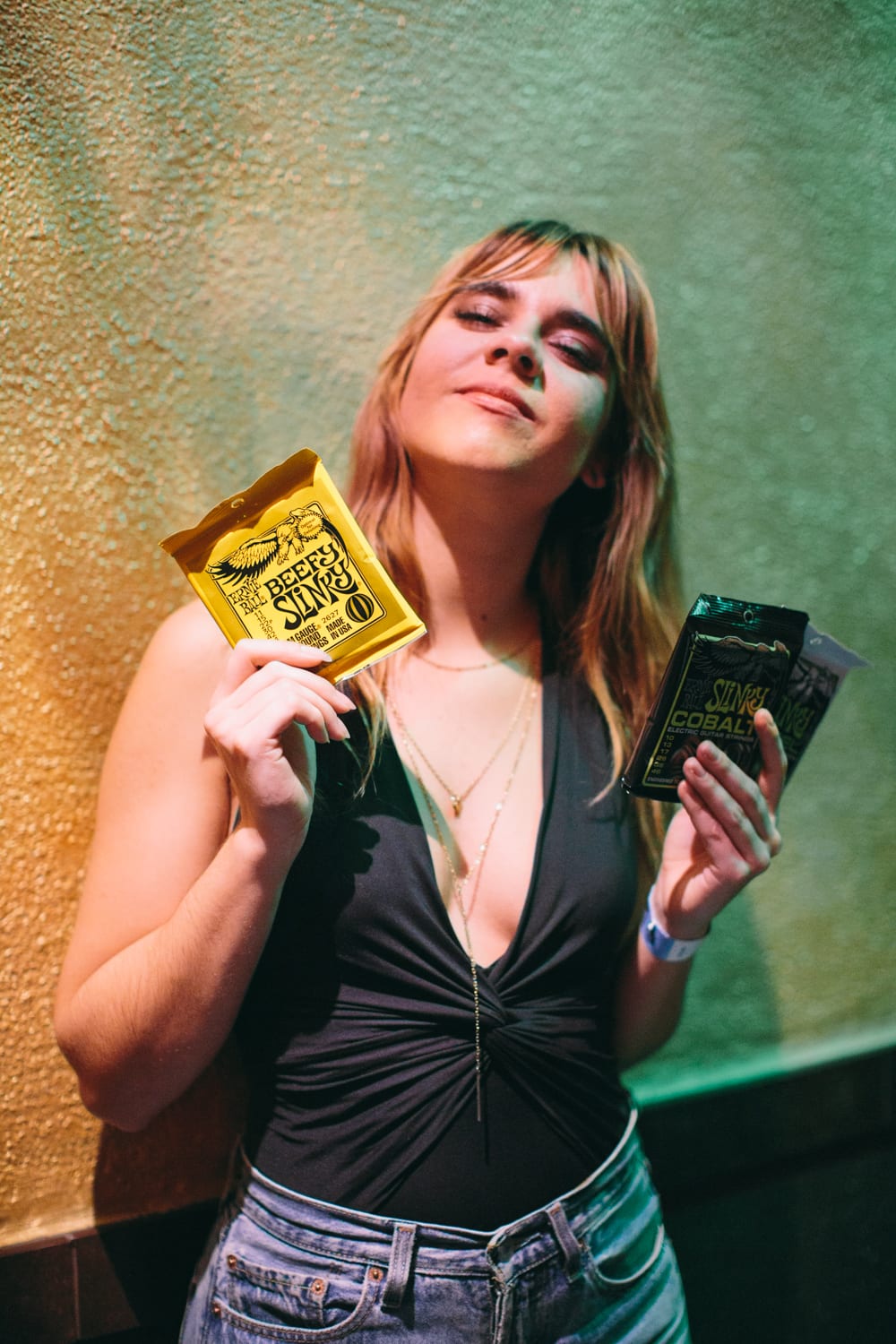
2016 winter NAMM was incredible. Thanks to EarthQuaker Devices, Dwarfcraft, Catalinbread, Ernie Ball, Reverb.com, and PRS Guitars, She Shreds hosted an amazing crew of women that quite frankly took over and blew everyone’s minds open. Special thanks to Thelma and the Sleaze and Thunderpussy for being our main shredders at NAMM and for being wild and crazy. Extreme special thanks to the coolest company, EarthQuaker Devices for always believing in what we’re doing and helping us in making it happen! Stay tuned for our NAMM 2016 video coming at you in the next couple of weeks.
In the meantime, check out some photos from the She Shreds X EarthQuaker Devices X Moon Block 2016 NAMM Showcase!
Lisa Bella Donna
Gothic Tropic
Thelma and the Sleaze
Cherry Glazerr
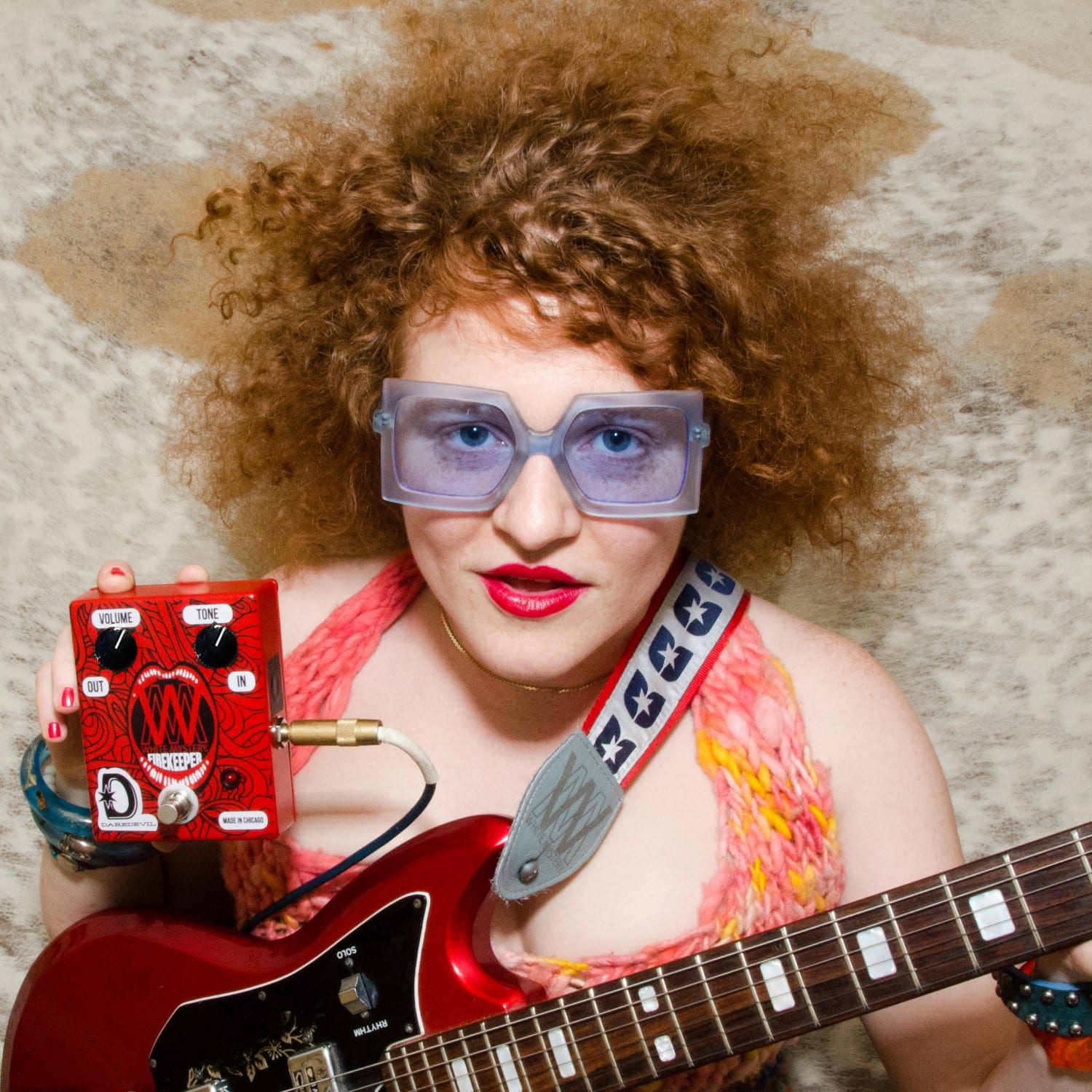
White Mystery guitarist and singer Alex White is best known for performing high-octane rock’n’roll with her brother, drummer Francis White, around the globe.
She’s also gotten press in recent years for putting her Business Management degree from DePaul University to use, juggling band management while constantly touring.
White’s latest musical venture and business partnership led to the creation of a signature fuzz pedal called the Firekeeper, a nickname given to her by Thor Harris of the affecting post-punk noise band Swans. “I’ve been wanting to use that for something it makes sense for, and this pedal definitely scorches,” White adds.
The pedal was constructed by fellow Chicago-based entrepreneur Johnny Wator, owner of Daredevil Pedals. “I wanted to work with a cool DIY band with a woman guitar player, and Alex is about the most DIY guitar player I’ve ever met,” he says.
Like other fans, Wator was curious about how White achieved her guitar tone. “For the last couple of years, I’ve used this Little Big Muff,” she says. “I painted it red and modded it a little bit. People, whenever they see me play, will say, ‘What’s up with that thing?’ Johnny was curious, as well. He said, ‘That thing is so cool. Let’s put it into production and see if other people are interested in using it.’”
Instead of simply retracing White’s steps, Wator used her modified pedal as the inspiration for something unique. “We took the concept and then dug a little deeper, looking at 1970s Big Muff pedals,” White says. “Specifically, this pedal is called a ’72 Ram’s Head—which is a style of Big Muff. We kind of took elements of all these different pedals and combined them into the ultimate fuzz pedal.”
Wator constructs each limited run of 10 pedals by hand. “I do it the old school way, so it definitely takes longer… probably two hours each,” he says. “Everything is done by me—drilling, ordering, and wiring. There’s a lot to it, but that way I know everything is up to par. It’s a labor of love mostly. I obsess about pedals, and I’m always grateful when other people appreciate what goes into it.”
Guitarists will notice at first glance that the Firekeeper lacks Big Muff’s traditional triangle of knobs. “The concept is that it has a volume knob and it has a tone knob,” White adds. “A lot of Big Muffs have volume, tone, and gain. The reason why the Firekeeper just has two is because we maxed out the gain. You can’t turn it down. It’s at the maximum Spinal Tap ‘turned up to 11’ gain. The interesting thing about that is a lot of people are curious with me… Like, ‘How do you get your tone? It’s so fat.’ I’m like dude, just turn everything up.”
The simplicity of the pedal’s design demystifies White’s sound, making it easy to replicate for novices and skilled players. “It’s turnkey is good to go,” she says. “It makes it a good beginner pedal for some people, but it’s also the perfect pedal for people who want to achieve a maximum fuzz sound.”
Firekeeper is the first signature pedal built for White or designed and constructed by Wator. Whether it is beginner’s luck or a testament to the loyal audience White Mystery has built after years on the road, the first run sold out in less than a week. “I didn’t know what to expect so we thought it would be cool to start with 10 and go from there,” Wator says. “I was a little surprised [the pedals sold out quickly], but obviously we hoped it would be well received. Fuzz pedal fans are awesome.”
As of mid-December, a second run of 10 went on sale on White Mystery’s website (www.whitemysteryband.com). “Each run is going to be limited and look kind of different,” White says. “That first run was bright red. The second one is different to kind of timestamp it for the future.”
White’s pedal has been a key element in crafting a playing style that owes as much to hard rock and metal’s past as it does to her peers’ garage and punk influences. “Something I’m really passionate about is tone, having a really strong guitar tone and voice,” she says. “The Orange Amps slogan is that they are the voice of the world. If you play an electric guitar and it’s not plugged in, it’s quiet. If you plug it in, it becomes this rip-roaring force. The pedal is kind of the conduit between your guitar and your amp. Some people elect not to use a pedal and some people have pedal boards full of them. But they afford the opportunity to create a signature sound, a custom sound.”
White Mystery’s stringent touring schedule did not slow down during the creation process, allowing White to test a demo version of the pedal during an October tour with Turbo Fruits. She also took Firestarter on the band’s first trip to Japan in November. With a unique pedal as a medium for White’s signature sound, she’s been finding herself fielding a new set of fan questions after shows. “It’s cool because there’s a lot of electronics nerds in Japan who were like ‘What is that thing?’ so I was able to show them.”
Fran Blanche is, quite simply, a genius. In 20 years she has manufactured over 20 original Frantone pedals of sheer reliability—designed to be kicked around and built to last—with a simple yet beautiful exterior that makes them the first to be spotted on stage.
Frantone has certainly been around the block—The Vibutron was featured on the cover of Dave Hunter’s book, Guitar Effect Pedals: the Practical Handbook, and Lou Reed was the first person to play the germanium transistorized fuzztone pedal, the Sweet. Despite a slew of unforeseen tragedies that almost ended the company for good, Frantone is making a big comeback this year.
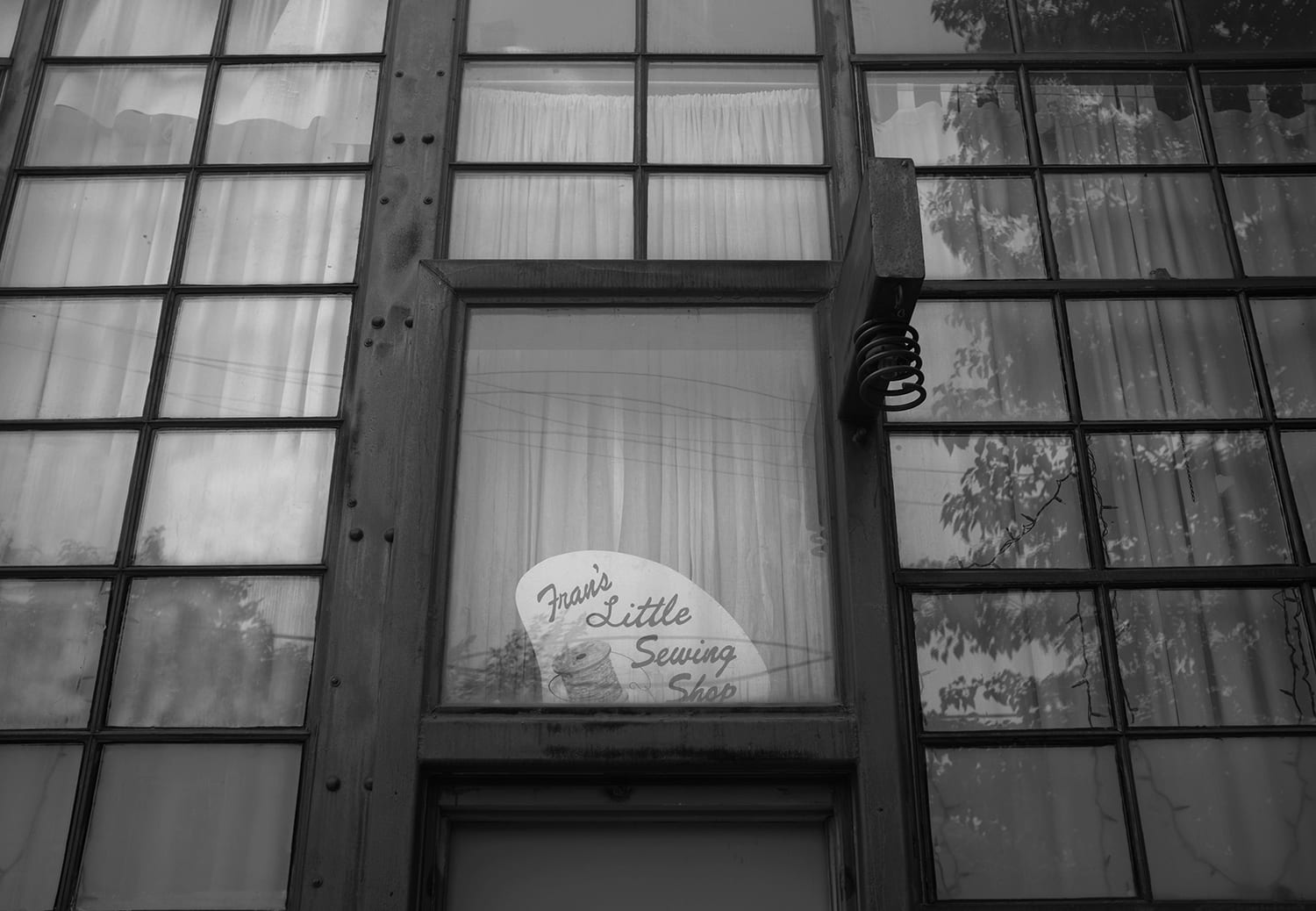
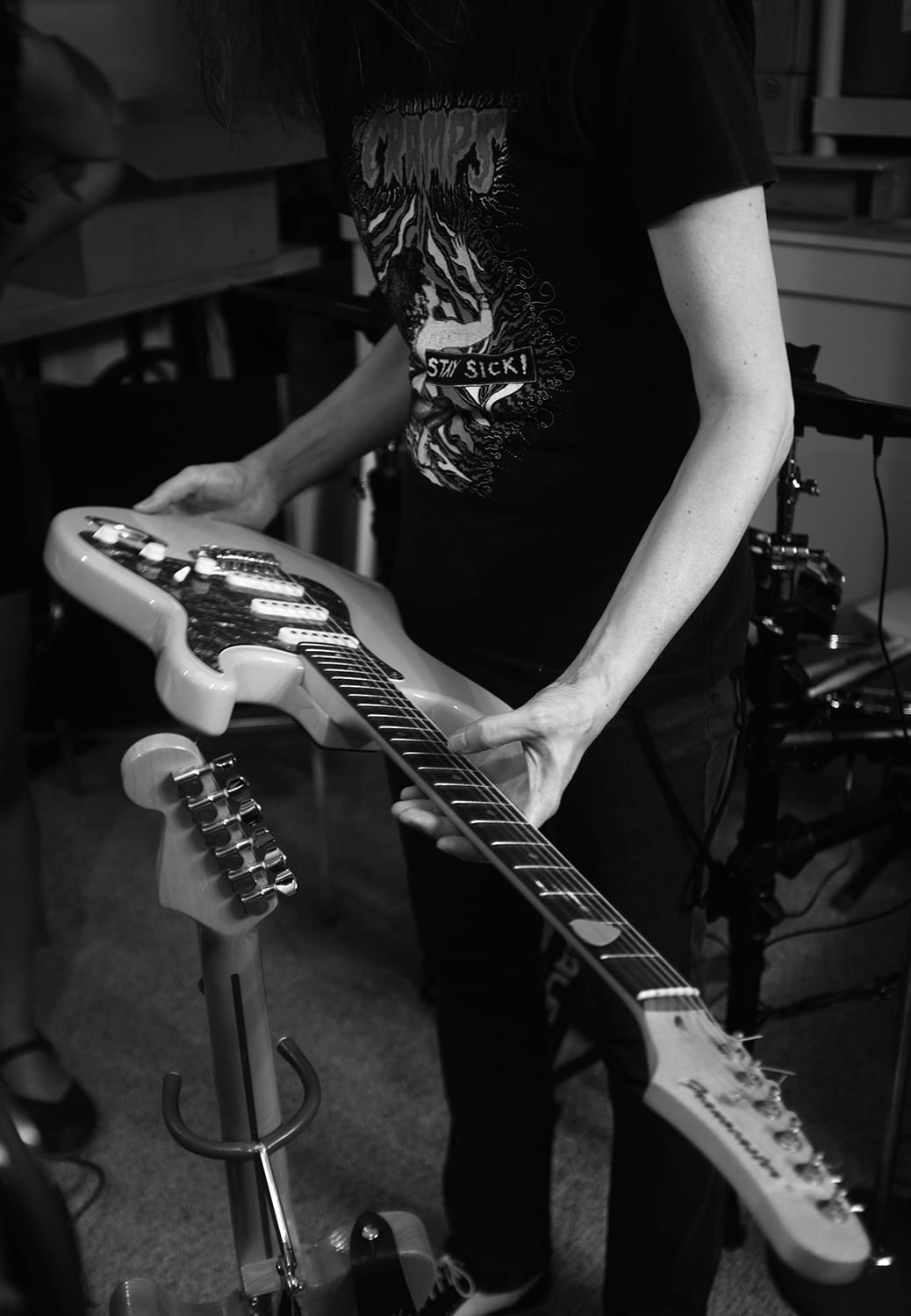
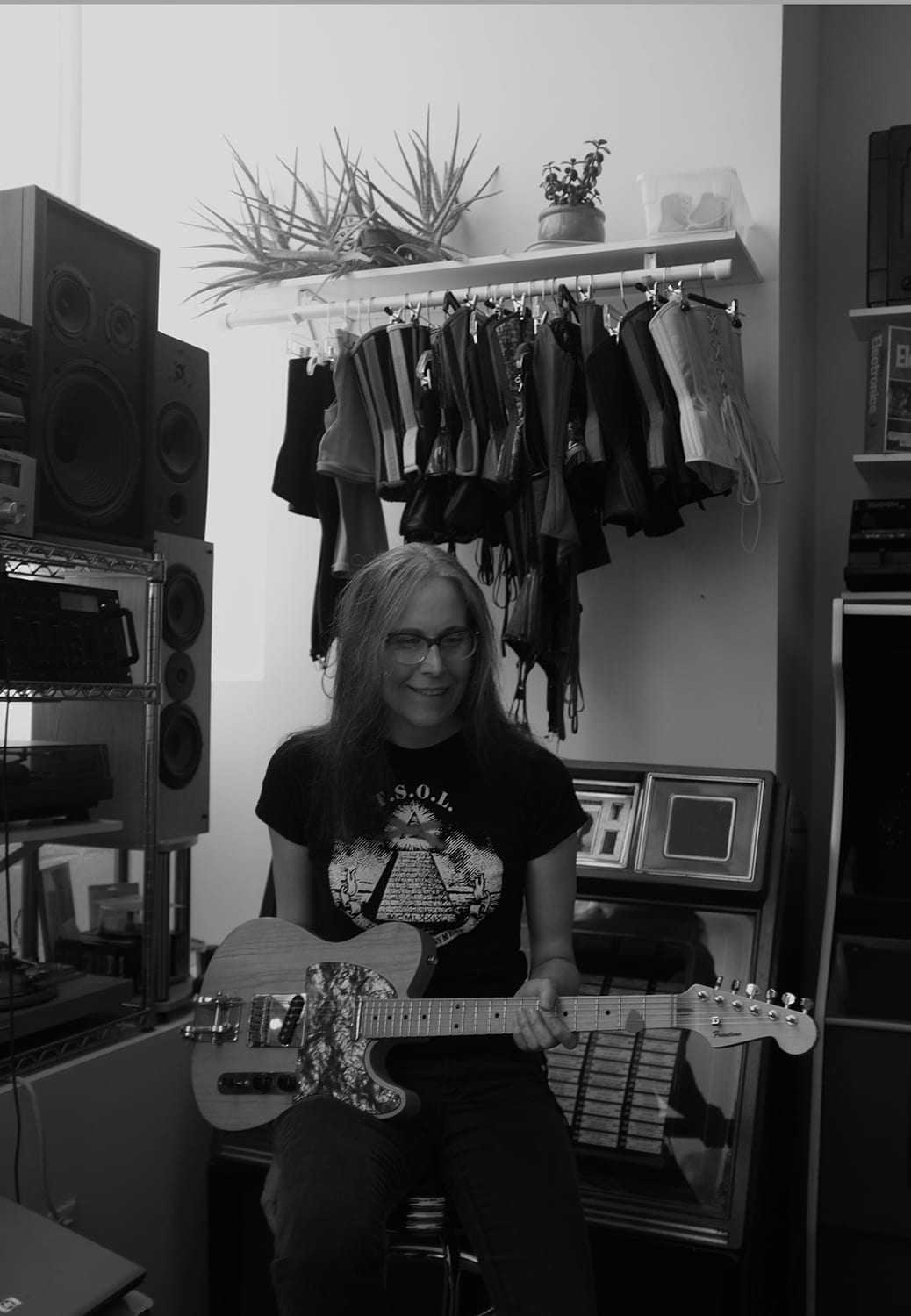
We met this May at her studio in Philadelphia, a duplex that houses Frantone as well as her hand-sewn corset company Contour Corsets. In between putting songs on the jukebox she services herself and playing around with Fran’s handmade guitars, we talked about her history in pedal building, being unwillingly outed as a trans woman, and what’s next for Frantone.
Can you tell me a little about the beginnings of Frantone?
I started Frantone with my first business partner, Merton Kenniston. He had come from Digital Computer Corporation and he had this business out in Central Pennsylvania that I worked for. We always, in the off hours, talked about engineering and computers. He said, “Well, I’d really like to get into manufacturing again.” At the same time, I had tinkered together a pedal that I needed because I was in a band and I needed to get overdrive for my little amp. What I really wanted to get was a Big Muff, but I couldn’t afford it. It was like $60 for the old gray Russian Big Muffs, which were crap, but I couldn’t afford it. I went to Radioshack and bought some parts and tinkered together a little overdrive pedal. I brought it to Mert and said, “I made this, and this is the kind of thing people might want.” He didn’t know anything about music, so I had to pitch the idea. There wasn’t such thing as a boutique market in ‘94. There were growing pains, but after about a year we came out with a box called The Hepcat. In ‘96, Mert ended up selling his business and working for a company doing virtual reality glasses. I bought out his share of Frantone and took it on myself. I came out with the Peachfuzz in ‘97 and was getting really tired of making pedals, so I took a job working for Electro-Harmonix. I ended up being the head tech and supervisor of production. I went on to design the new Big Muff in 2000—it was ironic because the only reason I started making pedals was because I couldn’t afford the Big Muff four years earlier! It ended up being the foundation of the most popular series of Big Muffs ever made. I should have designed it on a commision basis! I would have loved to get .5% of the revenue from that design [laughs].
When did you open your first Frantone factory in New York and what that experience was like?
After I finished the Big Muff I left Electro-Harmonix. They were located in the East Village, in a tremendously great location. It was the next building south of where the old Village Voice offices were on Astor Place. Back in the ‘90s I would go out for lunch, down on the street, Dennis Franz would be there because they were shooting NYPD Blue on the corner. You’d go down to St. Marks and they’d be shooting Sex in the City in some comic book shop. I was out for lunch one day, and we walked by Dojo, which was this place on St. Marks, and right here was George Lucas. Just sitting right there eat al fresco with his kids, and there he was. There was a lot of stuff like that. I became friends with Les Paul, and Marshall Crenshaw. I hung out with Luscious Jackson and went to Lou Reed’s studio. It was like a crazy adventure back on those days. I grew up watching TV, it was the Gilligan’s Island of culture in my house. There were no books, no records. When I moved to New York, it was this experience where everything got flipped around. Everything fell through the TV set and all of a sudden I was in the TV. I was living in the Upper West Side and working downtown. In the summer of 2000, it went down that Elecro-Harmonix was moving to Long Island City and there was no way I was going to commute to Long Island City. It was not a place you’d want to be everyday, and the subway didn’t go there. left Electro-Harmonix after I did the Big Muff and started up Frantone again in Brooklyn. The old Frantone factory was on 10th and Wythe in a building that isn’t even there anymore, I don’t think. That was quite a stressful time trying to get it all together. When I left Electro-Harmonix Mia Theodoratus left with me, so we entered partnership. She was going to do all the sales, and I was going to do all the building. I didn’t have to worry about selling, I could keep a low profile. If people called the office, they talked to Mia. Even when Dave Hunter released his book on pedals and Vibutron was on the cover, I didn’t want to be interviewed. I let Mia do it, even though she gave me the questions and I gave her the answers. I kept a really low profile. It was ideal, because I was spending 80 hours a week building. I was working until three or four in the morning in Williamsburg, and what people think of Williamsburg at that hour now is not what it was like back in 2000. Back on the waterfront in the middle of the night, it was scary.
Why did you leave New York?
I would have kept doing it if it weren’t for the waterfront rezoning that came through in 2003. We were there for the [9/11] attacks, and the factory was inside of the geographical radius of the quarantine zone. When the attacks happened, I had to go to the factory and pack up everything. The smoke from the fire was in the building. After that, I was almost convinced at the time that the months after the attack would be the end of Frantone because what people don’t realize is that living in New York, and especially living in Brooklyn at that time, was that it was a war zone. The army moved in. We couldn’t get groceries or supplies for weeks. We were the only people in the neighborhood—Mia and myself—who stayed. I have photographs of Bedford Avenue on Saturday after the attacks, and there are no cars or people as far as you could see. It was so hard to keep the business going, to stay there, to make product. For six months after it was real hard, almost the end of the business. If we didn’t have some money leftover to throw in, it would have tanked. Two years later, in 2003, the entire waterfront got rezoned. We all got pushed out anyway. The building got sold. My neighbor was Henry Hey, a famous pianist and arranger, he did Rod Stewart’s big band. His studio was right next to mine and we both got thrown out the same day. I was fortunate enough at the time to be in New York when I could afford a lot of space, but it didn’t last long enough for me. So I moved to Bushwick for more room, and was pushed out of Bushwick. By 2006 it was impossible. I did the lateral move, back to PA, but then more tragedy struck and I had to abandon Frantone.
What were the other tragedies?
There was a series of tragedies. My partner had troubles and passed away. I had to abandon our house. I couldn’t stay in the house. And again, was kicked out of those two big New York spaces, so I lost a tremendous amount of money. So then I had to abandon my house, because I just couldn’t stay there after she was gone. That was the last Frantone factory, a huge Victorian mansion that I had built on to. It had 23 rooms. It was palatial. With the outing [of being trans] and my partner, it all happened within the same year. I didn’t work for six months. I moved back to Philly where my family was and they took care of me. I was sick. By 2011 I started working again. I was making corsets. I got to a point where it was sustaining me. That became my therapy, when I built the first Fran lab. I didn’t know anything about video blogging, or instructional videos, but at some point I stumbled onto Dave Jones blog and Jeri Ellsworth, and I thought I’d love to do this. I tinkered together a space where I could do some videos. I saw it as an avenue to do education, which is what I’ve always wanted to do. It also started out as my therapy, to get my life together, but also it helped me because after the outing years before, my professional reputation was destroyed. I always wanted the product to talk for me, to sell itself. In the early days, there were no pictures of me. What I’d learned was, with the outing and all the weird things people were saying about me, they were sure about me and were painting this picture of me on these social networking forums. I would read threads that people would tell me about, and I read them and the image that people had of me, of being this parasitic faker, oger, thief…you know, everything that I’m not. I spent a lifetime trying to do my own thing, be my own person, live on my own terms…and I was in my real life, but the public perception was that I was this fake person.
They painted this picture of you because they found out you were trans?
Well, what I learned was, that in that vacuum of not talking about yourself, people will invent your history for you. What had happened was people were inventing my whole life and my persona, who I was and what I had done out of fantasy. Someone might hear something from someone who knows someone who knew me way back when, and you do the game where you circle jerk information around. Well, by the time it gets to someone who is angry enough to put it on a forum, it’s something completely unreal. I realized the video blogging ended up being a way for me to allow people to have….I wanted it to be an unedited, unobscured view of what I did. I started turning the video blogging into showing what I do, my lab, my sewing shop, what my work is like, and my philosophy. I starting writing my philosophy and experiences on various blogs and pages. Over years and years, I had even started doing trans video blogs, which, ironically, have changed my life a lot. I did a very spirited video blog about the trans problem, back when I still had bangs, and everything I said was 100% true. When it started out, it was a lot of bad comments. As the years went on, less and less. There was this inverse bathtub curve where, when I first started talking about it, overwhelmingly negative. People were going out of their way to email me, personally, to tell me what a shitty person I was. As time went on, and it was out there more, more and more people were venting positive comments. I did it as a means to recoup my reputation, but it ended up making a difference in some way. I started doing it for very selfish reasons, but people began learning from them, and changing their perceptions and views about trans people and about women engineers. The kind of macho crap that caused my outing, it’s kind of hard to do now because the landscape has changed. Not because of me, but because of people like me.
Absolutely. I feel like when that happened to you…well, now there is so much more dialogue about trans communities and trans people. People are looking to be more aware, and more inclusive. There wasn’t the same language ten years ago as there is now, and not like that makes any anti-trans comments that happened back then okay, but I feel like some progress has been made in comparison. It’s still insane to think that those comments on that forum almost ended you.
Well, what you have to understand is that I transitioned in the ‘80s. Back in those days, if people knew you were trans, it could be the end of you. Living in PA, there still really aren’t any legal protections for trans people. Trans people do have some protection under the general law, but there are no specific laws. Hate crimes don’t apply to trans people in PA. You can be charged with a hate crime if you kill someone or you wound them for being gay, but if you kill someone for being trans you can’t be charged with a hate crime. Back in the ‘80s, if your neighbors found out you were trans, you’d lose your apartment. If the person you worked for found out you were trans, you lost your job. You’d be run out of town on a rail, or killed. It was serious stuff. Your life depended on keeping a low profile. That’s really why, even in New York where I had this really active social life, as far as my work goes, I really wanted to be under the carpet. I had to not exist because I couldn’t afford any of that coming out because I knew that all my work would just be destroyed if people thought about what I was rather than what my work was. Even in 2008, you’d think, “Oh, it’s 2008, it’s the arts!” but no. People weren’t enlightened in 2008. It did come out, and the plug got pulled, and it was over.
I watched one of your video blogs about the press you’ve received, and you mention the interview you had Mia do, and how you didn’t want any photos of yourself released. I thought that was so interesting because most of the women pedal builders I’ve talked to said the same thing. The don’t want any photos of themselves out there because they don’t want people commenting on them. Just because they are women, they know people are not going to talk about their work but rather what they look like or what their wearing. It’s even more severe in your case because there’s a whole other element to it, but there’s even a necessity to it, especially with the change in mental landscape in past years regarding the trans community.
Well, if you’re going to be out you have to be really out. The years after my outing, where I was technically out but not out because I wasn’t talking about it, those are the perilous times because people were talking about me, but I was not talking about me. It took years for me to turn around the public perceptions. But even now, I’ve had huge rejections. for organizations that invited me to be apart and then, well, I’d always say the same thing, “Well, I’m sure that you vetted me to your satisfaction, but full disclosure: you do know that I am trans, right?” Usually the answer is, “No, we did not know about that and we thank you for your honesty, and you’re so brave, and it must be very hard, but we can’t have someone like you in our organization.” And I say, “But you asked me.” And they say, “Well, our organization depends on money from very conservative groups, we have church groups, and children are involved.” I have a long list of opportunities that have been presented to me where I have been thrown out just based on that, or my age, or both. Being old doesn’t help. You would think that the landscape would be much different, but like you said, people don’t know about the trans world. I had written years ago that the conflicts within….I was never sealth, but I was always protective of my work. What I had always learned was that in the trans community, there was always this very hardwired mindset. The first rule about trans is that you don’t talk about trans, for decades ago. I was indoctrinated into it in the ‘80s. If you’re going to do this, if you’re going to survive, if you’re going to be alive at 30, no one can know. You can’t tell friends, because if you do they’re going to tell everybody. There was always this naturally guarded secrecy, and the trans community has been built up on this philosophy for decades, and is still prevalent. The young people I think are the hope, especially trans teenagers and early 20-year-olds, because they are not growing up with the idea that you have to be stealth or die. That is changing everything. The idea that there are out trans teenagers in highschool…that blows my mind. When I was in high school, the word transsexual wasn’t even in our library. There was no internet. It wasn’t talked about, it wasn’t written about. There was no way to know it even existed. I didn’t even know trans people existed until I was 19, 20. When I found out that it was even possible, well, my whole mind changed and my whole idea of life changed. The most hopeful thing over the last 10 years, especially the last few years, is the young people. They are just really hopeful for the future of trans, to the point where the future of trans is that trans won’t exist anymore. I think it’s really just that the LGBTQ, well, the T is going to have to be removed because at some point there’s going to have to be a redefinition of gender, so that it’s not this binary thing. There’s a spectrum, and there are people all over the spectrum, and there are people not on the spectrum, there are people who have no gender. I think this gradually changing of the idea that people are on a continuum, which has been written about in the trans community for decades, but the idea that in the regular public people would, on any level, accept that there is a continuum of people, I think that’s where the future is. Maybe someday there will be no trans people. There will just be people, which is the way it should be.
Given your history, and all that you’ve been through, what advice would you give to any women looking to get involved with pedal design and building?
Be willing to fail. Never give up. Get really tough. Stick up for yourself. Know your shit. Don’t take anything for granted. If you’re a woman, and you want to be in the music gear business, you’ve got to be iron tough.
What makes Frantone different from other boutique companies?
My designs come from a need for something that I want to see happen. One of the things that sets Frantone apart from most other boutique pedal makers is that I don’t make knockoffs. Everything that I make is an original design. Because of that, even though in the early days I got known as a fuzz-tone maker, all the different designs are based on different principles. Each fuzz tone is like an experiment to exploit a certain kind of way of doing it. Rather than building one type of effect and then making alterations on that. The boutique pedal business is sort of cannibalistic. Even manufacturers that come up with an original design will just come up with alterations of that design. There’s lots of variations on common themes. With 20 designs in 20 years, I try to make all of them unique. My compressors are completely originally design, really efficient and optimal design, that hadn’t really been tried before. I just started from scratch—these are the features I want, this is the performance I want, this is the tonal response that I want—and designed from the floor up. I’ve done that with virtually all of the effects.I’m not a tinkerer. I don’t go up there and tinker and throw things together and throw it out. Some people would rather tweak. I just don’t have the time for that. And so I don’t have a lot of rejects, I don’t have a lot of prototype pedals that didn’t make it. I would be directed on making a new product and perfect it and be done.
You recently announced that you will be teaming up with BearFoot FX. What made you decide to revive Frantone?
An alignment of things. Kind of like the serendipity that started my pedal-making career, it’s the same sort of alignment of things. Weaving through my career I’ve just had lots of very serendipitous occurrences. I had been ready to bring it back, and looking for someone to bring it back for a while, and Don Rusk [Bearfoot] had just approached me. It’s been six months of negotiations, and figuring out how we can do it. Frantone was always wholly operated and run by me, and the idea of outsourcing the line, and quality control…there are certain standards. All the same philosophies. It’s all got to be an American handmade product.
So hence, now, I am doing a licensing deal with Bearfoot. They are a very established and efficient pedal-making machine. They have their own lines. This is going to be an extension of that, using their productions techniques and their people. I don’t have to be in a paint room, I don’t have to silkscreen. It’s pretty exciting. It’s still early, we’re still getting all the wrinkles out, but it should be happening by Fall.
Will you be reproducing Frantone classics or will there be new designs?
Yes and yes. We’re going to start with the classic line. There’s going to be some redesigns because some of the parts I use, especially in the early pedals, are now impossible to find. The Vibutron and the Glacier has a chip that hasn’t been made in a lot of years. The knockoffs are just not up to spec. We’re going to have to redesign those, and some other tweaks here and there because of component rarity. Sonically, everything should be identical.We’re going to use the same cases, and paint them the same way. We’re trying to upgrade them from a powder coating, which is a little problematic because it’s different material with trying to get the look right, but I’m excited about the idea of them being resilient to being knocked around.
I love the design of Frantone. They’re beautiful and yet simple. I was looking around, and I was wondering if some of your originals were knocking around, so I went on eBay and somebody had the Cream Puff up and it was totally destroyed but it still looked so beautiful. The seller even said it looked like a disaster but it sounded perfect. I thought that was so cool.
That was another problem. Because I’m a player, a lifetime player, one of the primarily design considerations has always been reliability. So, I designed and built all the different generations of Frantone pedals with the idea that they’d be knocked around kicked around on a daily basis. When I made the first Hepcat I had this idea of doing a promotion—I was flying a lot because Mert had a plane—and I thought a great demonstration would be to take a Hepcat, put a battery in it, drop it out of the plane at a thousand feet [laughs] in some field, and then we’ll land on the field, we’ll find it, dig it out of the ground, and I’ll plug it in and play it and it will work. I was so confident that it would work. That was the whole philosophy. That actually caused me a lot of pain to design stuff that was so reliable because trying to find cases that were really heavy and not so thinly walled that you could crack them by stepping on them, or getting knobs that wouldn’t shatter if you dropped it, or putting a steel bezel on the LED so it doesn’t get pushed into the case. Stuff like this, to make them really that rugged, was very painful to keep the quality up to that level. The secondary factor was non obsolescence—18 years later they’re still playing it and it hasn’t broken yet, so I haven’t sold them another one. [laughs] And so, that created an unusual problem for any kind of product. I saturated my market, and nothing was breaking. The repairs are always minor things, usual cosmetic. The reliability is a double-edged sword when you’re a manufacturer.
How are your feelings moving forward with Frantone after going on a hiatus for so long?
It’s different. Hard to let some things go. Pre-2009 I built every single Frantone pedal. So, I mean, that kind of blows my mind. I wouldn’t have the health problems I have today if I didn’t spent so much time in the paint, and so much time soldering, and operated orbital sanders. now I have peripheral neuropathy. I’ve got all these personal battles, and battle scars. But I’m glad I don’t have to do all this alone. So, there’s some letting go of the control of that, but on the other hand it’s going to be a new product and a new company. The point of it is that people will have a Frantone pedal they can buy again. In the years since I stopped making pedals, the interest has remained constant. I’m just glad the product is going to be out there. The whole point of Frantone was that it was never about me, it was always about the product. It will be again.
People who have used Frantone: Kyp Malone [TV on the Radio], Lou Reed was the first person to ever use The Sweet, Les Paul. Guitar players from REM had cleaned out all the Frantone stock at her Williamsburg dealer. Live Aid (the second big one), when REM performed they started playing, “What’s the Frequency Kenneth?” she heard the distinct harmonics of the Brooklyn Overdrive, and it was being used on the stage.
This is the final installation of our collaboration and giveaway series with She Shreds Magazine. For this video we featured our friend Mandii Larsen of Tulsa, OK. She stacks two Old Blood Reflector Chorus’ pedals, two Old Blood Processions, an Old Blood Black Fountain, and starts of the signal chain with a Caroline Guitar Co. Haymaker, finishing with the TC Electronics Ditto X2. I got chills a few times while we were shooting this and while I was putting this edit together, Mandii has a way of summoning sounds that conjure a lot of feels. Or, at least for me, anyway, you should decide for yourself.
With an impressive assortment of pedals and guitars in tow, Nicole Barille ofmr. Gnome looks like she’s setting up for a four-piece band at sound check.
Indeed, mr. Gnome’s huge sound seems to come from much more than two people, but only Barille and her husband, Sam Meister, are behind it. The Cleveland duo has played since 2005, putting out four full-length albums that entirely defy categorization. The duo’s juxtaposition of styles and sounds culminates in a unique aesthetic that is equal parts frenzied and gloomy, heavy and soft, fast and slow. Barille’s beautiful and haunting vocals range from childlike and playful to crooning and melodic, contrasting with her thrashing, distorted riffs and Meister’s powerful, lightning-fast drumming. Taking inspiration from a mixture of the music from the grunge era they grew up in as well as bands and artists like Portishead, Björk, and Mazzy Star, mr. Gnome creates a sound that is unclassifiable and completely authentic.
I sat down with Nicole and Sam before their recent performance at Dante’s in Portland to talk about their newest album, their fierce DIY spirit, and what they’ve learned from ten years of playing together.
She Shreds: Tell me about your label, El Marko Records.
Nicole Barille: When we were doing our very first full-length, we decided that we wanted to start our own record label and run it ourselves. That was in 2007, when everything was just crumbling around us in the music industry, so we thought that if we could figure out right then how to do it all ourselves, then we wouldn’t have to worry about it. We thought that if we were willing to work hard, we could definitely make it happen. It’s a ton of work but it’s really fun. We pretty much run the label… Sam’s parents help out a ton—they do a lot of the stuff when we’re touring that we can’t do when we’re away, like running the store and packing orders.
Sam Meister: It’s a family business, for sure. We just brought my little brother on. It definitely keeps us busy. When we’re not doing the art, we’re doing the business. It’s 24/7.
There is definitely a DIY attitude about the band. Where does that independent spirit come from?
NB: I think we’ve just always known what we’re going for. We’ve had people come from labels and offer us things, but to just give away all of that…it would have to be a really amazing deal. Never having to answer to anyone else and not having to worry about what anyone else thinks while you’re creating is really valuable. But I mean, maybe we are also kind of control freaks.
SM: I think at this point we are. It started out as necessity—no one wanted to have anything to do with us when we started because…well, we sucked and we were just getting started. So we just did it all ourselves, and then when people started to want a piece of it, we didn’t want to give it away at that point.
NB: Yeah, you learn how to do things yourself and then you can’t imagine doing it any other way. We were willing to put in all the work to run everything and then we were able to have all that control. It’s been worth it.
What have you learned from almost 10 years of playing together?
NB: I’ve learned the most from touring. I always tell people that if you want to get better, just tour your ass off. You get put into a million awkward situations and you just have to get good in order to be good. Not having monitors forever from only playing in crappy clubs, it really does make you better. You just have to figure out how to go about everything. It makes you troubleshoot a lot more and helps your muscle memory, all that stuff. You watch other bands all the time and start to pick up tips here and there, like figuring out what pedals you’re attracted to, and then you try to work all of that into your own set.
How did you decide to play as a two-piece?
NB: I don’t think we knew what we were getting into when we started, honestly—we didn’t have any idea how hard it would be. It really happened by accident. We were playing in a band with a bunch of other people and the two of us wanted to play all the time, but the others had different schedules. I had a ton of songs that I hadn’t finished that I brought to Sam and he decided to start playing the drums with me. We saw other bands like The White Stripes and The Black Keys doing the two-piece thing and we thought we could do it. We just kind of stumbled into it, not really knowing how difficult it is, how much pressure is on when you don’t have other people to lean on.
What do you think is the biggest difference between the new album, The Heart of a Dark Star, and your last, Madness in Miniature?
NB: I think that this one is definitely more heavily orchestrated, and that’s because we did this record entirely by ourselves. We had done a bunch of the quieter interludes on Madness by ourselves, but we had never done the drums. So we decided to take everything to our home studio instead of paying for studio time, and just took our time and had a lot of fun with it. So I think that’s why it ended up being more heavily orchestrated—we had the time to really layer and tweak all the tones exactly how we wanted them. It was a self-discovery process. We weren’t really worrying about how we were going to play it live between two people. Madness was a little more guitar and drum centric, and this one has a lot of keys and a couple other additional instruments.
I read that a couple years ago you had a puppy that you wanted to turn into a road dog. Did that ever happen?
SM: Well, we had a Rottweiler when we were 19—we saved a dog and he was our best friend and went everywhere with us. He passed away when we were on tour, so we didn’t have a dog for three years, and we were like, we’re gonna get a dog again and we’re gonna make it a road dog just like he was. So we got a little girl Rottweiler thinking she would be small and calm like he was.
NB: She’s not at all. We call her a Spazzweiler because she’s such a freak. She’s massive, too. We really should’ve gotten a French Bulldog.
We caught up with Jessi and Nikki of explosive southern rock quartet Those Darlins after they played the main stage at New York City’s 4Knots festival.
The two guitarists were one third of the band when it first got started back in 2006, and the coolest thing about interviewing bandmates who’ve known each other for so long is how they can finish each other’s sentences like kid sisters. You’ll see what I mean. Anyways, the band kicks off a quick tour with Diarrhea Planet starting in mid-August, so we got things rolling on that note.
She Shreds: What’s your favorite thing about tour?
Jessi: Playing shows [laughs] And it’s fun when you’re on tour with a friend’s band and you all get to hang out. You get bored of having the same old conversation [with your bandmates]. We all know everything about each other.
Nikki: I have a lot of friends in other cities, so I usually just meet up with somebody and have dinner with them. Or we’re like, “Lets just sleep for a little while.”
Jessie: Mhmm. Sleeping. Low-key stuff is really some of the best times on tour. When you have like a day and you just got a hotel room—
Nikki: —and you’re like, let’s just watch movies!
Jessie: Yeah, that’s the best.
You’ll be playing from Blur The Lines, which you released fall. What was that process like of writing that album?
Jessi: We wrote the skeletons of the songs separately but then as a band—
Nikki: —we get together and were like “What if you did this here, or maybe articulate this better”, and just kind of help each other build the songs together as a band—
Jessi: —and that’s where our band mate Linwood comes into it. He’s part of the arrangements, melody. Wherever he needs to fit in, he fits himself in, but we do the beginning for the most part.
Nikki: We’ve tried to write all together. That’s more difficult.
Jessi: Only a couple times, but it’s happened. And then we’ve done stuff where we paired off.
Nikki: I feel like if we did it more often we could figure out a new way to do it. I think it’s still like, “This is kind of an experiment; let’s see how crazy we can make ourselves.” It’s kind of fun, but it’s also frustrating. It just depends. Me and Jessi have gone and hung out at her mom’s house to write songs together, like camping, doing stuff like that; that was fun.
Jessi: We had an RV in the back and had a fire, and my little brother would come out—
Nikki: —and he’d be like, “Ooh! What about this!”
Jessi: He had ideas for songs [laughs]. It was so cute. We’d be like, “You really need to go to bed so we can write some real songs,” but then he did get one line in one of our songs.
Which one?
Jessi: On Screws Get Loose. The song was “Fatty Needs a Fix.” I remember it was Beach Boys-influenced, cause he would listen to Beach Boys all the time, and he was like, “I got the traction, I’m not in the mood.” That was it! That was his contribution.
That’s really cute.
Nikki: And he didn’t know that we were talking about sex either. He’s 11 or 12.
Jessi: He thought we were talking about being hungry.
Nikki: We were like, “We’re talking about being hungry for sex.”
In your new album, there are these polarizing themes that come out: good vs. bad, male vs. female. Was that intentional or did it come out organically?
Nikki: I think it was natural and then upon reflection, we were like, “Ok, here’s this and here’s that. And this is what this album is kind of representing.” There are these two forces, there’s black and white, and the balance of the two. And kind of being like, will there ever be a balance? The battle of these dualities. We’re different. That’s the cohesive part. We’re the black and the white. We’re the yin and the yang. And it really fluctuates song to song. It’s interesting to be like, “How do you really approach something when you have two songwriters?”
Jessi: I just honestly feel like that time period of writing the album was, for me, just a lot of thinking. Just sitting alone and thinking about everything. And a lot of the songs are me trying to discover how I feel about, “I’m in the middle. I’m really confused.” It was like a check-in of where I was at that point
Let’s talk about being from the South, which is where y’all are from. I grew up in Texas but was recently told by a lady in Alabama that that doesn’t count as the real South.
Nikki: People from Alabama are assholes. There are certain people from certain parts of the South who are all like, “You’re not as Southern as me!” I’m from Virginia and they’ll be like, “That’s not the South,” and I’m like, “Yes, it is.” Everyone has weird rules about what the South is.
Jessi: I pretty much spent my entire life wanting to not be in the South. I just knew I didn’t want to be there. I knew there were plenty of other places to go.
Nikki: I mean, we had plenty of dumb rednecks and stuff, but we also had a good, healthy side of weird hippies who had transferred themselves from wherever in the North. So I was like, “I know this isn’t as country as it can get.”
So, Jessi, you’re saying you always wanted to escape, but it seems like now this is a huge part of your identity. Do you ever want to get out and live in a place like New York City, or is it important now to stay?
Jessi: It’s important to me.
Nikki: I just don’t want to move anywhere else. I like living in Nashville. I would love to go live somewhere else. But not for a very long time. I don’t think I’d be happy living in New York City. I like visiting, but it’s too much. It makes me crazy. I’m like, “Everyone get out of my way!” Walking around through this festival, I was like, “God! I could never live here. Everyone get out of my way!” I still love New York City. I don’t feel any Southern pride about it.
Y’all dealt with some big controversies in Nashville with the release of Blur The Line, especially when it came to your album cover. I hear there was quite the uproar when you hung up a huge banner of the album art. What was that like?
Nikki: I mean, we didn’t put a giant banner of ourselves naked to not get attention [laughs].
Jessi: [Laughs] Yeah, that’s true. Good way to put it.
Nikki: It was funny what the reactions were, but it was also cool because it was pretty 50/50. Some people were really offended and other people were like, “This is art and fuck off.” So, in a lot of ways it’s still the South, but it’s progressing.
Jessi: It was an interesting experiment to see where the South is at this point.
Nikki: The frustrating thing about it was turning on the television and seeing Miley Cyrus or some fucking dingbat doing what they do on dick floats or whatever it is they do, and I’m just like, “How is this on television? How are you allowed to do that? Your vagina is showing through whatever weird bikini thing you’re wearing on stage. And it’s so oversexed that it’s not sex anymore. It’s synthetic. And there’s nothing empowering or interesting or sexy about it. It’s just like, ew. So, in comparison to that, I was just like, “It’s weird that [what we’re doing] is so offensive when that is so acceptable.” Just how overblown sexuality has become where every single pop star is walking around practically nude, but they’re like bleached and tanned and waxed and buffed up with God knows how many chemicals and weird things. And that’s supposed to be sexy, but a nude picture of our pale, weird bodies embracing each other, not being sexual, is like pornography. When they put us on television, it was blurred out. And they said—
Jessi: “Warning! This may be a little risqué,” [laughs] or something on the Fox News report. We were laughing so hard.
There are some people who will take any opportunity to bible thump and complain. So is that something y’all want to continue doing, pushing boundaries with people to see how they’ll react?
Nikki: Yeah, but not the same reactions. It’s something that, just like with the band and everything we do, is always going to be evolving.
Jessi: I think that living in the South and having something to push back against is part of what has made us interesting. And I don’t even mean just as a band, but also as people. When you’re growing up and surrounded by narrow-mindedness. It’s hard to be the person who’s like, “I’m sticking to my guns. I’m gonna be who I am no matter what you guys say.” But it’s also kind of easy to be genuine when I find a lot of music that comes out of Nashville—and not just Nashville, but everywhere, a lot of modern music—is not really genuine. To me, there’s a letdown sometimes in what the message is. Not that their heart’s not in it, but it’s like, “What are you guys saying? You’re just singing about some bullshit thing.”
Yeah, you look at the lyrics to certain mainstream songs and they don’t even make sense.
Jessi: Yeah, like you just wrote lyrics for the sake of having lyrics in your song.
Nikki: And they’re just formulated because they know how to reach an audience that doesn’t want to be mentally stimulated. They’re like [pretends to dance], “This makes me want to do nothing!”
Jessi: And, you know, there’s a lot of guys in bands and they’re just writing these love songs [in silly accent] “cause life is all just about falling in love, and I’m gonna change your whole life.” And then these girls think, “Oh! My whole life is gonna be so much better as soon as I find a guy who sings songs like this to me.” It’s this fairy tale thing. And a lot of young women forget to invest in themselves as strong people and build their own character. Especially in the South, I think that’s happening a lot.
Nikki: Even with girls our age in the rock ‘n’ roll scene, it’s like even if you still rebel, you’re still like, “Well, I just want my boyfriend to be happy.”
Jessi: There’s more to being a woman than just trying to be—
Nikki: —in a relationship.
What a radical idea.
Jessi: Yeah! [Laughs]
Nikki: It’s a message that we don’t intentionally put out there, but we don’t write songs about boys.
Jessi: Or we do, but it’s more about being, like “What the fuck is up with this shit?”
Nikki: “I can’t break up with you. I’m gonna die without you.”
Jessi: It’s more like, “You make me wanna kill myself!” [Laughs]
Nikki: Your heart’s broken. Whatever. Get over it.
Have you heard from younger fans who appreciate that message? I don’t know exactly what age your fan base is, but—
Jessi: It’s a really wide range of people. We’ve got old guys, we’ve got young girls. We don’t have many middle-aged women fans. Late high school or college-aged to mid-thirties girls and guys, and then older guys.
Nikki: Old guys [laughs]
Old guys like your music!
Nikki: They’re like, “Oh! It’s kinda like rock ‘n’ roll! Remember those times? Joan Jett!”
Yeah, I saw some older guys rocking out pretty hard to your set.
Jessi: It’s weird, but it’s cool.
Nikki: But it’s also because they grew up in a different time. There weren’t a lot of female guitar players.
Jessi: And the ones they saw that were really good stuck in their heads, so they remember, and they just want more of it. And there hasn’t been a huge amount more compared to all the… male shredders [Laughs]
Nikki: It’s crazy how many times we get compared to Joan Jett. Like, we never even listened to Joan Jett. She’s not an influence to us. She’s the only one that people are like, “You guys are just like her!” Like, how? And they’re like, “It’s even better cause there’s two of you! You’re two Joan Jetts!”
Jessi: They’ll be like, “Has anybody… ever… told you… that you’re like Joan Jett?” And I’m like, “… No, of course not!” [Laughs]
Nikki: We’re like, “Have you heard of Patti Smith? Have you heard of Chrissie Hynde?”
Yeah, tell us about the music you’re actually into.
Nikki: Yeah, those two are big for me. Patti Smith and Chrissie Hynde.
Jessi: Me, too.
Nikki: I also was first inspired by—well, it was Patti Smith and PJ Harvey when I was a teenage girl. And Courtney Love. But I don’t know how I feel about Courtney Love anymore. But it was good when I was 13, 14. I was like, “Those are the girls I look up to, and I think they’re really good musicians. I like their work, and it has depth.” Patti Smith is someone that I’m constantly learning more from.
Jessi: I didn’t know who they were when I was young, but one of the first female artists when I was young was—
Nikki: —Joan Osborne? [Laughs]
Jessi: [Laughs] Maybe a little bit. That was further back. But when I was in high school, when I started playing music with other people, I really liked the Yeah Yeah Yeahs. Karen O, she really inspired me. I was like, “You can be crazy!” I was like, “I can do that.” That was definitely inspiring. And, you know, she had big eyes and black hair, and I had big eyes and black hair. It felt like she was more like me than anyone else that I had seen, especially as far as being a new artist that was out at that time period.
Nikki: Jessi, Linwood, and I all very much love the Velvet Undeground and have been inspired by them. Neil Young, Rolling Stones. Keith Richards is my soulmate. It’s just sad that he’s so much older than me.
Jessi: And so much more famous. So hard to reach.
Nikki: Someday.
What new bands are you listening to right now?
Jessi: I’ve been in a musical funk. I haven’t had a record player for a year. I kind of stopped listening to music for a really long time. I got burned out. I only listened to classical and jazz for a really long time and just got a record player. But I’ve only bought one album, a Charles Mingus album. I think I got worn out by bands that just don’t do it for me. I got tired of sifting through.
Nikki: Yeah. You gotta do the break thing, and then you come back, and then you go to the old standbys. I’ve been listening to Television’s Marquee Moon constantly, because I’m trying to learn a bunch of those guitar parts. I’m like, “If I learn this album, I could be a really great guitar player.” So I’ve been listening to that a lot and getting inspired to write differently than I ever have, writing more parts than just strumming guitar. Also listening to a lot of Santo & Johnny, learning instrumental stuff. I want to start learning how to play slide guitar. Just going to different places, just trying out things that don’t feel safe to me.
What about you, Jessi? What do you do to push yourself musically?
Jessi: Honestly, I just got so burned out with everything that had to do with music. All of it. After a while, I was like, I don’t music to be something I have to do. I mean, I played shows and everything, but as far as doing it on my own, I took a break from trying to do anything. But what I’ve been doing naturally is playing the baritone ukulele or acoustic guitar, and I work on finger-picking a lot. I like to just sit around and play the same rhythm over and over until I have it down. I don’t even know what I’d use it for—actually, that Bob Dylan song that we covered today, I was finger picking on. It just came naturally. It wasn’t something where I was like, “Oh, this is something I should be finger-picking.” It was just easier, because I’d been practicing—
Nikki: —which is where I started. I was just playing ukulele and finger-picking, and that was just how I played. And then I was like, “I don’t want to play this anymore. I want to play guitar, play rock ‘n’ roll.”
Gear talk time. What are y’all playing? Are you gear heads, or do you not really care about that stuff?
Jessi: Yeah, I’m pretty minimal about it. I can have a short gear head talk, and then I get to a certain point and I’m like, “Alright, I’m done.” But I like people who are really into gear because they can teach me how to be better about my own gear, because that was one thing that was really frustrating when I was first starting. I really wanted to play, but I couldn’t get good tone, I couldn’t get the right amp.
Nikki: I feel like I’m still figuring that stuff out.
Jessie: Definitely still figuring it out. But I finally have my rig now. I have a Dr. Z amp, which is a boutique company in Cleveland. It’s a MAZ 18 Jr. It’s awesome. I love it.
How’d you hear about them?
Jessi: A bunch of people in Nashville play them. I borrowed an amp for the first five years I was in the band, from Linwood actually. And finally, we got to a point where—
Nikki: —our amp situation was bad—
Jessi: —and guitars! I borrowed guitars forever. I finally bought my own guitar and amp in the last three years. We had just recorded Screws Get Loose in Atlanta with this guy Ed Rawls, and he had [a Dr. Z amp] there. I liked it. And then I had this guy Jessi in Nashville who fixed amps, so I asked both Ed and Jessie in Nashville what amp… and they both said Dr. Z, definitely. So I wrote [to the company] and asked them if they would give me a deal. It was cool. And then I got my guitar. I don’t really give a shit about what year it’s from or all that stuff. Whatever, it’s all gonna be dirt some day anyways. It’s more about, does it feel good when you play it? And the guitar I have is a Fender Strat that I found in this record store in Nashville called Fanny’s House of Music. It’s run by all women. It’s really cool. This one was in there, and it was like 300 dollars, and some guy in town put the parts together from different years, and it’s all Mexican parts. That’s the only thing I know. I played it, and the neck was just incredible. I remember being like, “This is the best guitar I’ve ever played!” I couldn’t believe it was only 300 dollars. And then it ended up that the guy had modded the tone knobs out to where there’s a distortion modification built into the guitar. So one of my knobs, instead of a tone, is like a gain, and it makes it more gritty.
That’s cool.
Jessi: It’s awesome. Like today, playing at 4Knots, normally if I would have had my other guitar, I couldn’t get the tone I wanted out of my amp because it didn’t have master volume. But I just turned this knob up, and it was like “GAINNNN.” It was cool. And I didn’t even know that was on there until I went in to get it set up, and the guy was like, “You know this knob here does this,” and I was like, “What? That’s so cool.” Oh, and my pedals. We both play Fulltone Fulldrive distortion pedals, and then I play an MXR Phaser and Electro-Harmonix Memory Boy Delay, and a Voodoo Treble something—I don’t remember what brand it is.
Nikki: Aquapuss is the delay pedal I use. I play through an AC-15 Vox amp. And my guitar’s a Telecaster with p90 pickups. I like it.
Our Official Newsletter
She Shreds Media: Our mission is to educate, empower, and inspire people through unexplored musical and cultural landscapes. Our vision is to continuously refine, redefine, and reimagine the possibilities of how music connects us, ensuring an inclusive and accessible music community 100% of the time.
 Colorsound Bass Fuzz: Colorsound is a little company based out of Macari’s, a music store in London. Their pedals are used by Smashing Pumpkins, The Cure, and a bunch more great bands. The Bass Fuzz they have is next level and it was also the first fuzz pedal I ever bought. It doesn’t translate to guitar too well but it’s easily the best bass fuzz pedal I’ve ever heard.
  Electro-Harmonix POG 2:
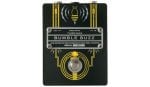 an Records – Bumble Buzz:
 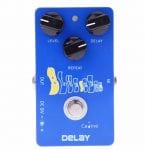 Delay: Th
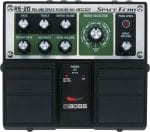 Echo
Echo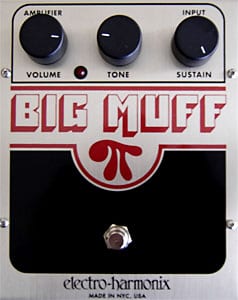 For the last few years, my main distortion pedal has been the Reissued
 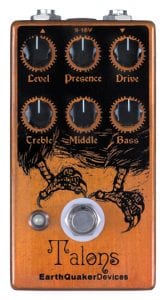 Recently, I have also been experimenting with another distortion pedal called The Talons, made by Akron, Ohio based pedal company