Fun-loving, bold, and uncompromising, Kim Shattuck has returned with the fierce attitude that defined The Muffs’ origins in the early 1990s. Lucky for us, we got a chance to talk to Kim about the new album, guitar gear, and her experience with both the Pixies and the Pandoras.
When I started to try to write songs for this, I didn’t know that we were going to do an album, but I always like to write. One of my goals of songwriting was to get back to my roots a little bit, just to remember what used to inspire me because my inspiration changes.
The stuff that I liked when I was first writing music was really kind of fast, melodic…I don’t strictly like the Ramones, but some of the Ramones’ songs – I would call them the non-angular Ramones’ songs (laughs) – I liked “Sheena is a Punk Rocker” or “I Wanna be Sedated” type of music. Stuff like the Beatles. Stuff that I liked back around 1990.
The way that it translated into me writing was that I picked up more aggression. As I was getting more soft in my old age with ballads…and being happy, and writing about stuff like that, I started getting back to my roots of aggression and being snarky (laughs) and sarcastic and mean and vindictive – in the lyrics I mean. And maybe a little more upbeat, up tempo. I decided I needed to start writing more fully fleshed out choruses.
The harder you try, the less you’ll get done…I have to sit down with my guitar and just sing and play it – just make stuff up – just pretend like I’m writing… If I look back on it later, I realize that …I’m writing without thinking…it’s coming out of my soul. I realize that I’m working on issues or I’m experiencing some kind of storytelling that I wasn’t even thinking about. Something that’s happening in my life is coming out and I’m not even trying.
I was older than normal people who pick up guitars. I was 19…I got really inspired by seeing Brian Setzer – I saw him on TV playing a guitar really well and cool and singing… And so I was inspired by that to go and buy my first guitar and learn how to do little things here and there. But I’m a slow learner. It was hard. I used to throw the guitar across the room and get really mad and frustrated (laughs).
I still have it actually. I wanted really bad to get one of those semi-hollow body Gibsons but I ended up getting an Ibanez semi-hollow body – it looks just like that Gibson – but it’s called an Ibanez Artist. I still have it – it’s a great guitar.
I used to see the Pandoras’ girls around at clubs and stuff but I didn’t really know them but one time I ran into them at a shop with my boyfriend and he knew them so I got an introduction to them. It turned out that they needed a bass player … So I auditioned and I got it….I was really elated. I thought it was going to maybe be the funnest thing ever. I was 22. I was pretty young and I was really excited. It was a whole new world.
Yeah, well the Pandoras were really young, fun loving and wild…and the Pixies were way more popular than the Pandoras obviously and very, very stodgy old men. The Pandoras were crazy and wild and the Pixies were more set in their ways and you know, very precious about every little thing. Not really that fun. They were nice to me
Oh man, there are so many positive things. I know it ended bad and stuff but one of the things I thought was really cool was to learn their whole catalog like that…to learn a band’s entire catalog was really super hard and their music is difficult ….It was good to not be the leader of the band. It was good to be doing something for somebody else for a change.
With both bands, there was good and bad. With the Pandoras it was good in that we all had a lot of fun and we played and we rocked out. There was a lightness to it…but as the leader Paula was writing songs to change her style so severely that it became a band I didn’t like the music of because I don’t like metal or hard rock really.
With the Pixies, the good part was learning all the songs. It was fun to play for those amazing audiences because their audiences are really friendly and really into the band and so they were super nice to me for the most part. I didn’t really get any Kim Deal fall out or any of that…Some of the inter-band dynamics were strange to me and I didn’t really understand the lack of communication and I didn’t really understand some of the preciousness. Everything is planned out so extremely that there’s no spontaneity.
There are not many bands that I’m super into right now but one of the local bands that I really like is called Honeychain…their music really inspired me. I really like Redd kross. There are a lot of good bands right now coming out of Burger Records…it’s a really good scene. A lot of 20-year olds are super into it.
I’ve been playing the same guitar since at least 1991, 1992. I’m seriously a creature of habit. I don’t go and buy new gear that much. My guitar is a solid body Gretsch from the 70s called Gretsch Beast (BST)…I hated the pickups so I changed the pickups. And lately I’ve been playing a Fender Vibrolux amp because it’s way less obnoxious and it sounds very good and it’s very versatile. I now use two overdrive pedals…one’s an Ibanez Tubescreamer and the other is called Little Green Wonder.
I really like when we start playing a bunch of shows in a row because we get really good….it’s amazing to feel confident with everything. ..I really like playing to our crowd. The people that come see the Muffs are really super into it.
The Kim of back then was a wild animal…I swear I was like a pirate…I had a lot of raw energy and crazy thoughts…now I’m more controlling about stuff. The Kim back then would be amazed that the Kim now is doing all of this adult stuff, like reading contracts.
As stated in her campaign, Ever has handed over her company to Dwarfcraft Devices who will continue to manufacture select Devi Ever: fx pedals.
Most notable for her exemplary fuzz and distortion pedals, Devi Ever: fx has been influencing the sounds of many influential names including My Bloody Valentine, The Shins, The Black Keys, ZZ Top and many more. We are extremely excited of what’s to come from Ever and are honored to have gotten a chance to take a look inside of Ever’s studios and talk to her about the story behind her inspiration and the console that could have changed DIY stompboxes. Below is the article published in Issue 1 of She Shreds Magazine.
Tucked away in a quiet neighborhood on the outskirts of Portland lies a house that has produced some of the most popular guitar tones in rock today. Musicians like Trent Reznor and Wilco’s Jeff Tweedy and Nels Cline count on these homemade pedals to deliver monstrous sounds. My Bloody Valentine, on their recent reunion tour, re-created the genre-defining sonics of their album “Loveless” in live form with Devi Ever’s pedals. Having the shoegazing pioneers trust Ever with their trademark sounds is, in itself, endorsement enough to cement her place in the rock pantheon.
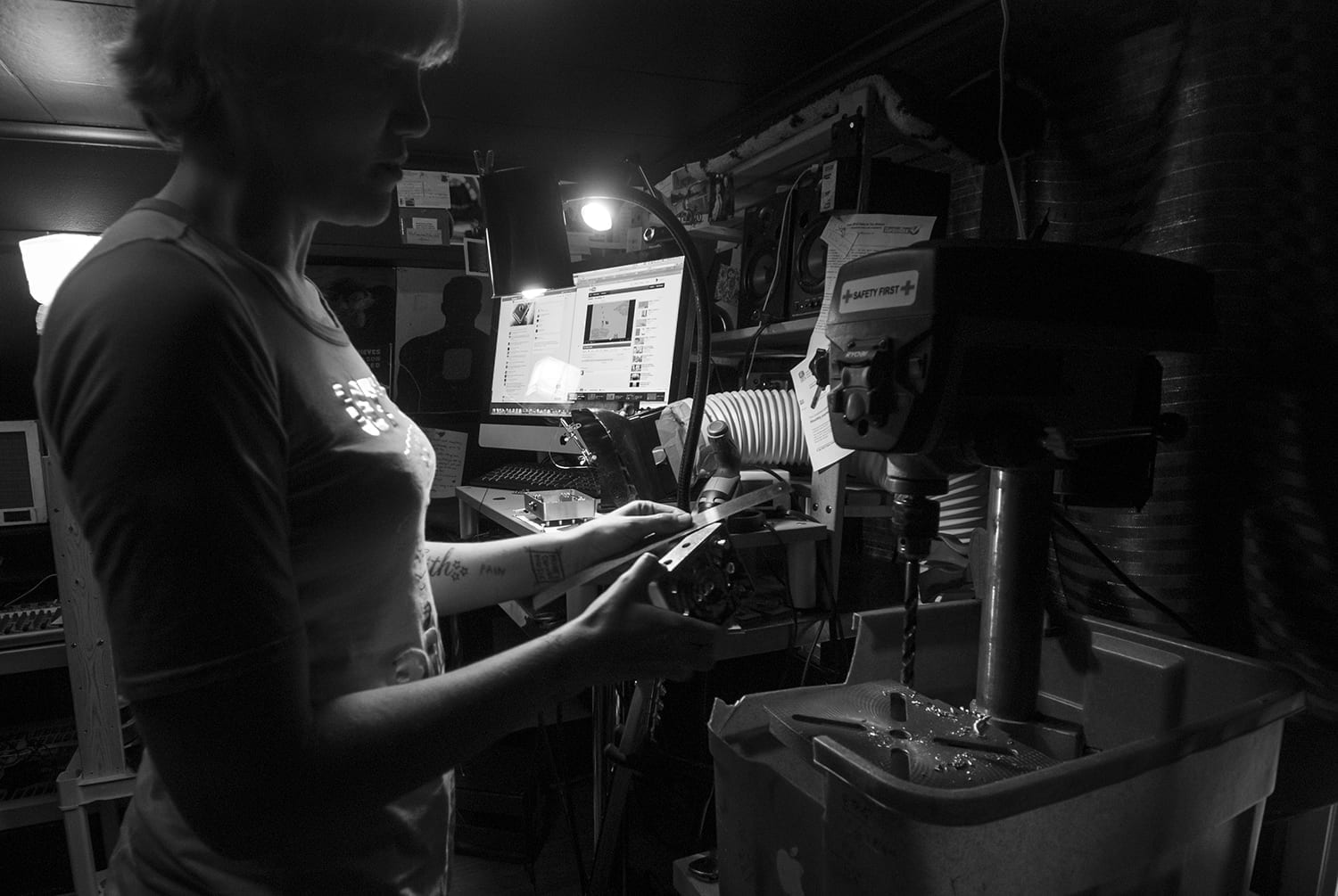
Ever’s unassuming Portland abode destroys the fiction of rock legend. Her southwest Portland home looks like her pedals sound: messy, but intentionally so. The place wouldn’t make sense otherwise; walking around, you’re as likely to step on a tossed-aside guitar pedal as you are a half-open video game case or a bra. Looking at the neat rows of stompboxes lined up in her workshop, and then looking at the music, game and pop culture ephemera gives one the sense that Ever puts more into her pedals than just circuit boards and hot solder.
Once upon a time, several big-name manufacturers dominated the guitar pedal scene. Large factory companies like Boss, Electro-Harmonix and MXR captured the market for pedalboards and didn’t let go until the turn of the 21st century. Over the years, boutique and individual pedal manufacturers worked in a vacuum, largely getting their information from opening up pedals and studying DIY tomes such as Craig Anderton’s “Do-It-Yourself” series. When the proliferation of Internet forums gave previously isolated pedal tinkerers a place to share information, independent manufacturers stepped up their production and quality. And this is where Devi Ever stepped in.
“I thought it would be cool to archive all of the guitar pedals,” Ever says, sitting in her workshop that doubles as a physical archive of her pedals. “Advertising wasn’t going so well and I realized I could build them pretty easily.” Her incessant tinkering produced the first Devi Ever stompbox: the Crackle Fuzz. “I was trying to make a transistor do things — the most basic form of that is a boost, but I couldn’t really get the boost to work right. I didn’t really understand the math behind everything — this was back in the day before there were big online DIY resources. So I just started plugging things into a breadboard until it made sound.”
Ever reveals a small stompbox with her signature hyper-slick video game-inspired designs. “This is actually number one. Someone sold it back to me.” The pedal looks remarkably fully realized, bearing all of the hallmarks of her visual panache. The only difference between the Crackle Fuzz and the stacks of current models lying in various states of assembly around her workshop is the sound: monstrous, rooted in a classical tone yet more menacing than anything born of the hippie generation. Before placing the pedal back among the stacks, Ever gives it one last once-over. “This is my beginning.”
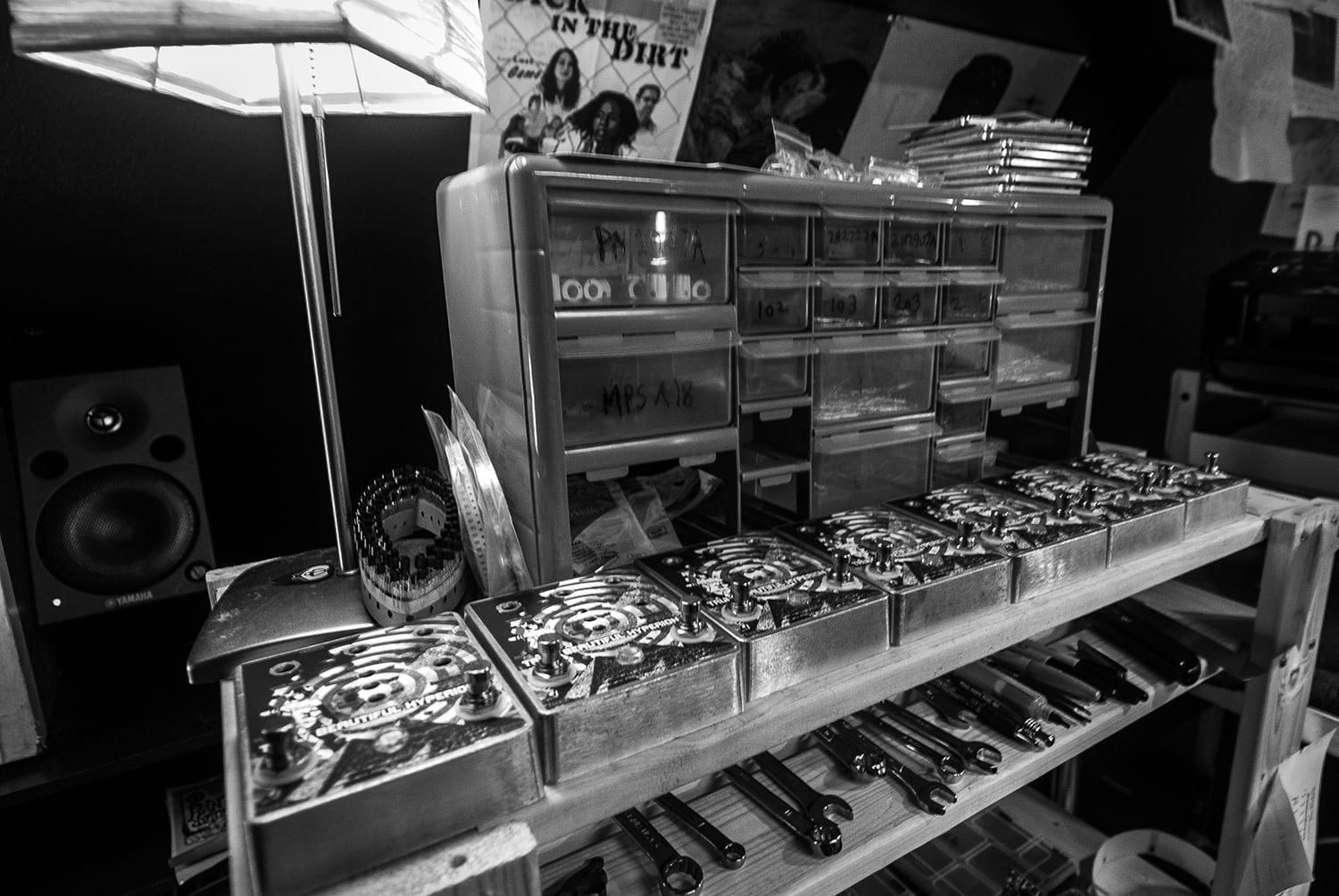
To open a fuzz pedal is to peer into one of the primitive elements of rock ’n’ roll. Early on, fuzz was an accident — the byproduct of bad circuitry literally chopping the guitar’s waveform in half. Fuzz is one of the first true artificial sounds; woodwinds, strings, and other acoustic instruments capitalize on phenomena audible, to various degrees, in nature. Fuzz is a completely human conception.
Early rock ’n’ roll capitalized on the aggressive sound of these electrical mishaps. After a few musicians captured the fuzzed-out sound of a faulty bass amp on a hit recording, engineers started attempting to replicate the circuitry that made the racket. Forty years of fuzz history has yielded only a handful of iconic pedals, and perhaps the most iconic is the Big Muff. The pedal — named for its hallowed muffled sound — defined the style of countless guitar players from its creation in the late ’60s. “There’s something about the tone control,” Ever explains, placing her hands out in front of her as if reaching out to something much larger than a guitar pedal. “At a certain position it’s so smooth.”
Ever admits that her sound has evolved linearly, over slow increments straight ahead, rather than in all directions at once. “People criticize me because my pedals are small tweaks of the same circuit over and over again,” says Ever. “My designs tend to happen in an echo chamber of their own. The Year of the Rat [pedal] is quite different from the original Soda Meiser, so what happens is I make these small tweaks that make larger tweaks.” Her variations-on-a-theme design (most of her pedals use the same set of transistors and circuit boards, and some pedals are just one solder different) allows her to produce custom-tailored pedals, which have put her in touch with some stars of sonic tailoring — UNKLE, for one — but also brought her into a disastrous series of correspondences with her one-time idol, Billy Corgan.
Ever is candid with her love (or ex-love, rather) of Corgan’s band, the Smashing Pumpkins. “[Pumpkins album] ‘Siamese Dream’ is probably the one thing that has influenced everything I’ve done in terms of tone,” she notes, musing particularly on a sound from its seventh track, “Soma.” “Amongst all the fuzz, all of the delay, you hear that one highest note echo out for that one moment. It’s taken me probably a decade to realize how he got that sound.”
But in mid-2011, a possible collaboration between Ever and Corgan on a pedal went spectacularly south. Corgan dropped hints on his Facebook account about wanting a custom-tailored pedal from Ever, who took the hints as a challenge and sent him one she created. Ever says that Corgan never responded to her offering, prompting her to vent angrily on a Pumpkins message board. In turn, Corgan issued a series of transphobic tweets and Facebook posts (which he subsequently deleted) that referred to Ever as “he/she” and “an ugly pig.”
Ever responded to his attacks with a YouTube video documenting how Corgan’s words hurt her. “I have no problem saying this out loud, because I’m not saying he’s a swindler or a bad business person — he just literally said some fucked up, bigoted things.”
While the events may have ruined Corgan’s music for her, Ever doesn’t seem to be saddened over her new status as non-fan of the Smashing Pumpkins. She has bigger things to look forward to. Her latest project is the Console, a sort of plug-and-play pedal system with a double-size guitar pedal acting as a port for any number of interchangeable effects cartridges. Instead of paying for boutique or vintage pedals that go for a few hundred dollars a pop, Ever envisions players buying a Console and having an infinitely upgradable multi-effect pedal. The Console works almost like a great equalizer for pedals; no longer do users have to pine for $400 hand-built pedals and settle for cheap software emulation pedals. “There should be cheaper versions available, so that people can play with [real pedals],” she says. “Not models, actual circuits!”
Not only will the Console be a platform for unifying guitar players’ pedalboards, but Ever sees it as great tool for innovation: “I don’t want to be bogged down by the process [of creating].” The Console is a step toward inclusion for the pedal community, democratizing the manufacturing process so that pedal makers can cheaply get their pedals into players’ rigs. Rather than hoarding her fan base and capitalizing on their desires, Devi Ever wants to open up the process so the best pedal makers can reach an audience, translating into a better end result for all. This sort of inclusive stance stands out in a business dominated by just a few manufacturers and gives Ever a sense of excitement about the future. Slowly, but surely, Devi Ever is opening up the pedal market for anyone with a curious eye and a soldering iron.