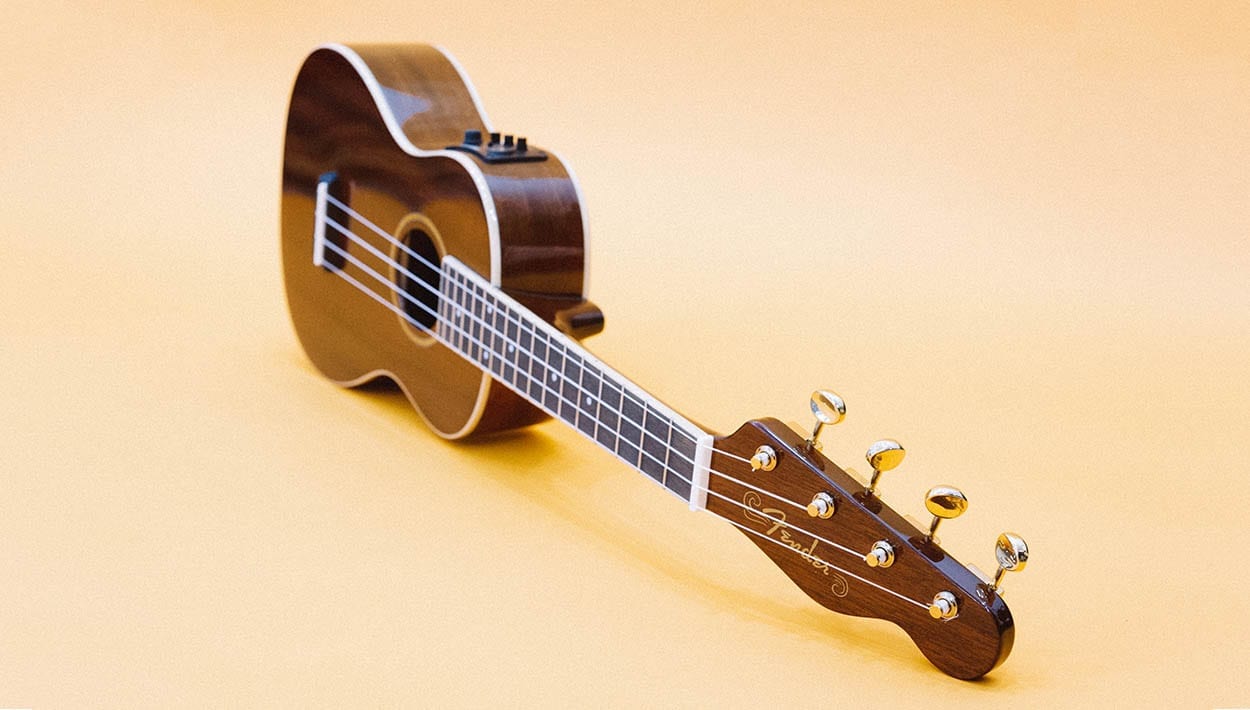
Get to Know the Grace VanderWaal Signature Fender Ukulele
The Grace VanderWaal Signature Fender Ukulele gives an honest and even tone, rich of sound and history.
From hometown coffee shops as a pre-teen directly to one of America’s largest stages on television, Grace VanderWaal’s story is one decidedly outlined by modern standards. She won the 2016 season of America’s Got Talent at just 12 years old and has gracefully parlayed it’s $1,000,000 prize into a record deal with Columbia and millions of online followers. She is now the youngest signature artist in Fender’s 72-year history and has used her new platform to advocate for better music education in schools through her Little Miracles Show Choir program and for women in general within the music industry.

The Look and Feel, and Sound
Her signature ukulele features Sapele wood top, back, and sides with a Nato wood neck and dyed Walnut fretboard. The concert-sized body uses fan bracing and a high gloss Dark Walnut finish. At first glance, the VanderWaal signature model appears effortlessly elegant, particularly for an instrument born out of a teenager’s design. Its overall presentation was left relatively unembellished and has only a few striking ornaments to highlight the juxtaposition of old and new. The use of Sapele wood for the body is reminiscent of Martin’s exemplary Mahogany ukuleles from the 1920s-1940s, while the gold sparkle sound hole rosette and gold colored hardware are modern but tasteful accents.
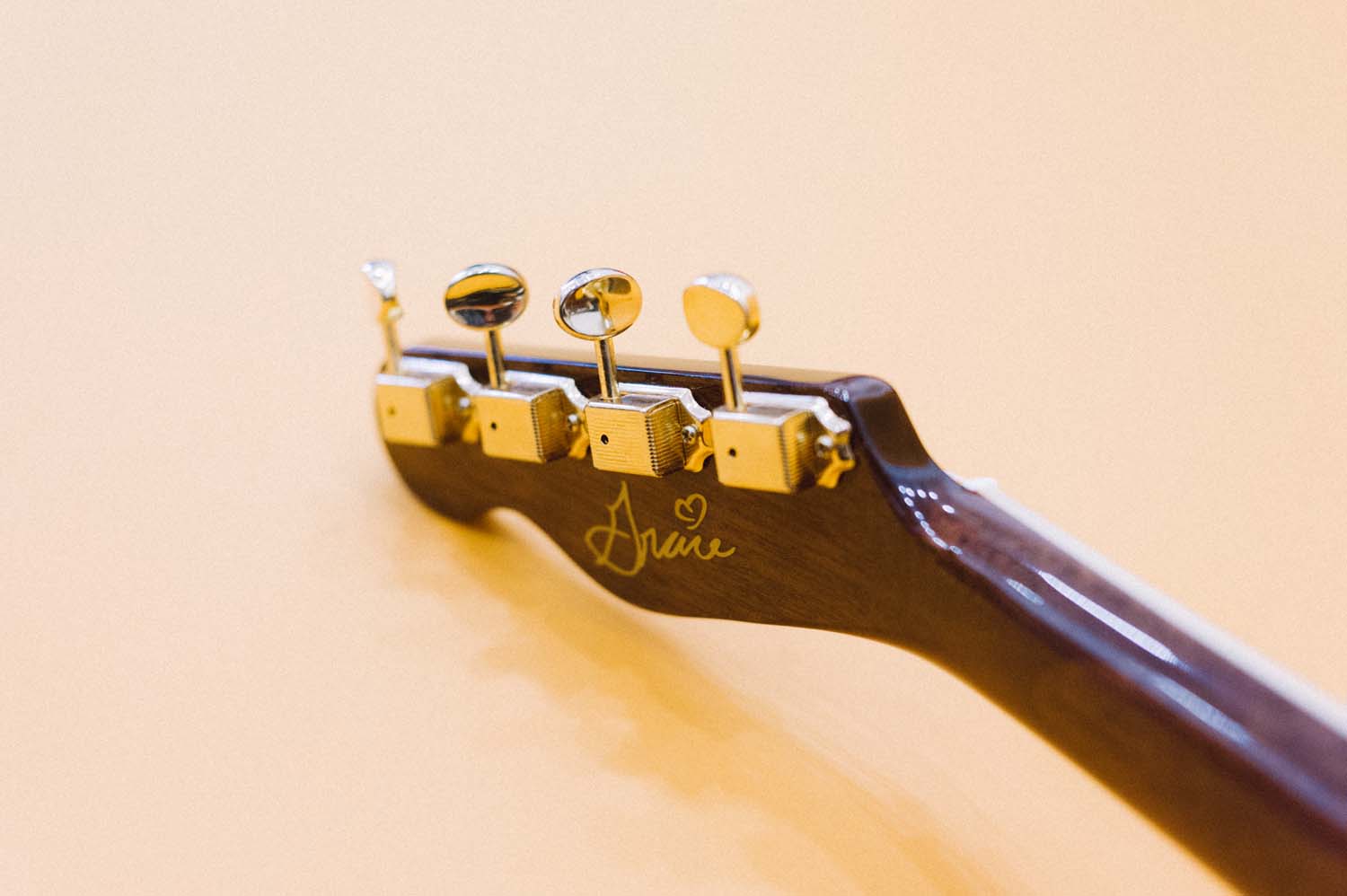
The unusual inclusion of Fender’s iconic Telecaster headstock shape serves both aesthetic and stability purposes. Unlike the angled headstocks typically found on two-per-side ukulele headstocks (which are commonly connected via a scarf or diamond joint and thus, unfortunately, act as a precarious point of weakness for the instrument), the straight and recessed nature of the six-in-line Fender headstock on the VanderWaal model will be durable for everyone from bedroom players to touring musicians. Gold Kluson-style tuners beautifully round out the instrument’s homage to vintage Fender guitars but seem to have the wrong tuning ratio for the job. They did not respond to minute tuning adjustments as effectively as players might hope and one might question their hardiness after many months of use. When considering the high standard of quality on the rest of instrument, however, perhaps the tuning gears can ultimately be overlooked or eventually replaced.

Much of the ukulele’s tonal characteristics are derived from the all Sapele construction. Sapele is usually employed as a substitute for genuine Mahogany because it shares the same dark color and warm tone. While Sapele instruments might lack the distinct high-end sparkle of a Spruce-top, the Sapele used in the VanderWaal signature model has a deep and rich sound perfectly fit to accompany the vocal range of most women singer-songwriters.
Accessibility Within Shape and Size
Just like the violin family, ukuleles come in a varying spectrum of sizes. If island music was your first introduction to the ukulele as an instrument, your sonic memories most likely include the sweet and high-pitched tones of a soprano. But the small size is often a deterring factor for budding players. The decision to make this signature ukulele a concert size is a welcomed one – it will be equally comfortable to fret and to hold for musicians of all ages and even musicians transitioning to the ukulele from larger instruments. This broad accessibility may attract buyers who might not have considered purchasing a soprano or tenor model in its place.
Built For The Stage
In promotional material, Grace explains that making her signature model immediately “stage ready” was a top priority and Fender certainly came through on this promise. Even though nylon strings notoriously require additional time to break-in and settle before they consistently stay in tune, this instrument was favorably set up straight out of the box. The neck’s flat radius was well matched with both the height of the saddle and the height of the bone nut, making fretting in first position just as easy as fretting towards the body. The Fishman Kula pickup system was also surprisingly balanced across its entire frequency range and required only minor adjustments when amplified through an acoustic amp or PA system. It is unfortunate (but true) that the proprietary electronics included on inexpensive acoustic-electronics instruments are usually their most inept features. The under-saddle piezo on the VanderWaal signature sounded both honest and even—an accurate representation of its acoustic tone, particularly for its price point that begins at $99.99. With an onboard tuner and classic three-band EQ located directly on the ukulele’s preamp, the instrument is undoubtedly worthy of its “stage ready” description and perfect for players of all ukulele skill sets.

Grace VanderWaal herself is living proof that there are countless paths to stardom and success in today’s music landscape. Although her rise to fame was dotted with chance encounters and television production crews, her hard work and innate talent have certainly carried her the rest of the way. As Fender’s youngest signature artist in history, VanderWaal is a symbol that women musicians and women consumers are finally beginning to garner their fair share of acknowledgement within the industry. Women’s voices can now be heard in nearly 50% of all new guitar sales and the Grace VanderWaal signature ukulele tells us that Fender, at least, is indeed listening.


More posts
-
 By: Cynthia Schemmer
 -
Powered By: Fender
-
By: Cynthia Schemmer
-
By: Cynthia Schemmer
-
By: Leila Sidi
-
By: Leila Sidi
-
Powered By: Reverb
-
Powered By: Marshall Amps
-
Powered By: Positive Grid
-
By: She Shreds







Comments
Thanks for the thoughtful review – I’ve been thinking about getting one and your remarks helped me decide! I also love the idea of supporting Grace.
Comment by Iammy on November 30, 2018 at 2:21 pmI have had the GVW Signature uke for about 2 months, now. I agree with this article. Just like it pointed out,the tuners are its only real weakness. Other than that the tone, quality and looks are great. I would also add that it comes with a beautiful dark blue gig bag, (easily worth $40+ ), with Grace’s heart signature embroidered on the front zippered pocket.
Comment by Tyron on November 30, 2018 at 2:43 pmGrace is genius. And I love the looks of this instrument.
Comment by Bruce Macintyre on November 30, 2018 at 3:06 pmOh, just wanted to add that the gold sparkle sound hole rosette looks 3-D in real life and pays homage to the gold confetti that was dropped when Grace got the Golden Buzzer from Howie Mandel.
Comment by Tyron on November 30, 2018 at 5:58 pmHomage to gold confetti? No link to this information anywhere. I call B.S.!!
Comment by FakeNews on December 17, 2018 at 6:33 pmBeing a beginner ukulele player I find the fingering & barre quite pleasant on her signature concert. Have achieved some usable strumming patterns and find switching from (hard for me) cords like E to B7 or D7 to Am7 much easier than on other Ukes. Tuning does not seem that bad, but do occasionally have to go way off pitch to then come back to a more stable in-tune setting. I rate Grace’s concert as a real value .
Comment by Philip McNeill on November 30, 2018 at 10:39 pmI sat with Mr Fender and Jimmy Messina in 1986 in carpinteria as we produced a song written by : Suzan Webb (,Jimmy Webb’s sister ) the studio recording of her song entitled
” too much”
Mr. Fender was very personable kind and witty inspired me become a better more productive person.
Comment by mitchsartbusiness@gmail.com on January 3, 2021 at 9:10 pmI sat with Mr Fender and Jimmy Messina in 1986 in carpinteria as we produced a song written by : Suzan Webb (,Jimmy Webb’s sister ) the studio recording of her song entitled
” too much”
Mr. Fender was very personable kind and witty inspired me become a better more productive person.
Comment by Mitchell Jay Goldstein on January 3, 2021 at 9:12 pm