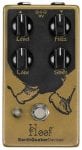
 Earthquaker Hoof Fuzz Pedal: I love Earthquaker and I visited their offices in Akron, Ohio last time I was on tour. This is one of the pedals I tried while I was there and it’s been on my gear wish list ever since. I’m a fan of this fuzz on a bass.
“I play through two guitar amps, and I have them set up through a YBA pedal so they both run at the same time,” she said. “Our nerves were already there because it was our first show with them. The sound check was all good, we went on stage, everything is good and then part way through the first or second song I heard a huge drop in the levels from my monitor and I’m just like, “Oh, shit! What’s going on?” In a lot of my songs I’m constantly singing, so there isn’t time to take a second to look around and see if something got unplugged or what happened. [This time] it turned out one of the amps just totally blew.”
If you’ve ever performed in a band, you know that you can be as prepared as possible and life can still get in the way of a perfect set. When that happens, you have two choices: you can totally freak out, or you can roll with the punches as they come until you find a solution. In this instance, the band, which has been around since 2010 and has seen their share of stage mishaps (their own and others), played through the song and thankfully the venue’s sound person was on their game to help out. “At that point, you have to put a lot of trust in whoever is doing sound in the front of house because if they don’t notice that something is happen, they’re not going to be able to remedy the situation. It’s happened to me a couple of times. Running two guitar amps, one of them will go, and the front-of-house person will notice and just double up on my other amp and fill the sound. Because there is nothing you can do, right? You have 30 minutes to play a set and you don’t have time to really do much troubleshooting on stage. You just have to wait until it is over and figure out what went wrong after the show, and hopefully get it fixed before the next one.”
Mobina Galore is currently on their own tour of North America, in support of their recently-released LP, Feeling Disconnected (New Damage Records), and once again they’ve found themselves facing technical difficulties. “My amp head just blew the other day and I’ve been borrowing gear from other people,” she said. “It’s pretty annoying because you get used to your own sound and the tones coming from your amps, specifically, but at the same time it forces you to manage and make it work, and it’s been alright for the last few shows. I’ve been able to borrow an additional amp from one of the other bands and just make it work because there’s always something that goes wrong.”
With that in mind, Priestner shared some tips for troubleshooting or lessening the impact of unexpected gear issues while on the road. Feeling Disconnected is available for purchase now.
Stay Calm: To stay calm, I usually touch base with my drummer [Marcia Hanson]. We both usually know if something has gone wrong, if one of us has messed up, or a guitar gets unplugged or a cymbal falls over. We touch base with each other and give a quick glance that says, “Don’t worry about it. Don’t let it stress you out.” Make that eye contact with your bandmates to make sure they know it’s all good, you can get through this, and it’s not a big deal. You need that support and you need to be able to communicate without actually communicating.
To Err is Human: When you see a show and you see the band bickering on stage, it’s the worst. You have to stay positive and laugh it off, or it gets worse. That’s the thing about live music. Something is going to go wrong at some point, and you need to remember that you are just a human and you are playing music live. Just wait until the song is over, find out what is wrong, and try to fix it. Sometimes I’m jumping around and I’ll unplug one of my cables. If people are engaged and they are watching me, they’ll see exactly what happen and they’ll say, “Oh my god, that was funny!” When people mess up, it just makes everyone human. It’s about staying calm and knowing if you look nervous or freak out about it, the audience is going to see that and then they are going to be wary of you throughout the show. So stay calm and laugh it off.
Find Support Offstage and in the Crowd: Onstage, you’re relying on stagehands, or people in the audience depending on the venue you are playing. It’s a constant thing for us that the mic stands are really crappy and worn out, and they’ll slowly start falling. If someone out there in the audience happens to be a musician, they’ll hop on stage and help you out. I do that all the time when I see bands play. That’s the thing—just getting the crowd engaged in the show so they really want to be part of it. When they want to be part of the solution it’s really awesome. Everyone wants to be on stage, so if some kid gets to jump up and save the day they kind of feel like a hero, and it makes everyone else in the audience feel more like they are a part of the show.
Be Organized: I do a lot of band management stuff and I am a very organized person. That’s important because if you don’t have an actual manager you need someone in the band who will take over those duties… I’ve got a dropbox folder, “Mobina Galore promo,” that I update every year with our band bio, stage plot, band photos, everything that a promoter or an agent or a sound tech needs so when we’re on the road we’re not scrambling to pull over and find wifi to shoot a press photo to someone. We have a link we can send them to instead.
It’s about managing your time well. If people ask I can say, “Go to our website and you will find everything you need on there.” I always carry hard copies on me as well. We just have a bag we carry around to shows and stuff with paper copies just in case. It’s kind of being overly prepared for something going wrong and having a preventative measure for something in place to hopefully solve the problem quicker than being, “Oh my god, what do we do?” Putting stuff like that up on your website is so easy to do, but a lot of people are lazy, or don’t think it’s important at all. If I was running a venue and I saw that, I’d think, “This is great! I don’t have to email them for anything.”
Do Your Research (which includes playing more shows!): When you start out, everything’s a learning curve. When I was just starting out I was Googling things like, “What’s a stage plot?” “What’s an input list?” and stuff like that. For an artist who is starting out, it takes a while to find out all the assets that you need, but once you start learning, it starts being easier for you. And knowing what exactly what you want to hear on stage is a matter of playing more shows. The only way you’re going to learn it is to keep playing shows. Every stage is different. An outdoor show is going to sound different than a smaller club. Some places have crappy monitors, and even though you know what you want you might not get it in your sound. The only way to get what you want is to play more shows, to ask properly, and to not be an ass on stage. So many people you see playing shows and saying, “I can’t hear myself.” All you have to say is “can I get more vocals in my monitor?” Just be polite. Everyone there is doing a job.
Cultivate a Strong Social Media Network: Social media makes it is so easy to reach out to people. Like when my amp head blew the other day, initially you would panic a little bit, but now you can look at your schedule and post, “Hey, does anyone in Milwaukee know a good amp repair shop?” It takes a while to get your friend list growing, but I put a lot of stuff out on social media. “Do you have a guitar I can borrow at tonight’s show?” Guaranteed, like I said earlier, someone will want to be the hero. They’ll show up at the show with a guitar, you’ll put them on the guest list. Social media is huge! Just getting the word out there. Everyone wants to share and help out. We’ve even needed to get people to run our merch at the Against Me! shows, and we just reached out on Facebook. Friends of friends of friends will just want to help out. It’s pretty cool. There is a lot of garbage on social media, but if you use it to your advantage then it is super beneficial.
Born in Cameroon, where she first developed her love of music, Tamko and her family relocated to New York when she a teenager. A few years later, as a student pursuing a degree in engineering, she began performing around town and little by little, came to think of her art as more than a hobby. Her first EP, the lo-fi, guitar-and-vocal-driven Persian Garden, was released by Miscreant Records the fall of 2014.
This week, Tamko will release her first full-length LP, Infinite Worlds. Recorded and co-produced with engineer Chris Daly (Diet Cig, Porches) at Salvation Recording Co. in New Paltz, NY in early 2016, the album contains a dynamic mix of upbeat indie rock, minimalist electronics, samples, and introspective fingerpicked guitar-driven ballads that together leave the listener guessing (but eagerly anticipating) what sounds will come next.
Though Tamko brought in studio musicians and guest vocalists for certain parts, the bulk of the tracks on Infinite Worlds—guitars, synths, drums, keys, and of course, vocals—are hers alone. In the past, she primarily wrote music on her guitar and added additional layers from there, but the more she’s gained access to different instruments, the more her creativity has been opened up in new ways. “I think my songs starting out as “folk songs” applies to this first record, Infinite Worlds, and that has derailed from that with newer material i’m toying with. A lot of that boils down to resources and access. The only instrument I had until very recently was a guitar so all my songs were written with it. These days I’ve been writing on bass more than guitar,” she says.
Tamko’s fiercely independent approach to recording that stems in part from her experiences performing solo locally and on the road, using three instruments and a sampler to create a fuller sound. “Touring alone allows me to think of different arrangements for my songs and how to keep them new for myself as well as the audience, especially if there are people who have seen me perform multiple times on tours and are familiar with the song. It’s always fun to rearrange and add dynamics to allow a fresh perspective,” she says.
Upon the release of Infinite Worlds, we asked Tamko to share some of the equipment that helps her create her sound. The album is available for preorder now, and will be released 2/24 by Father/Daughter Records.
Earthquaker Hoof Fuzz Pedal: I love Earthquaker and I visited their offices in Akron, Ohio last time I was on tour. This is one of the pedals I tried while I was there and it’s been on my gear wish list ever since. I’m a fan of this fuzz on a bass.
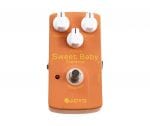 Joyo’s Sweet Baby Pedal: A super cheap low-gain overdrive pedal that I can’t play without.
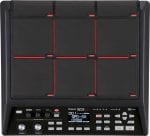 Roland SPD-SX: Across the board, the best drum sampler!
Logic Pro 8: I can’t get myself to update. [I use] Logic Pro 8 for all my beat making needs and my overall recording needs.
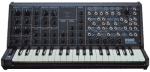 KORG MS-20 Analog Synthesizer: I get my favorite bass synth sounds from this synth.
Beatbox Drums by Beatbox Drums
In a touring vehicle, drums generally take up the most space. Even without drum cases, if you play a decent sized kit, drums are going to dominate the space in your touring vehicle. This product is a drum kit that fits into a box. This is all possible because the box itself doubles as a resonator. It would definitely look unconventional onstage, but big ups to anyone making moves on economizing the amount of space that gear takes up. Playing Tetris with musical equipment every night does indeed get old. Leah Wellbaum / Slothrust
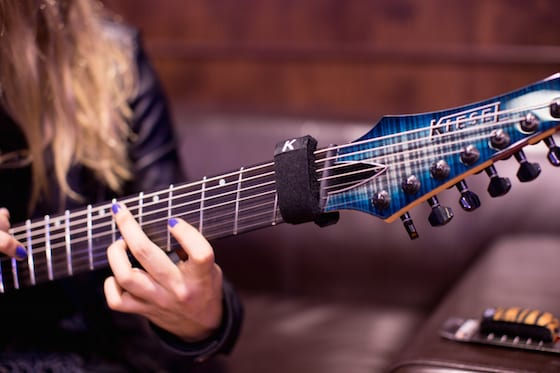
Fretwrap by Gruv Gear
This little accessory is great for muting the strings while you do tapping and also in a recording context when you what to avoid unwanted resonance and noise from the strings you are not using. -Laura Klinkert
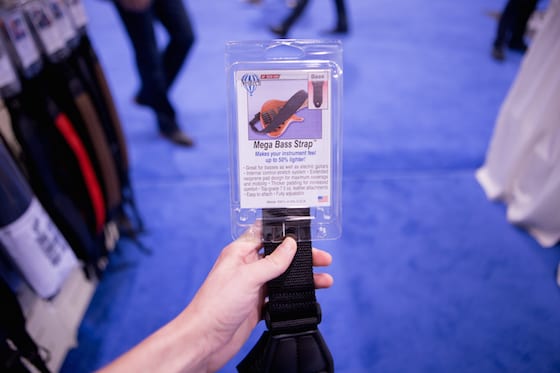
Mega Bass Strap by Neotech
This memory foam guitar and bass strap is the perfect thing for someone who gigs a lot, but also suffers from back problems. The internal-control stretch system reduces the weight of the guitar on your shoulders by up to 50%. The people working their booth even had a complicated scale / pressure measuring machine to prove it. It is also more adjustable than straps I have encountered in the past, and caters to people who like to play their guitars higher up. -LW
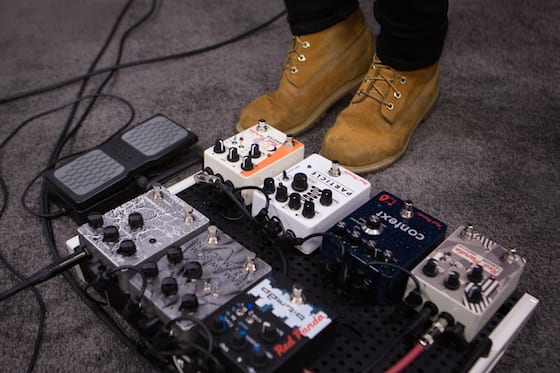
The Particle by Red Panda
The Particle pedal by Red Panda is a granular delay and pitch shifting pedal with a ton of other things going on. Depending on the settings, this pedal can be well controlled, or incredibly unpredictable. Sonically, I do not know its limits. It can sound like a video game underwater, like a creature about to attack you in the forest, or like a fairy flying toward you, about to kiss your nose. And of course, it is capable of the psychedelic flip-it and reverse-it madness you might imagine. -LW
The Squaver by Sonicsmith
As someone who does not venture far from stringed instruments, it is rare that a synthesizer would catch my attention, but Sonicsmith’s new device definitely had me excited. The Squaver P1 is a semi-modular, audio controlled, analog synthesizer. It turns any audio input (vocals, guitar, bass, you name it!) into analog synth waves. It allows you to mix between square and sawtooth waves. It has the capability of extracting envelope, pitch, and trigger CV from the input audio. The possibilities seem endless with this synth, and it definitely seems like a groundbreaking product in its realm. Go get weird with the Squaver P1 for $730. –Laurence Vidal
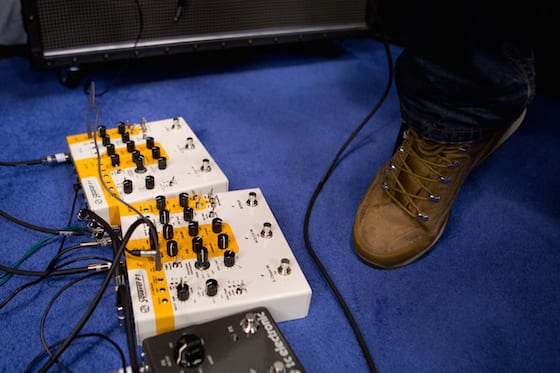
Tempest Analog Drum Machine by Dave Smith
This drum machine has one of the best quality sound I’ve ever heard, It’s easy to use and super easy for editing the inbuilt sounds in any context, studio or live. The building and the quality of the hardware seems to be really well done and resistant. You can get all of the most common techno and electro sounds out of it and way more by editing the inbuilt sounds. -LK
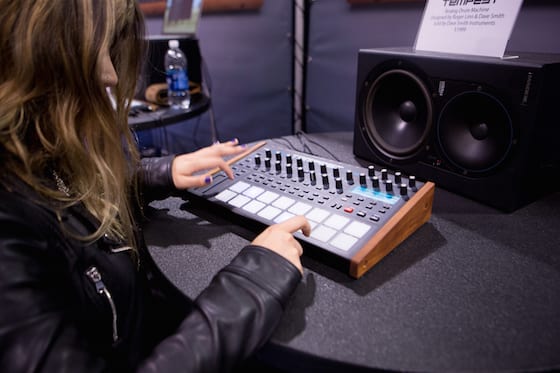
TriplePlay by Fishman
The Fishman TriplePlay is a wireless MIDI guitar controller. Whether or not this product is for you, it certainly demonstrates where we are at with music and technology. With the TriplePlay, you can select a variety of instrument plugins and play them via your guitar. It is an ambitious product that I think will evolve with time, and with the development of new plugins and latency solutions. To me, the TriplePlay almost feels like a prank. If you want to play a digital-sounding clarinet on your telecaster, welcome to it. -LW
Ultex Jazz 3 Guitar Picks by Jim Dunlop
This picks are sharp-pointed and also 2.0MM thick. This allows you to have a lot of control over the dynamics, rhythm, and intention. I recommend this picks for sweep picking players because since it’s super thick and sharp it will not blend at all when you sweep. Also, because of the material (ultex) I feel like it is not that bright as common picks and that it will keep it sharpness for longer. -LK
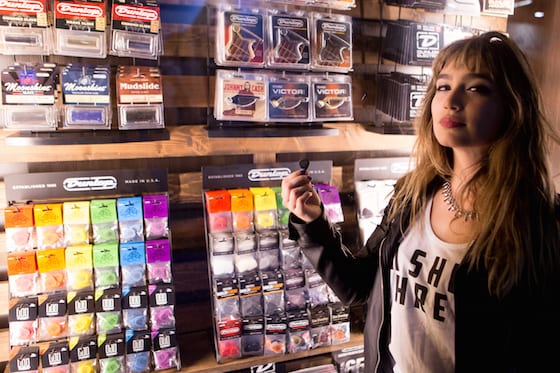
Paradigm Strings, which were introduced at NAMM last weekend and will be available for pre-order starting March 1, will be available in a variety of popular gauges for both electric and acoustic guitars. They promise to deliver the same, high-quality tone and feel as Ernie Ball’s iconic Slinkys but with the company’s proprietary Everlast nanotreatment, RPS (reinforced plain string) technology, and plasma treatment, they have been engineered to be more durable than other coated strings on the market.
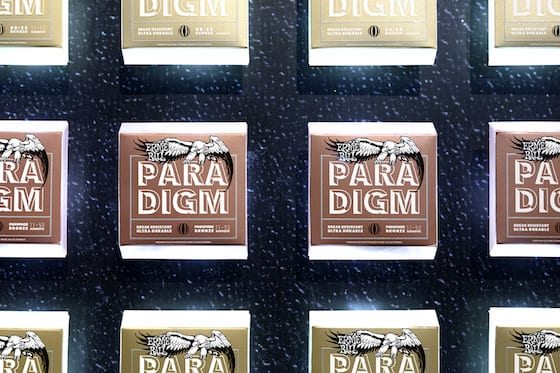 Paradigm display at NAMM, 2017 courtesy of Ernie Ball
Ernie Ball is so confident about their strength and durability that is offering a full refund to any consumer who experiences a broken or rusted string within 90 days of purchase—making them the only strings out there to come with a guarantee. Solid!
Stay tuned for more on Paradigm and our full NAMM coverage over the next couple of weeks!
Some guitar problems require professional attention, so it’s a good idea to develop a relationship with your local repair shop (they might even teach you some stuff!). Most of what I share in this column I’ve learned as a result of showing up to a shop and asking, on a whim, if they needed interns.
That said, some of the most common guitar annoyances are totally fixable at home. In this entry, we’ll tackle grounding and output jack problems, as well as how to solder. If you’re unfamiliar with guitar electronics, it might help to have read the last entry, which you can find in the last entry, here.
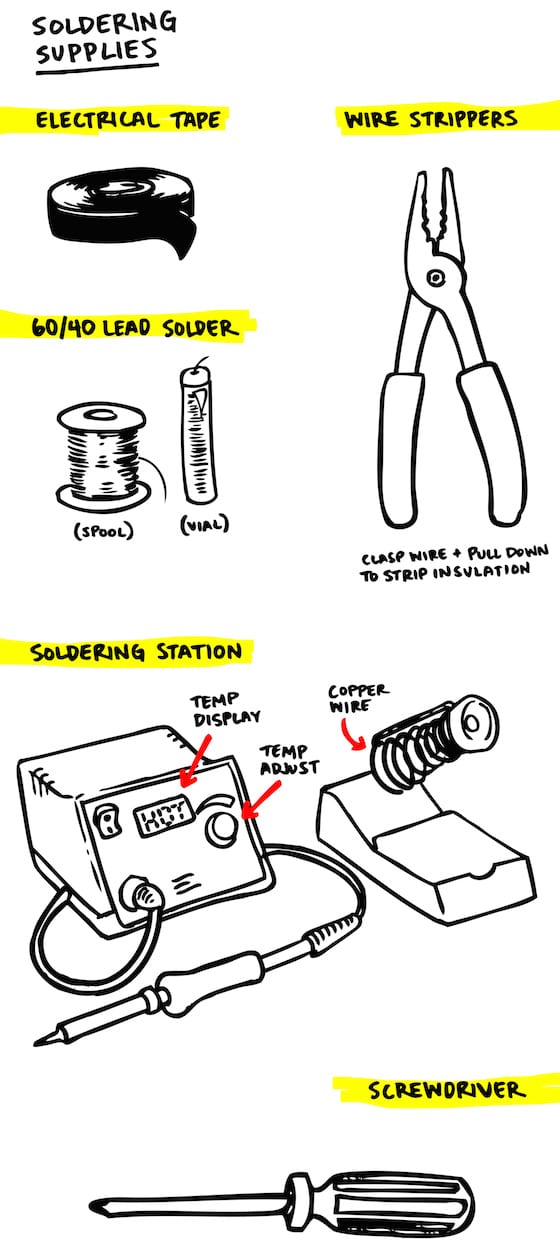
WHAT YOU’LL NEED
TROUBLESHOOTING
Nasty buzz? Check for a grounding problem.
If you have single coil pickups in your guitar, you’ll probably hear a quiet humming when you’re plugged in, turned up, and not touching the strings. (This is the noise that humbuckers were designed to stop, by the way.) Sometimes, though, if your guitar electronics are not properly grounded, you’ll hear a distracting buzzing sound.
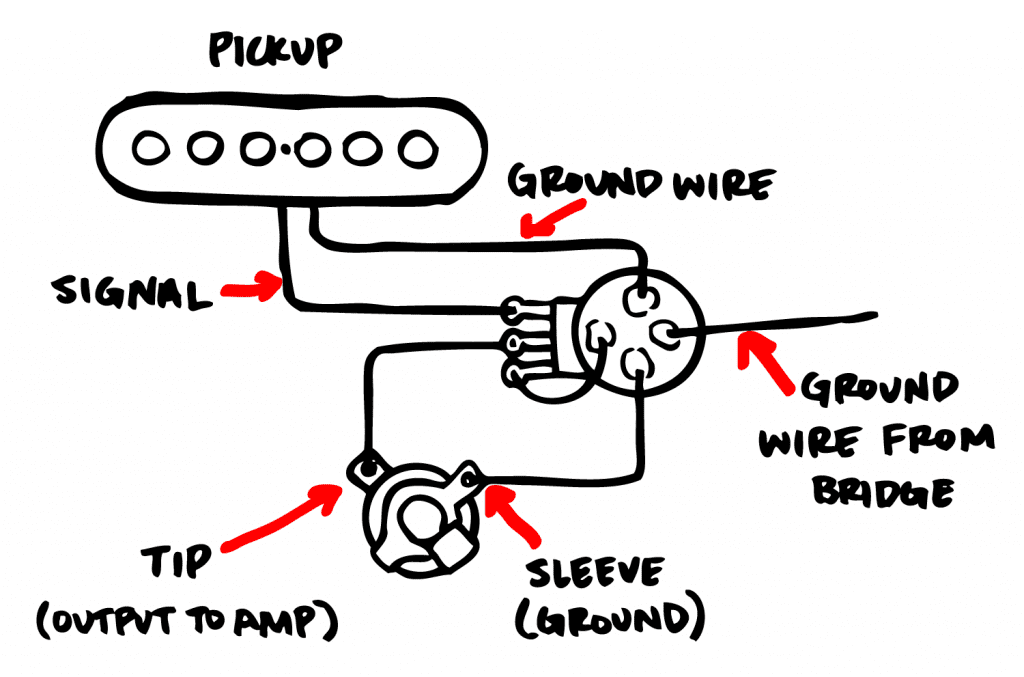
The diagram above illustrates something called “star grounding,” in which the back of the volume pot is used as a central grounding point for all the components in your guitar’s circuitry. This isn’t the only way to ground, but it’s a good one: it ensures that you won’t end up with more than one path to ground from the same point, keeping your signal as clean as possible.
INSPECT YOUR CONNECTIONS
Open up your guitar. One at a time, unscrew and lift up any plate that surrounds knobs and switches. There are solder joints, connecting wires to metal components of your guitar’s circuit, underneath all of these.
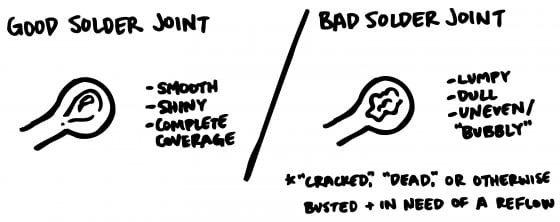
Look for the following “bad connections”:
HOW TO SOLDER
Here are some helpful tips for working with molten hot lead!
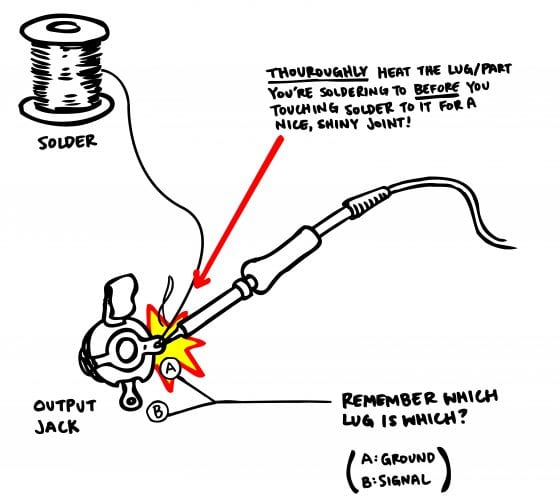
NOTE: It’s best to re-tin the tip before each application. There should also be something like brass coils in your soldering station for knocking any excess globs of solder off the iron’s tip. Also remember to be careful to avoid touching your iron to any point other than where you are making a solder joint. If you accidentally do burn some of your wires’ insulation, you can probably fix it with a bit of electrical tape.
REPAIR JACK CONNECTIONS
Signal cutting in and out completely when you know you’re cable’s good? Sometimes temporarily fixable by jostling the cable in the output jack? Sounds like a loose output jack connection.
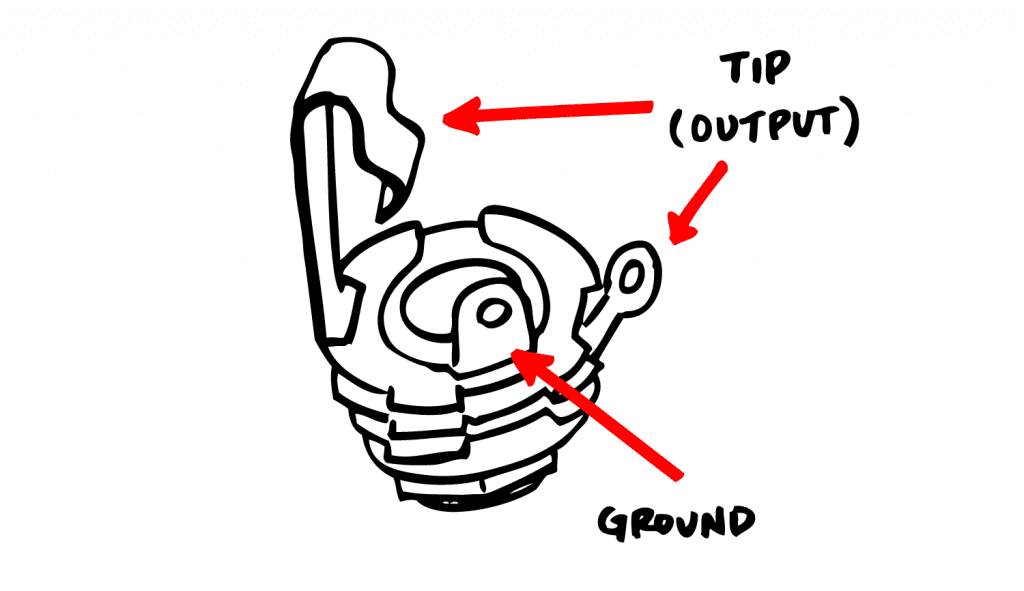
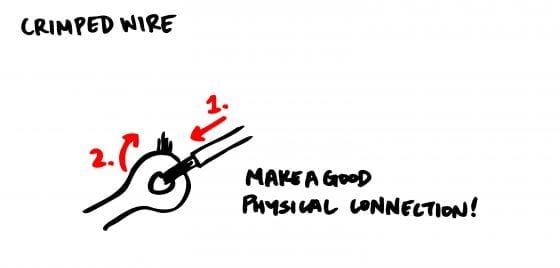
This is by no means meant to be a comprehensive guide to grounding or soldering. If these fixes don’t work for you, it could mean you missed a spot or made a bad solder joint, but it could also be a number of other things. For example, a guitar you buy used could have had previous repair work where the wiring wasn’t done properly. If you have to take your guitar to your local repair shop for professional work, so be it!
When you pick up your instrument, never hesitate to ask the repair technician to explain what they found, roughly how they fixed it, or if they have suggestions for you to keep the problem from happening again. If this stuff interests you, you can get good enough to do some of your own repairs pretty fast. Before you know it, your guitar (or guitars) will be in consistently great playing condition and you’ll be helping your friends with their fixes.
Have fun, learn stuff, be safe. Unplug your iron!
The professional-grade instrument series, which will debut at the NAMM conference on January 19, updates the sounds and style of Fender’s classics with modern features including a new neck profile, pickups, tuners, additional colors, and more.
The American Professional Series also adds a new Jazzmaster and new Jaguar to the Fender collection. Check out the full selection of instruments, and a video preview of the Professional Jazz Bass featuring Nik West, below:
For more information on the Fender American Professional Series, check out a Fender dealer near you, or if you’re able to, head over to NAMM next week!
The Arizona native is an incredibly versatile musician whose talent has brought her all over the world and work alongside Prince, the Eurythmics’ Dave Stewart, and hard rock shredder Orianthi, among others. She can switch gears from pop to R&B to jazz to on a dime (or combine them all), but above all the bassist is arguably best known for her hard-grooving funk stylings and energetic stage presence. Having shared the stage with the likes of Macy Gray, and Bootsy Collins, she is currently preparing to release a new solo album in spring, 2017.
West plays a number of Fender bass guitars, with varying numbers of strings. “When I am recording, it’s always a 4 string bass, and for the new school sound,my go to bass is my American Deluxe Jazz bass (now called the Elite bass) because it cuts through the mix very well. You get nice crispy slap tones and fingertone, or if I am going for more of an old school sound, a 60s [Fender] P bass.”
Live, she chooses her instrument based on which genre she is performing. “R&B/Gospel music really sounds great with a 5 string, while the funk is really best with a 4 string bass. I tend to lead toward jazz basses. For rock, I love the Dimension basses as the humbuckers really give me a growl with nice midtones,’ she said.
Despite her extensive knowledge of her instruments, West stresses that the gear itself is less important to her than the sounds she creates from it. “I actually don’t consider myself a gearhead, but I do love a great tone and that part has been very consistent throughout my career. I’m more of a naturalist… meaning I tend to love the natural sounds of my basses. If I can sit down and practice without an amp, just acoustically, and it feels good and sounds good I know that when I plug it in, it will be a great bass. Adding various pedals definitely add fun sounds but for me, different pedals expand my playing ideas. Certain pedals actually help me play differently on the bass,” she said.
With that in mind, West shared a few of her favorite pieces of gear and accessories that help her bring out her signature style on bass.
Neve 1073 Channel Amplifier
Universal Audio has some nice preamps and EQ Collections. The Neve 1073 is a mic pre that really gets a great vintage tone. It’s like you are recording in the 70s. That’s definitely something that says true funk… the 70s!!! It is really warm and the tones sound amazing.
Warwick LWA
I tend to love German engineering (and cars!). If I can plug my bass in and set the amp to flat and still get great tone, it only gets better when I decide I want to EQ it a bit. This particular amp sounds clean, crisp and you hear low ends and mids that are not muddy. Oh! You can plug in two basses and set two different tones and just switch to either channel without resetting anything.
Dunlop Super Bright Bass Strings
I call it the FUNK STRING! I never thought that strings matter so much when I first started playing. But, after trying different brands and gages, I could not have been more wrong! I play medium gauge and I change them on tour maybe every couple of weeks. For recording, I prefer they have some wear in them. It’s like having my own little compressor.
Spectra Comp Bass Compressor Pedal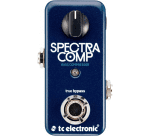
TC Electronic makes a great little compressor pedal that pretty much fits in your pocket. I loved it so much I had it installed onto my Nik West pedalboard (it has it’s own followers and fans… check it out on YouTube sometime!). Another great pedal was introduced to me by Bootsy…. That and the Baby Bass Wah are two of my favorite pedals to play with.
Gruv Gear Fretwraps String Muters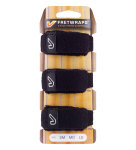
My last honorable mention would be these little fretwraps by Gruv Gear. They are a lifesaver for funk players or slap players. They are a brilliant replacement for the hair tie most bass players put on the bass to mute the strings as we play through fast and furious songs.
Here are eleven more classic pedals and under-the-radar gems that would make great gifts for you or any other tone freak in your life:
Crowther Hot Cake, $179.99. A nice bright overdrive with equally beautiful harmonics but a more distorted character than the Tube Screamer, the Hot Cake gives you a clean boost with only the Level knob in play, and great controlled feedback as you crank the drive and presence. Beloved of Nels Cline and members of Sonic Youth, it sounds pretty much perfect before the top boost of a Vox AC 30.
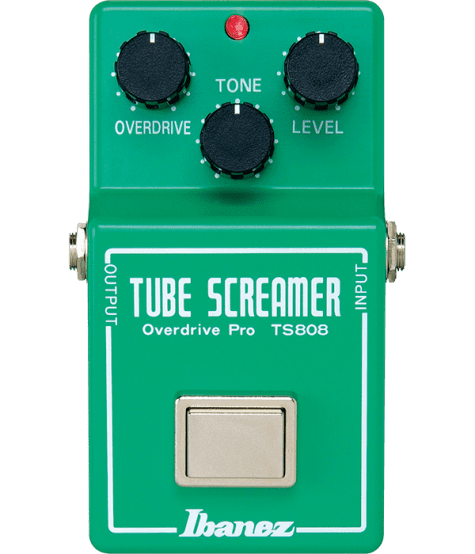
Ibanez Tube Screamer TS808, $179.99. See The Guide for more on this reissue of the classic pedal.
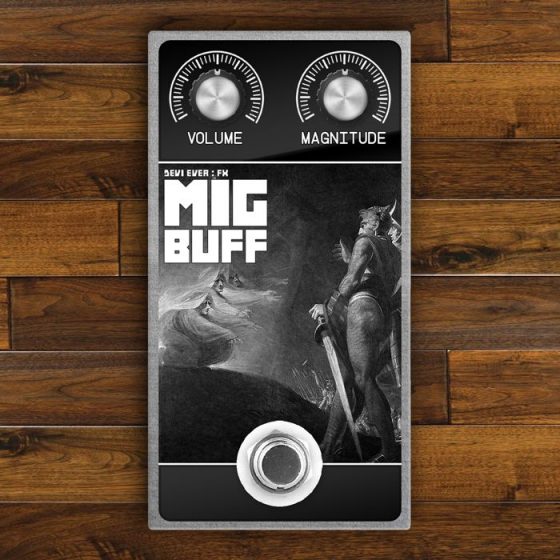
Fuzz Goddess Mig Buff, $85. So much more than a Muff-killer, the range of fuzzes available in the Mig Buff is best described by the Fuzz Goddess, Devi Ever, herself: “gated and woolly, traversing through the land of classic with character, settling into some scrambled octavia fun, and then ending with intense and biting power. I wouldn’t say this is the end all be all of my fuzz designs, but it’s close.” Added bonus: the name’s dig at the misogyny of pedal names like Big Muff. With a price tag of only $85, this one’s a no-brainer.
WMD Geiger Counter distortion, $299. Billed by WMD as a collection of “entirely new face melting sounds,” the Geiger Counter can serve up anything from beautiful, harmonically rich drive to “total madness (impossible amounts of gain, multiple octave foldover, harsh digital data errors, and piercing sculpted noise.)” It’s got Bit Depth and Sample Rate controls, Gain and Tone controls and a Tone Enable/Disable switch, Bit Depth control and a Bits/Mask switch. The Geiger Counter also features an extensive wave table control and display, which “takes your signal and destroys it with math” and always remembers your last setting. This is one for the distortion-obsessives who appreciate an envelope filter and love sputter and annihilation.
Frantone Cream Puff and Peach Fuzz, $295. The Cream Puff is adorable but ferocious. High gain with “full fat” harmonics, it’s perfect for thick rhythm playing. It’s freaking adorable (pink, with a “fluff” knob) but built like a tank and hand wired, like all of Fran’s creations. See The Guide for more on the Peach Fuzz.
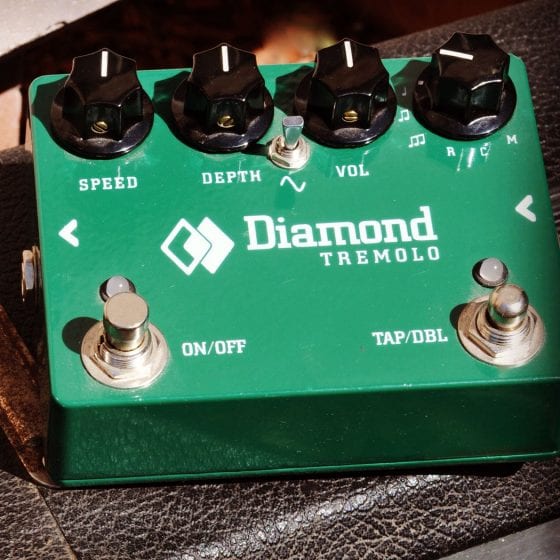
Diamond Tremolo, $239. An all analog tremolo that will comply to your every whim, Diamond’s TRM1 boasts a tap tempo with foot-switchable double speed mode, sharkfin, sine, square, and “chop” waveforms, timing accents, rhythmic trem mode, and “chaotic” mode for random speeds. You can get anything from a vintage amp trem sound with the sharkfin to a sputtering ring mod-like effect with “chop.”
DLS Versa Vibe, $259. Practically indestructible and with seemingly unlimited headroom, the all analog Versa Vibe yields gorgeous, dynamic chorus and vibrato effects. A Modern/Vintage switch lets you choose fatter or brighter tones in both the chorus and the vibrato setting. With waveform, bass throb, and wet-dry pots, you can dial in some really exciting vibes. Sounds great dirty or clean—particularly killer on fuzzed out, melodic leads.
Death by Audio Robot, $320. This one’s a lo-fi analog 8 bit pitch transposer/re-synthesizer which, according to DBA has “absolutely no feelings what-so-ever.” It’s hard to disagree: with four modes (Normal, Octave Down, Octave Up and Arpeggiator) this fucked up fuzz obediently serves up a variety of beautifully decimated tones with impressive precision.
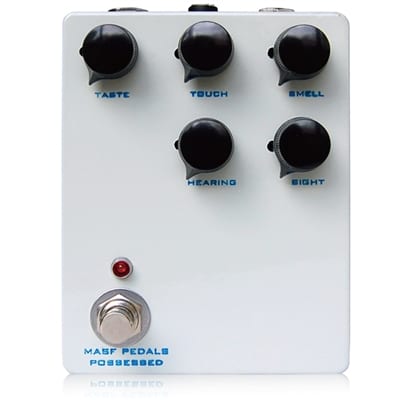
MASF Possessed, $269. If you’re a guitarist who loves the beautiful, glitchy sound of folktronica (The Books, Lucky Dragons, etc.) but also wouldn’t mind your guitar becoming an a laser gun with a mind of its own when you switch on the distortion, this is the pedal for you. This beautiful offering from MASF will truly possess you, bringing an ecstatic tear to your eye one moment and cracking your head open the next. Sturdy construction and an effortlessly cool, minimalistic design, to boot.
Mid-Fi Clari(not), $225. When you first get your hands on the Clari(not), you might audibly say, “what the hell is this?” From the Mid-Fi website: it’s “an Envelope controlled vibrato/chorus/wow and flutter simulator, with the ability to modulate over an octave.” Its controls are Delay, Depth, Blend and Tracking. It’s available in a 4-knob “Clean” or a 5-knob “Fuzz” version, which adds a volume knob. If you’ve scanned this entire guide, you can probably guess that the fuzz comes highly recommended. The Clari(not) will take your leads to a new level. It’s as much of a showstopper as the Versa Vibe: more wild and perhaps less versatile, but with a sharper bite and a cool, minimal design.
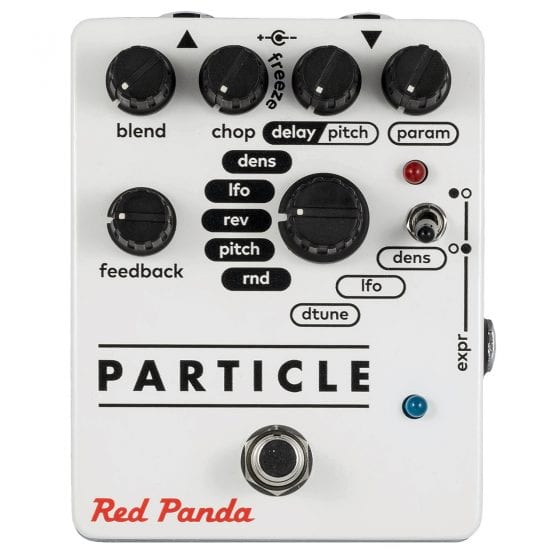
Red Panda Particle Granular Delay, $275. This may be a case of “Save-The-Best-For-Last.” Particle is a granular delay and a pitch shifter that chops up your signal and spits it back out, pitch shifted and delayed using granular synthesis. The “grains” are super short segments of the signal you feed Particle, and in return you can get back anything from shimmering echo clouds to stuttering glitch collages. This offering from Red Panda is so much more than a delay. Nor is it an all-or-nothing beauty vs. rage machine like the Possessed or an unapologetically uncontrollable beast like the Clari(not). Particle is a subtle machine with something for everybody.
Throughout the years you all have been asking us to suggest gear that we can’t live without. That, paired with so many new and improved tools that came out in 2016, made us realize that we needed to add a fourth release to our year. Unlike the rest of our print publications, The Guide will be a 100% free of charge bonus issue sent to She Shreds subscribers and available digitally to all. Written by locally respected and loved guitarists (full list below), the Guide includes artists from past issues and their gear as well as picks for the categories of Guitars (electric, acoustic and bass), Amps, Pedals, Accessories and Vintage; all of which are directed to pages that will provide more information on the product and purchasing options. Check it out below and happy shredding to all y’all shredders out there!
Designed by Eileen Tjan of Other Studio, The Guide features reviews by:
Miss Alex White (White Mystery)
Amanda Glasser (Purrer)
Claudia Meza (Explode Into Colors)
Devin Trainer (Club Night)
Glenn Van Dyke (BOYTOY)
Lance Seymour (Gear Talk)
Laurence Vidal (Tiburones)
Lena Simon (La Luz)
Randy Randal (No Age)
And She Shreds Founder and Editor-in-Chief Fabi Reyna
Thanks so much to Guitar Center, PRS Guitars and Ear Trumpet Lab for the
If you’d like to receieve a physical copy of The Guide, free or charge, please fill out the submission form below!
*USA only
Now in her mid-twenties, Loveless has solo four albums under her belt, starting with 2010’s The Only Man. On each one, she has drawn from influences across a spectrum of country, punk, classic pop/rock songwriters such as Stevie Nicks and Paul Westerberg, and has woven them together with her silky voice and naturally defiant attitude. “Vocals are always the most important aspect of [country and Americana music], and I consider my voice my main instrument. Of course, we have pedal steel but we tend to use that sparingly as more of a keyboard. I use my own guitarwork more minimally these days, creating atmosphere instead of a wall of power chords,” she says.
On her latest release, Real, (the making of which was highlighted in the Gorman Bechard documentary, Who is Lydia Loveless?), Loveless has taken her craft to the next level, baring her soul with straightforward, introspective lyrics while trading off between upbeat ballads (“Real”) barroom country/rock (“Midwestern Guys”) and lush, ambient-leaning pop (“Out on Love”). Since it came out on Bloodshot Records in August, it has received near-universal praise and has recently been ranked as a top album of the year by Rolling Stone, American Songwriter, and Stereogum.
When it comes to her gear, Loveless says her tastes and interests have evolved alongside her musical and and songwriting chops. “When I started out, I was 16 years old with an acoustic guitar, and that was all I had,” she says. “I didn’t even own a tuner, so a lot of my requirements have changed since then. It’s taken me a long time to get to experimenting. You can do a lot of cool stuff with a good pedal…I think experimenting is really the lifeblood of being a songwriter. Once you stop doing that, you’re just going to stagnate. It’s definitely important to play around and have fun with it.”
Loveless recently spoke to She Shreds about some of the gear that currently powers her songwriting, studio sessions, and performances. Real is available for purchase now.
Fe nder Telecaster: My Fender Telecaster is my BFF. When I was
younger, I started out playing bass. I was not super into guitars, but I started playing a Telecaster that wasn’t a real official one. I really liked the way that sounded, but I always had problems with it because it was one that someone built in their house. I bought my American Fender Telecaster four years ago and it’s kind of been my “old faithful.” It’s just really playable. That sounds kind of stupid, but it crunches up enough to the level that I need but you can get that twang sound out of it. I don’t really like a dull sounding guitar… I like brightness, and being able to bend or chunk along. It does whatever I need to. I kind of have a throwing and dropping things problem too, and Telecasters are really good for that. They’re really sturdy.

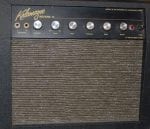 Kalamazoo Amplifier: [Mine has] got to be a 70s-era model. I’ve had to have it rebuilt multiple times, because it’s just not a touring amp. Tubes fall out of it, it’s rickety and it is tiny enough that someone could walk off with it pretty easily. It’s only got three knobs: tone, loudness (instead of volume it says loudness), and tremolo. For me, it breaks up really well, but it’s tiny so it breaks up quickly. It’s not like you have to turn it up to 11 to get a good tone out of it. That’s why it’s good in the studio—you can play around with that. You don’t need it to be as loud and blast everyone. The old rickety tremolo knob is also really fun to play with when I have PMS or whenever I get depressed and need to play sad songs. On tour I use a Fender Blues Junior, which is still a pretty small combo amp compared to what a lot of people use, with an MXR overdrive pedal for if I’m playing a solo, or something, and I need a little bit of a volume boost … That’s how I get on certain newer songs where it’s a little grungier, that’s kind of how I get that sound on stage.
 Voodoo Lab: I don’t use a lot of tremolo live, but this is something that I use in the studio. It’s also just something that I use to write, because basically when I write, I’m alone, and I have to go through all these different moods and find what sticks. The thing about tremolo is it’s really a mood maker for me. I’m kind of a sad person, so it just really fits that depressing crying in the desert mood that I sometimes get into. A lot of tremolo pedals will change the tone of your guitar, and the Voodoo Lab doesn’t do that in my experience. That’s why I really like it. The tone’s the same, but it adds the tremolo.
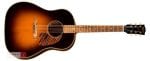 Gibson J-45: I‘ve always liked to write on acoustic, but it took me a long time to get a really reliable one that I felt like I could take it on tour and it would stay in tune and the tone would be good. I finally saved up enough to get a Gibson, because that, to me, has always been the best sounding acoustic. It’s really warm, and it’s easy to play, and it’s fun. I got that at Corner Music in Nashville when I was actually doing my photos for the real album cover. It was kind of a special adult moment in my life where I could buy myself a nice acoustic. I feel like that’s something you really need to invest in. With electrics, you can kind of use really cheap rickety stuff and just get a cool sound. I feel like with acoustics it has to be really reliable and this has been for me.
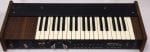 Mini Korg: You could buy a $500 Mini Korg that sounds great and you could also buy a $3,000 one that doesn’t play as well. That’s why it’s important to go into the store and just play for an entire day, and be that annoying person. This one is actually my guitar player’s keyboard, but he brought it into the studio when we were making Real, and someone was always playing around with it. I’m really into melody and I think that’s the best thing a keyboard is for—to play little melody lines under things. You can kind of bury that and people might not even know it’s a keyboard. And there’s a lot of atmospheric stuff on this record where it came in handy, too.
UPDATE: Congrats to Tilda Bergsten from from Sweden for winning the Ernie Ball Expression Series Pedals!
She Shreds’ 2016 Shred Guide will be available December 12th in a physical version for subscribers and a free digital version for everyone. In addition, we’ll be announcing a new giveaway each week for the next four weeks with some of our favorite products from the guide, starting with the Ernie Ball Expression Series Ambient Delay and Overdrive pedals. Full info on both pedals is available here.
To enter, fill in the submissions form below and follow these three rules:
1. Follow @sheshredsmag and @ernieball (Twitter + Instagram)
www.facebook.com/sheshredsmag/ (Facebook)
2. RT(Twitter) or Repost (Instagram) or Share this link (Facebook) + Tag a friend + #SheShredsGiveaways
3. Enter to win at sheshreds-staging.jzck3hem-liquidwebsites.com/EBGGG
The winner will be announced on December 13th.
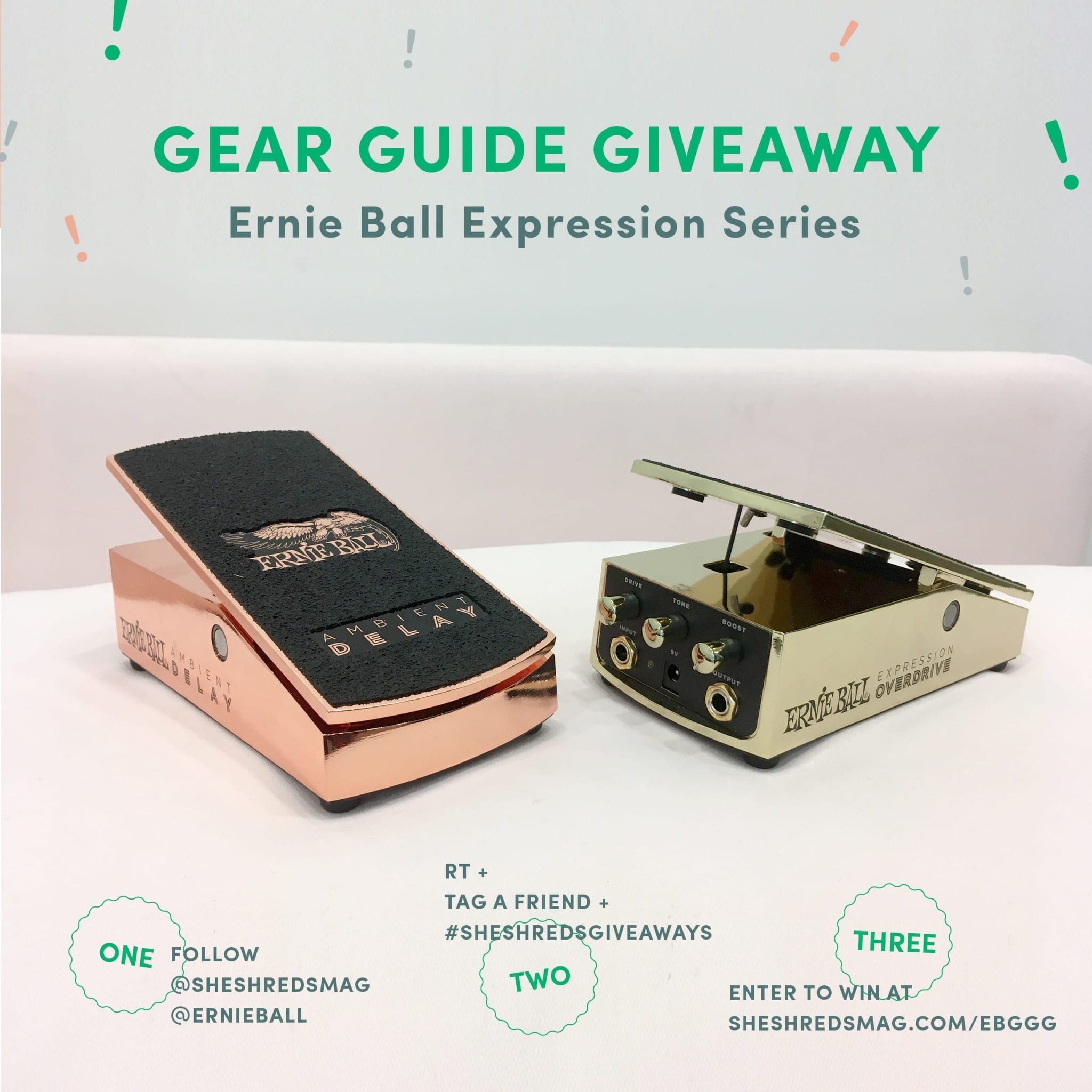
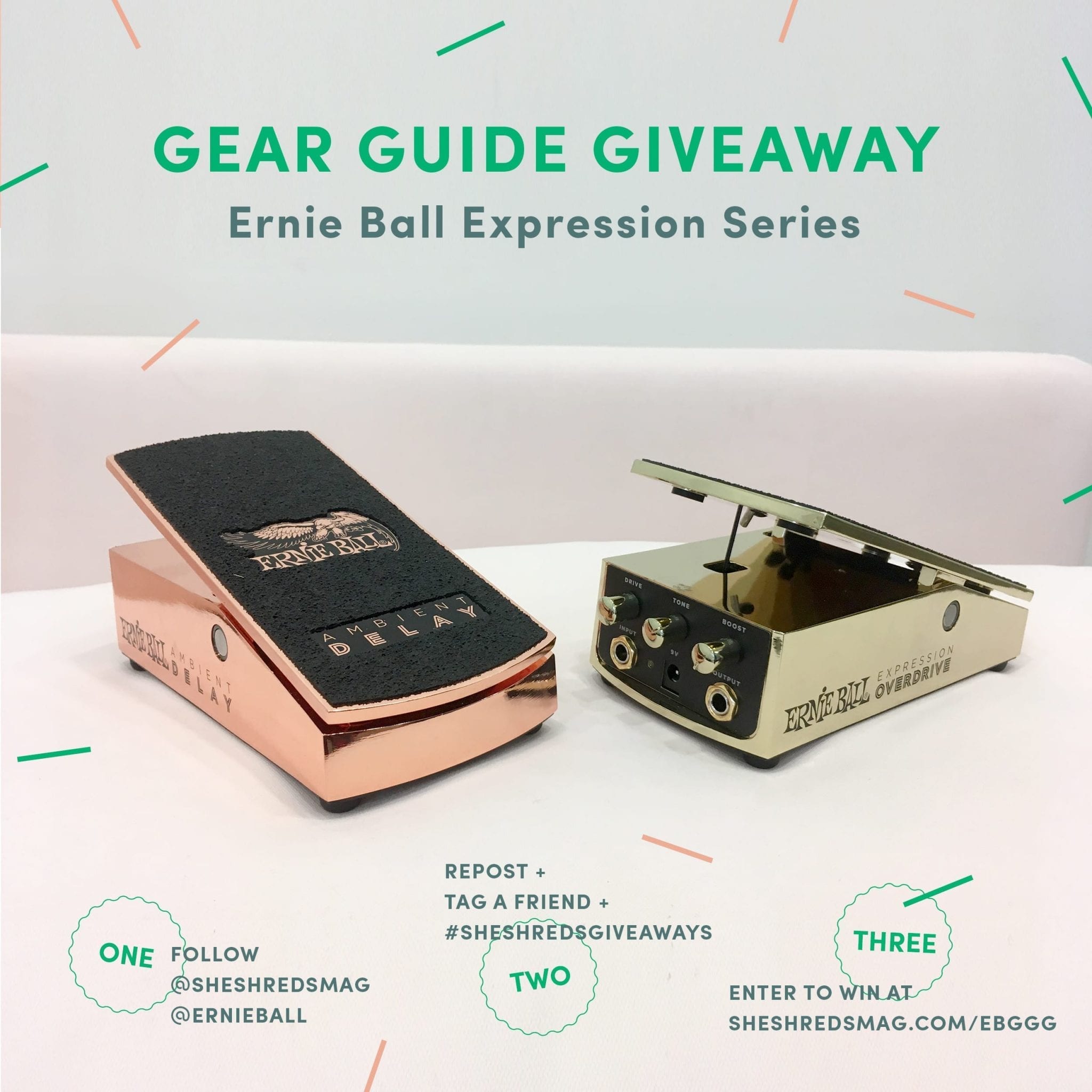
While they have a reputation for being near indestructible, they have been the only pedals Ernie Ball has produced since they were introduced in 1975. That is why I felt a bit skeptical when I first laid eyes on the company’s new pedal line, the Expression Series. It features two pedals, the Ambient Delay and the Expression Overdrive. My major question seemed to be, while they look totally stunning, do they stand up sonically to the competition? After trying them out, I can confidently say that Ernie Ball’s first offerings in the realm of effects are equally successful and impressive.
AMBIENT DELAY
With digital delay and plate reverb, Ernie Ball has successfully engineered a highly-functional 2-in-1 hybrid pedal. Its rose gold encasement features a foot-sweepable design just like their Volume Pedal series. You have the ability to control the delay time (50ms – 1s), reverb level, and feedback level. Tap tempo is only accessible by the addition of an external footswitch (not included). The delay pedals I have owned in the past conveniently have the tap tempo built-in, but I understand that the foot-sweepable control function would not be accommodated with an integrated tap tempo switch.
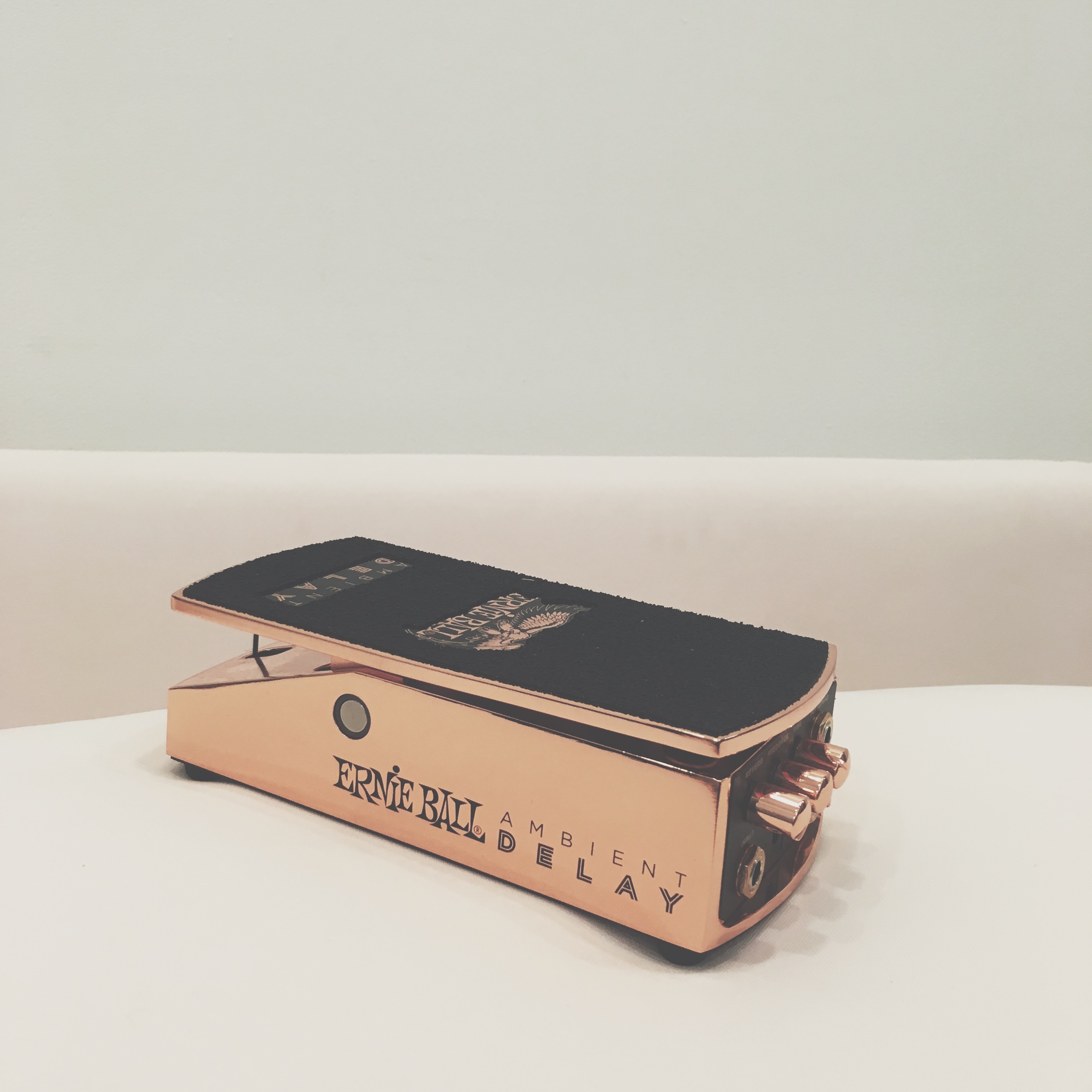
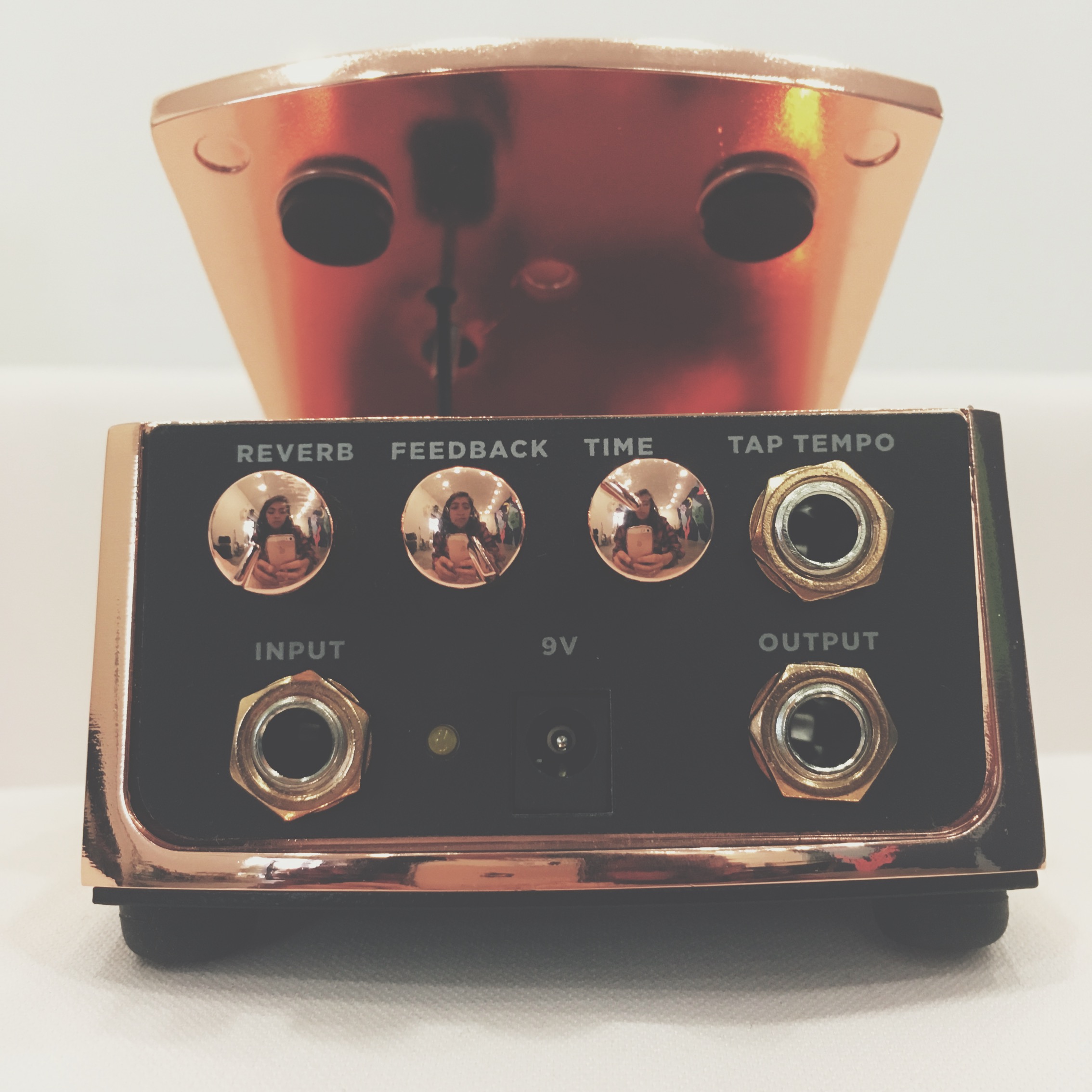
While most delay and reverb pedals are controlled by simply switching the effect on and off, this pedal has the ability to swell into the effect. This allows for a seamless transition into warm, textured delay making the Ambient Delay extremely unique.
EXPRESSION OVERDRIVE
Just like its sibling, the Expression Overdrive offers the same foot-sweepable design but in gold housing. Ernie Ball engineered this pedal to make the transition from rhythm to lead guitar as easy as possible. With three simple settings, boost, tone, and drive, the ability to go between minimal, tube-like drive to grunge crunch was very easy. Integrating the Expression Overdrive onto your pedal board also makes your boost pedal unnecessary.
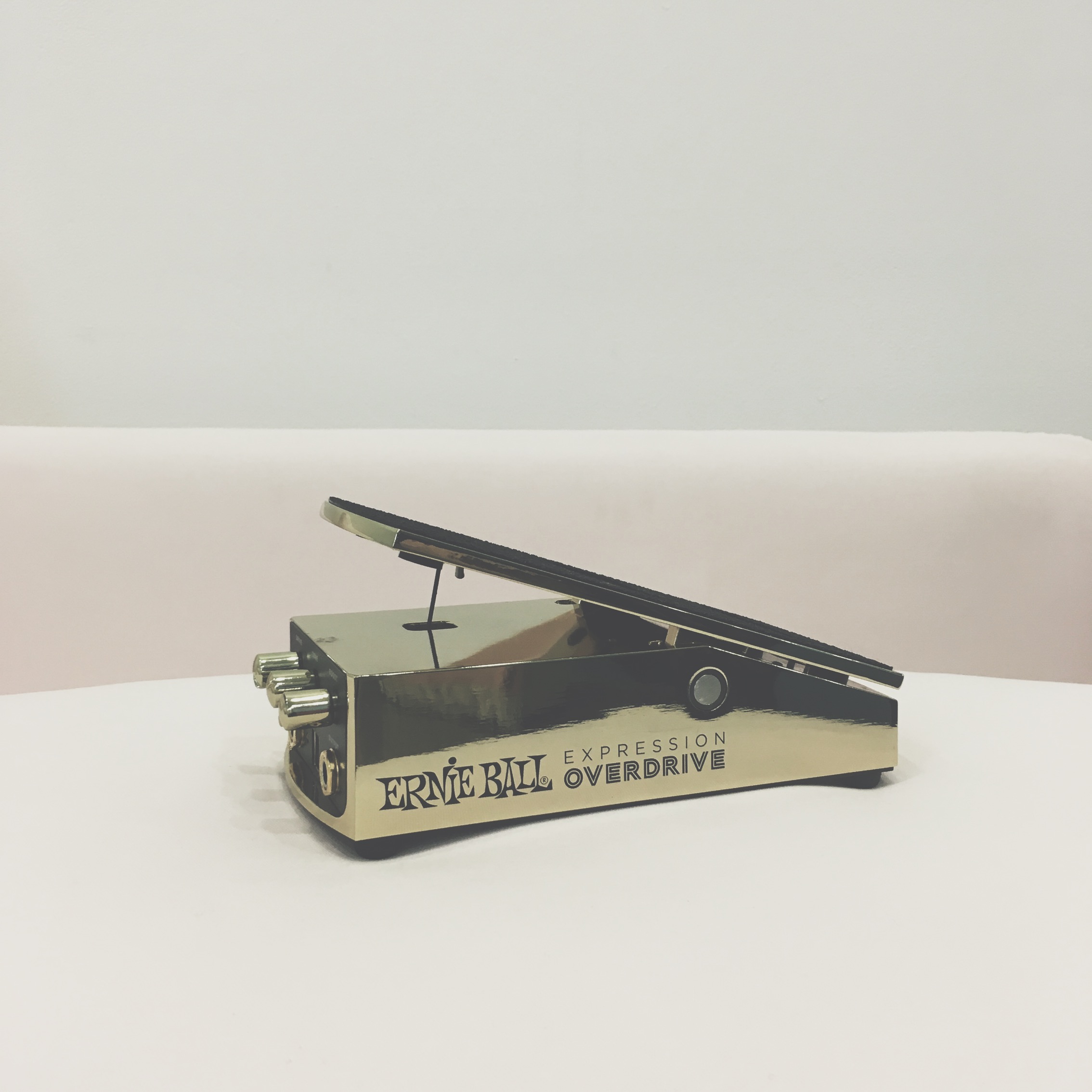
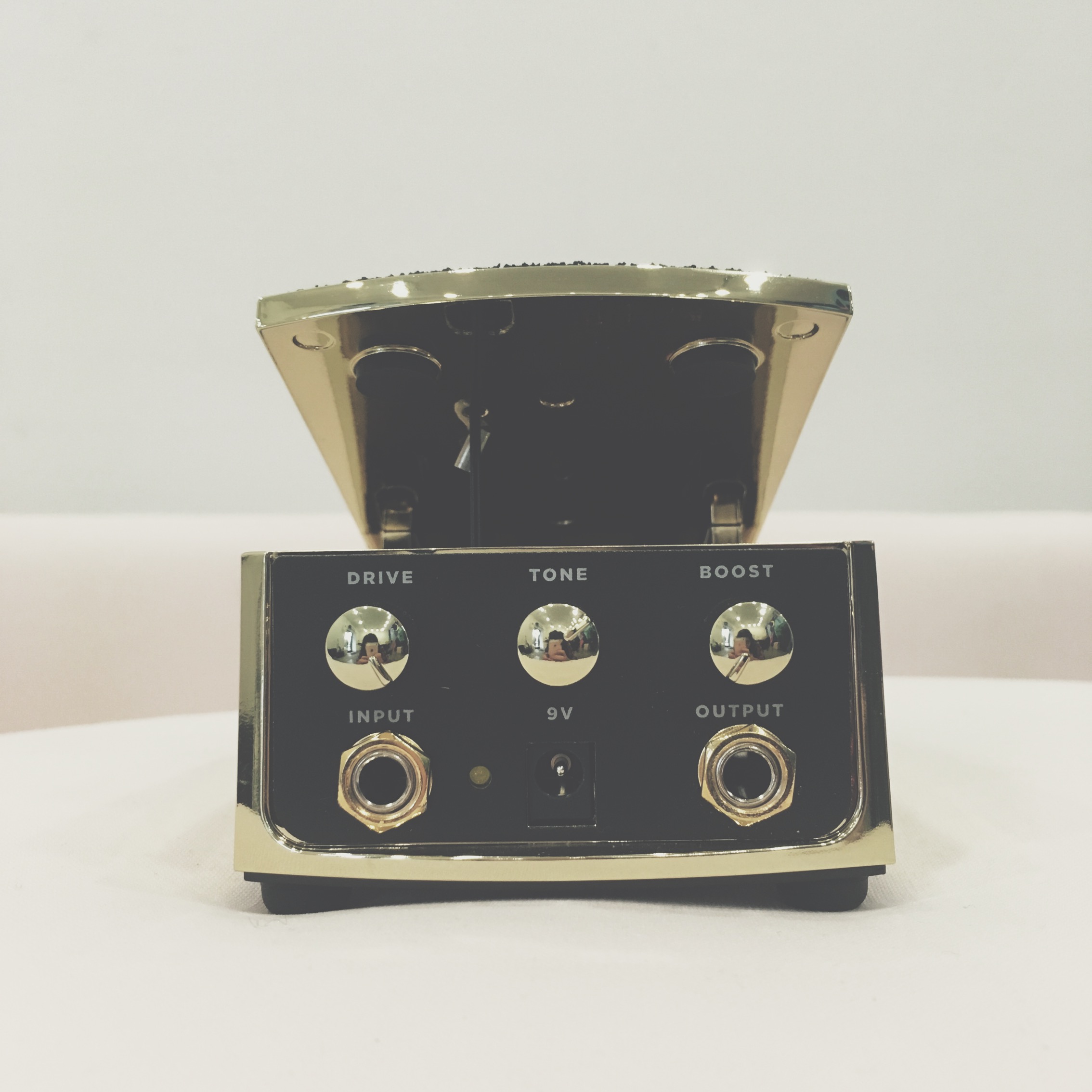
While the design of the pedals is completely efficient, they are a quite larger than most pedals. At first glance I found myself wondering if their footprint on my pedal board would be worth my making room for them. Once I tried them out, I found that was not even a question. Each pedal eliminates the need for at least one other pedal. These hybrids are incredibly adaptable while offering sincere, quality texture to your sound.
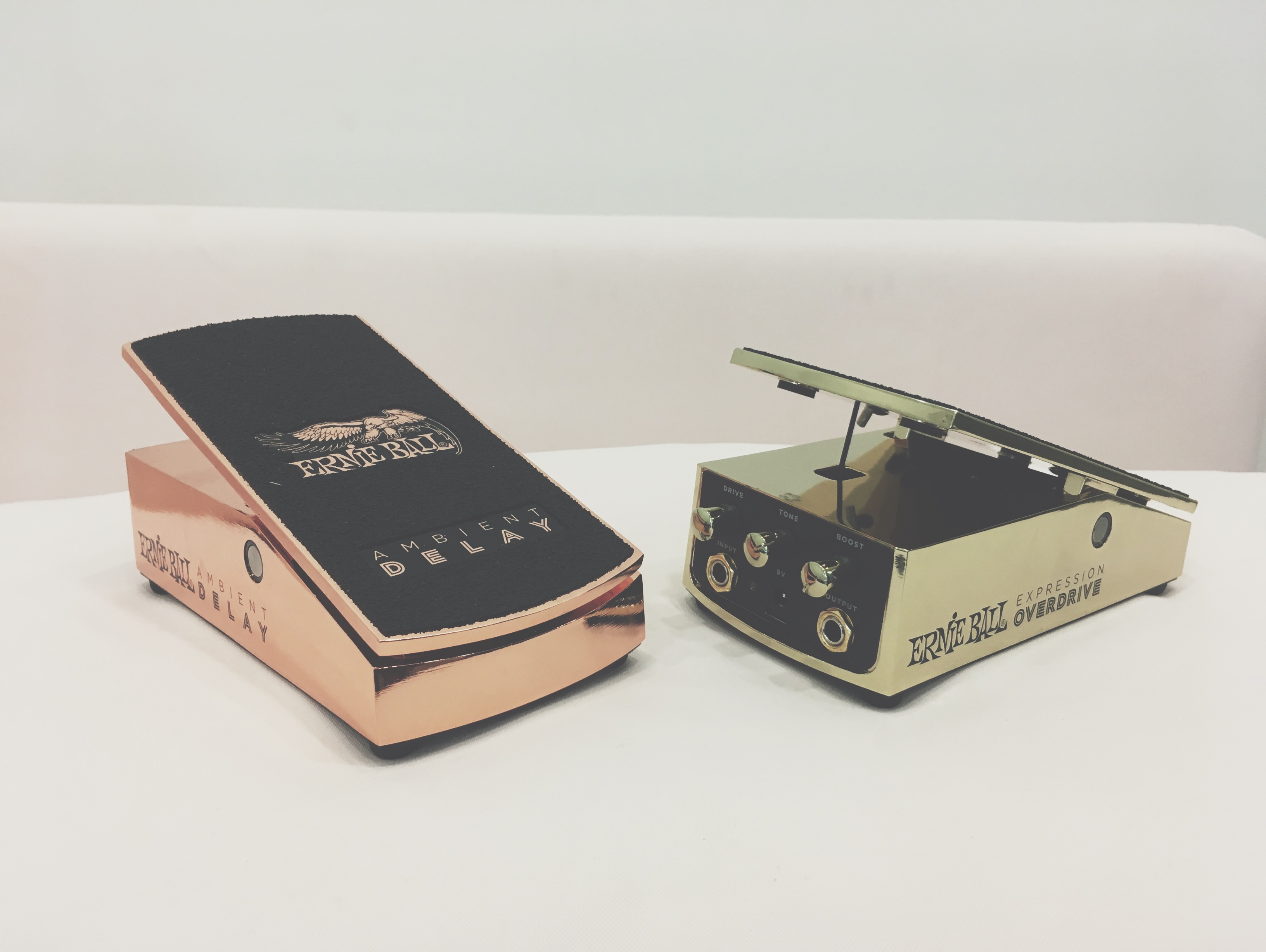
Bravo, Ernie Ball. You have managed to blend both auditory and mechanical ingenuity to create a highly desirable effects series. The Ernie Ball Expression Series pedals are available now.