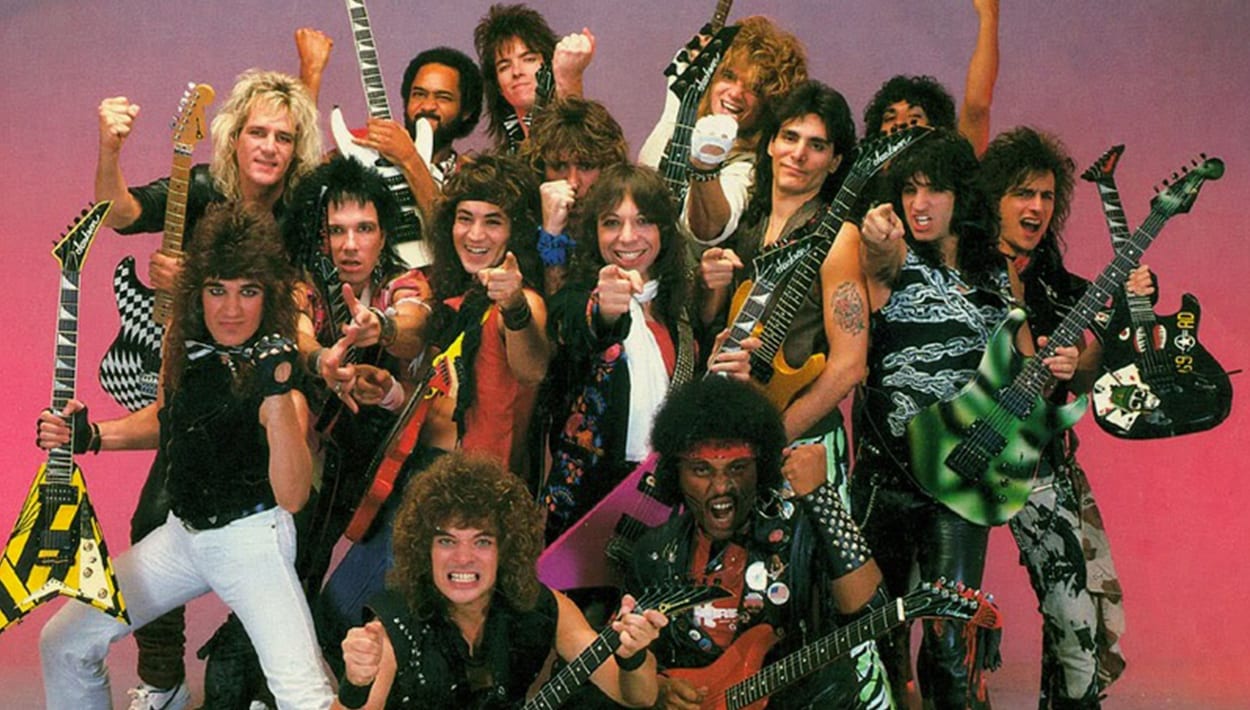
Two flagrant issues with these analyses were immediately clear. The first was a conflation of guitar sales with guitar playing. The Washington Post’s way of measuring things would suggest that neither I nor many of the guitar players I know who play used guitars (or guitars we bought new a long time ago) count in the consideration of whether electric guitar culture is dying. The booming business of effects pedals (16% increase in unit sales in the past ten years according to Music Trades) challenges this. The second issue was a sad lack of self-awareness about mourning the hierarchical and hyper-masculine performative decades-gone culture of guitar heroes like Eric Clapton and Jimmy Page, and assuming that such a culture is the only way to sell guitars or get people to play them. In fact, maybe it’s the leftover dregs of that very culture that are holding us back.
In the five years since the first issue of She Shreds was published, public conversations on inclusivity and respect for women in popular culture have been getting louder and louder. And the resulting milestones—both in the dethroning of prominent misogynistic practices and elevation of feminist epicness—have been increasing in kind. Within the guitar industry, we’ve covered some of the biggest of these evolutions: Ernie Ball’s first-ever mass-produced guitar designed by a woman (St. Vincent, no less), Guitar World trashing its tacky tradition of showcasing gear in the hands of bikini-clad models in its annual gear guide, and Guitar Player Magazine celebrating its 50th anniversary with a list of 50 favorite women guitarists (and the singular Sister Rosetta Tharpe on the cover).
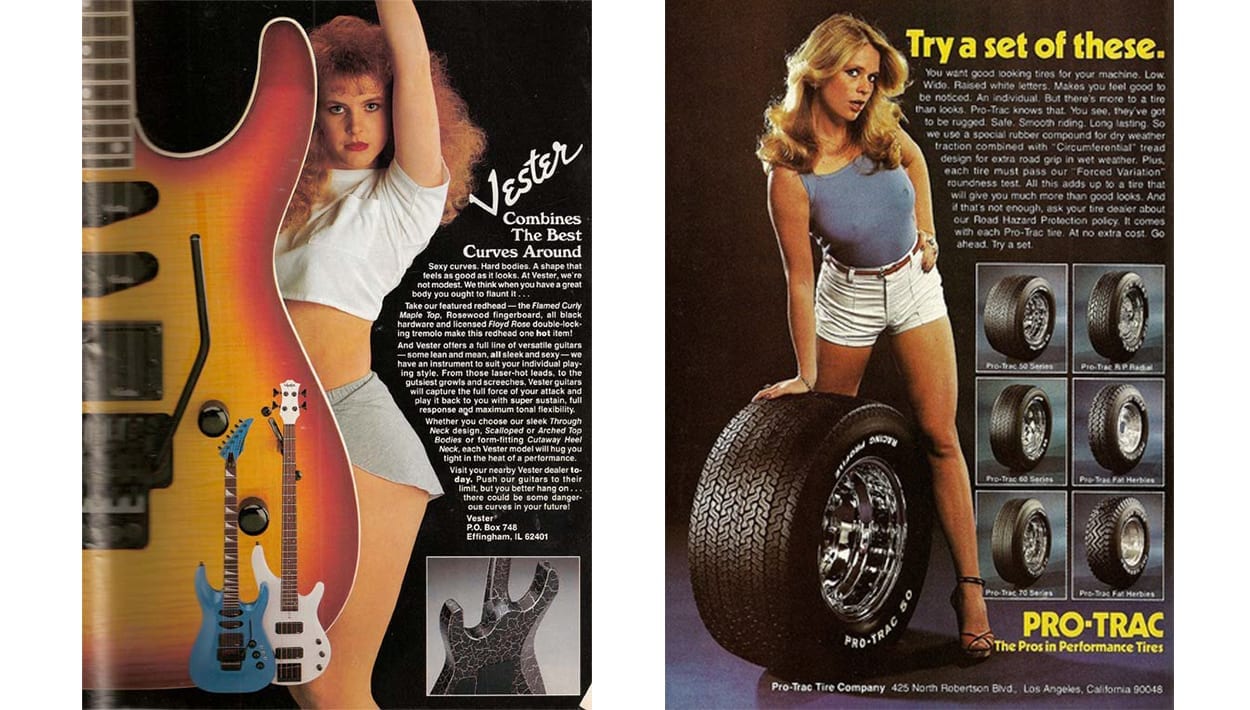
These moments didn’t happen without reason—but first, let’s start with why they matter. For those of us guitar and bass players who identify as women, femme, or gender-conforming, the dearth of acknowledgment for the talent amongst us has been just as glaring as the intensely bro-centric representations of guitar culture that do permeate our society, from testosterone-soaked music festivals to glossy, misogynistic magazines. Some of the worst perpetrators have been guitar brands, with archaic marketing strategies ranging from companies like Gibson hiring booth babes to lure people who fall for that kind of thing at the annual National Association of Music Merchants conference to Dean Guitars posting a photo on social media of a naked model licking a new guitar.
While these tactics have been used for ages, only recently has the pushback been significant enough to stop some of this absurdity. Until now, the public hasn’t tended to see, let alone challenge, the crimes of marketing as being as toxic as other mainstream media forms. Because, frankly, who amongst us really wants to care about advertisements? Why seek change in what we don’t want to see in the first place? And when we do finally call for change, it’s often against flagrantly problematic representations of women rather than in support of positive, realistic representations of all of us who play guitar.
But the messages that these marketers disseminate matter. Just like any other attitudes rooted in stereotypes rather than truth, the ideas forwarded by ads (and other more chameleon forms of marketing) across the public landscape trespass into our everyday experiences, irritating those of us with our guard up but, more importantly, influencing the unsuspecting among us with the implication that maybe this is really the way the world is or, worse, that it’s okay. Each billboard, Hulu ad, movie poster, product placement, and website banner is just a drop in the bucket of our daily lives, but the collective message we’re fed by them about gender and society is an ocean. And mainstream guitar culture has been drowning in the likes of Gibson ads with “Watch for flying panties” splashed across them, and a Vox Amps advertisement asking you, “Like what she’s wearing? Not the bikini, dude.”
As the idea of marketing guitars solely to straight, masculine men goes from passé to unprofitable, companies have been scrambling to appeal to the very people they’ve ignored for decades. It’s a lesson also recently learned by another industry in which women have long been ignored: cars. In 2012, a study revealed that more women in the United States have drivers’ licenses than men. By the next year, Porsche had joined the legions of carmakers trying to capitalize on this apparent revelation by designing a sleek luxury crossover SUV with young urban women in mind. Unlike faux-feminist gimmicks like Cosmopolitan’s SEAT Mii that drew a combination of wrath and head-scratching for being marketed like accessories rather than means of travel, the car was generally heralded as a new classic. Only two years later, in 2015, the company made headlines with its best financial year in company history, with less than 32% of its revenue coming from its traditional sports cars.
Now, the guitar industry may be experiencing the very same wake-up call. In 2015, Fender hired Evan Jones as its Chief Marketing Officer with the goal of driving a new era of growth for the legendary guitar manufacturer. Fresh out the gate, Jones spearheaded a national survey of U.S. guitar buyers under age 45 to see just who their untapped audiences might be. What did that survey reveal?
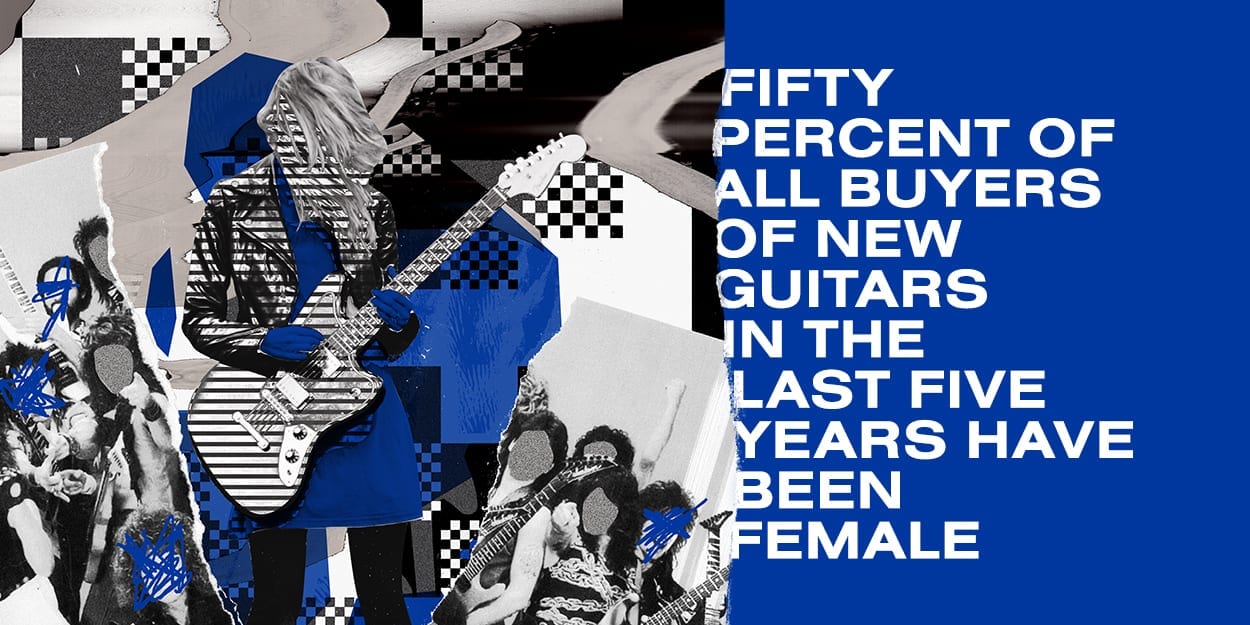
“Fifty percent of all buyers of new guitars in the last five years have been female,” Jones tells She Shreds. That’s right: According to Fender’s research, the future of the guitar industry is gender-diverse, playing the instrument for fun rather than in pursuit of guitar herodom, and is less obsessed with specs.
Since then, Jones reports that Fender has been undergoing widespread change, including its newly rebuilt marketing staff, product lines, and publicity. Last year, it rolled out a freshly modified take on their classic Offset Series, providing affordable, lightweight, and tone-varying options of the Duo-Sonic and Mustang bodies (favored by alt-rock musicians like Liz Phair and Kurt Cobain). Fender also included Warpaint and Bully as two of the four bands featured in the new line’s promotional campaign.
Jones explains that the results of these marketing campaigns were as instantaneous as they were diverse. “There was an orange Duo-Sonic guitar that we featured with Bully,” Jones says. “That was our fastest-selling guitar of all the Offset guitars we launched. I remember walking into guitar shops in New York City that had [sold out] cards on the wall, where older players had come in and wanted to buy it because they saw the advertising.” Jones’ point is an important one: Fender had found commercial success, not with one target group of a particular demographic but with loyalists and newcomers alike, by genuinely including popular bands with women guitarists to promote a product that resonated with players of varied backgrounds. “I think if you were to ask a 16 to 24-year-old today how they see gender… they don’t see it the same way that people did 20, 30, 40 years ago,” says Jones. “I think the biggest compliment that we could pay any artist is to look at them with the same level of investment, the same level of perspective and support, whether they’re male or female.”
We suspect that if Fender continues evolving with a broader, more complex audience in mind, it could find itself with Porsche-esque results. But changes in product lines and marketing strategies aren’t the only things uniting the two brands; their reasons for adapting to their newfound reality have something in common, too. Women aren’t just an opportunity for these companies and their respective industries—they are lifelines.
The revelation that women drove cars just as much as men hit the automotive industry just as they were recovering from the crisis of 2008-2010, in which car sales had slumped 40% from ten years prior. Look at guitar sales in the United States during the same time period and you’ll see another industry’s revenue pummeled by the recession: Music Trades data shows revenue from guitar sales dropped 30% from 2005 to 2009, and the total number of guitars sold declined from 3.3 million in 2005 to 2.4 million in 2010. Even the most iconic of brands suffered. In 2012, Fender withdrew from an attempt to go public when investors balked, citing the company’s debt and the guitar industry’s poor outlook. Things have improved since then, but the need to ensure that no potential guitar buyer is being left out remains. Fender’s strategy of being inclusive rather than tokenizing is a cornerstone of that. “We do not ever intend to offer a ‘women’s guitar.’ There’s no need,” explained Jones in a recent interview with Music Trades. “There’s a very real need, however, to offer electric and acoustic guitars that acknowledge that guitarists—male and female—come in all shapes and sizes physically.”
Jones made a similar point in his interview with She Shreds, stating that the company is expanding the base of artists it works with to reflect a holistic picture of today’s guitar players, rather than pigeonhole people into stereotypes. “Our ambition is that we will, over the next five years, be able to look back and say that not only did we, yes, grow the brand, but we helped introduce a whole new generation of players to the guitar, and we helped elevate the profile of an incredibly diverse body of guitar players across multiple genres, regardless of their gender,” he says. “That’s really key for us.”
With some companies like Fender stepping up to the call of the 21st century rather than staying stuck in the past, there may be hope yet for the guitar industry. But the work is far from over. Fender’s willingness to dedicate its own resources to finding accurate data on how diverse guitar players truly are came out of a lack of such information existing in the first place. Even Music Trades, the closest thing to an authority on music industry data, is starved in this department; the best they have procured so far is a questionnaire answered between 2011 and 2014 by 1,117 people who were found through their warranty registration for a new guitar worth $900 or more and made by one of “two prominent guitar manufacturers.”
One finding of this stunningly flawed research was that seven percent of guitar buyers are women. How is an industry steeped in stereotypes supposed to change when its source of thought leadership is suggesting that less than 10% of guitarists are women? Improvements in the representations of not just gender but race, age, size, disability, sexuality, and every other aspect of our socio-political identities have a long way to go, but the road to that—at least for profit-driven entities who invest their time, energy, and resources where they expect to make money back—is paved first by documentation that they, that we, exist. It’s time for the hibernating heavyweights of this industry to wake up. Let’s make sure they do.
UPDATE: We asked Fender if, since the shift in marketing, there had been a significant increase in numbers, including an increase in consumer diversity, profit, or socials.
A member of their PR team answered saying that “across the board in social, web traffic and PR the numbers are significantly higher.”
Beatbox Drums by Beatbox Drums
In a touring vehicle, drums generally take up the most space. Even without drum cases, if you play a decent sized kit, drums are going to dominate the space in your touring vehicle. This product is a drum kit that fits into a box. This is all possible because the box itself doubles as a resonator. It would definitely look unconventional onstage, but big ups to anyone making moves on economizing the amount of space that gear takes up. Playing Tetris with musical equipment every night does indeed get old. Leah Wellbaum / Slothrust
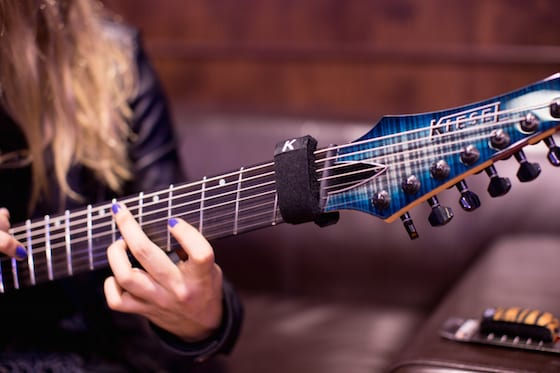
Fretwrap by Gruv Gear
This little accessory is great for muting the strings while you do tapping and also in a recording context when you what to avoid unwanted resonance and noise from the strings you are not using. -Laura Klinkert
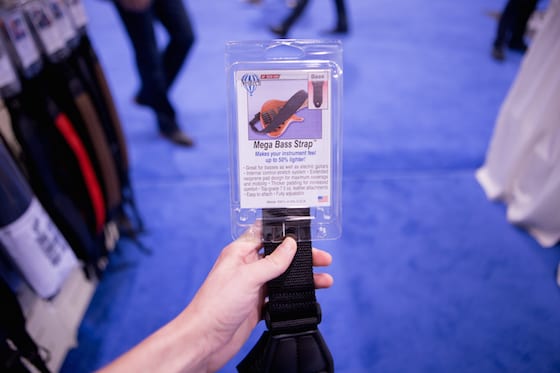
Mega Bass Strap by Neotech
This memory foam guitar and bass strap is the perfect thing for someone who gigs a lot, but also suffers from back problems. The internal-control stretch system reduces the weight of the guitar on your shoulders by up to 50%. The people working their booth even had a complicated scale / pressure measuring machine to prove it. It is also more adjustable than straps I have encountered in the past, and caters to people who like to play their guitars higher up. -LW
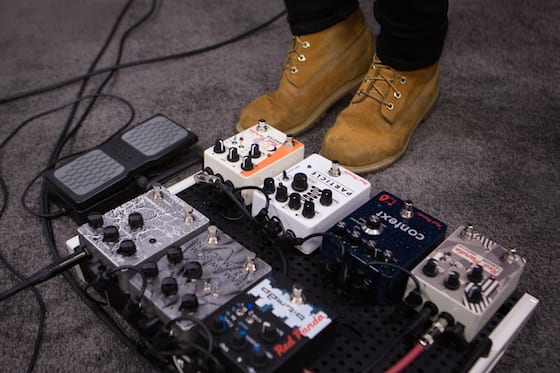
The Particle by Red Panda
The Particle pedal by Red Panda is a granular delay and pitch shifting pedal with a ton of other things going on. Depending on the settings, this pedal can be well controlled, or incredibly unpredictable. Sonically, I do not know its limits. It can sound like a video game underwater, like a creature about to attack you in the forest, or like a fairy flying toward you, about to kiss your nose. And of course, it is capable of the psychedelic flip-it and reverse-it madness you might imagine. -LW
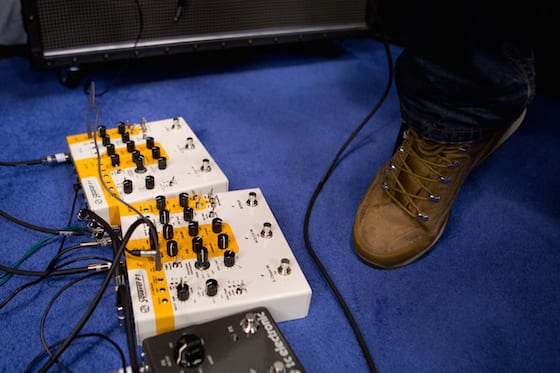
The Squaver by Sonicsmith
As someone who does not venture far from stringed instruments, it is rare that a synthesizer would catch my attention, but Sonicsmith’s new device definitely had me excited. The Squaver P1 is a semi-modular, audio controlled, analog synthesizer. It turns any audio input (vocals, guitar, bass, you name it!) into analog synth waves. It allows you to mix between square and sawtooth waves. It has the capability of extracting envelope, pitch, and trigger CV from the input audio. The possibilities seem endless with this synth, and it definitely seems like a groundbreaking product in its realm. Go get weird with the Squaver P1 for $730. –Laurence Vidal
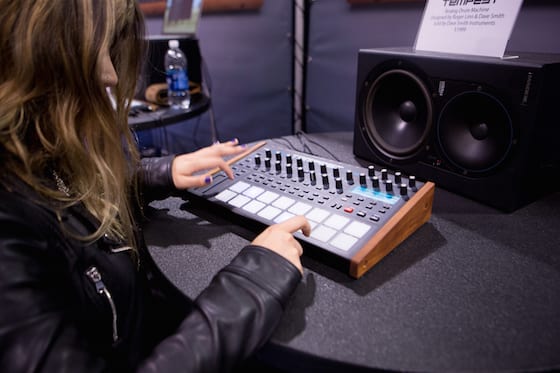
Tempest Analog Drum Machine by Dave Smith
This drum machine has one of the best quality sound I’ve ever heard, It’s easy to use and super easy for editing the inbuilt sounds in any context, studio or live. The building and the quality of the hardware seems to be really well done and resistant. You can get all of the most common techno and electro sounds out of it and way more by editing the inbuilt sounds. -LK
TriplePlay by Fishman
The Fishman TriplePlay is a wireless MIDI guitar controller. Whether or not this product is for you, it certainly demonstrates where we are at with music and technology. With the TriplePlay, you can select a variety of instrument plugins and play them via your guitar. It is an ambitious product that I think will evolve with time, and with the development of new plugins and latency solutions. To me, the TriplePlay almost feels like a prank. If you want to play a digital-sounding clarinet on your telecaster, welcome to it. -LW
Ultex Jazz 3 Guitar Picks by Jim Dunlop
This picks are sharp-pointed and also 2.0MM thick. This allows you to have a lot of control over the dynamics, rhythm, and intention. I recommend this picks for sweep picking players because since it’s super thick and sharp it will not blend at all when you sweep. Also, because of the material (ultex) I feel like it is not that bright as common picks and that it will keep it sharpness for longer. -LK
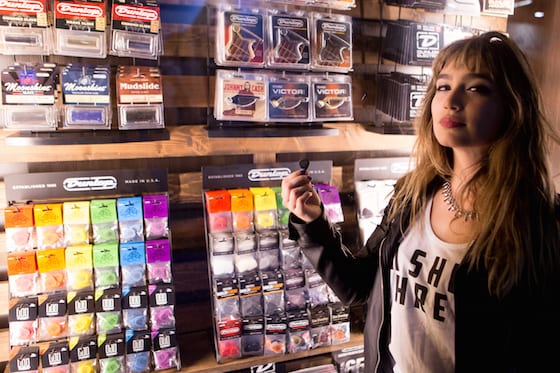
Founded in 1901 as a way to solve trading problems in the music industry, NAMM has grown into a four-story conglomerate of hundreds of manufacturers, distributors and affiliates from all over the world that come together to showcase the latest products to almost 100,000 private attendees. Historically, the NAMM show is meant to foster relationships for trading purposes between those in the instrument manufacturing industry while also giving general attendees and media partners a sneak peak into the evolution and innovation of music gear.
With the rise of rock ‘n’ roll, and later hair metal, the last 40 years of NAAM shows reflected a shift in guitar culture which can be seen through advertisements depicting half-to fully-naked women straddling instruments—a marketing move that was extremely popular and effective with men up through the 21st century. While guitar culture may have once perhaps been silently and privately sexist, now it was aggressively, publicly and shamelessly misogynist. Subsequently millions of gear nerds, enthusiasts and fans followed suit, and women musicians and consumers were largely ignored.
And now we’re here—trying to shift the industry once again by burying old marketing ploys, and ideals while creating new ones that speak to both men and women.
As a convention that hosts those companies who move the industry into what is and isn’t guitar culture—through advertising, language, and product display—NAMM also plays a pivotal role in answering questions like, “What are companies doing to ensure that their products, and the way they advertise those products, aren’t geared for men only?” and, “What kind of efforts are these companies making to represent women within their companies?”
These results are answered by the amount of banners seen showcasing actual women musicians, the amount of women demoing at booths, and the kinds of discussions that are being held through panels and between companies.
While the guitar industry has shown leaps of progress evident in just the four short years She Shreds has attended, it also has a lot of work to do to implement the simple idea that women are musicians too.
2016 saw Ernie Ball and St. Vincent’s new STV guitar model, The Evolution of the Producer hosted by Women’s Audio Mission and featuring an all star line-up of women including tune-yards’ Merrill Garbus, not to mention our partnership with companies such as EarthQuaker Devices, Reverb.com, Dwarfcraft Devices, PRS guitars, Loog guitars, and Catalinbread to bring in as many women as possible and demo all over the building. To say the least, it was nuts and wonderful and clearly a breath of fresh air to us and those seeing the industry shift for the past 40 years.
We asked LG from Thelma and the Sleaze to take us around the four story convention and show us some of her favorite products. Check out the video to find out some of the other weirdness she found!
In most cases, the general public believes this small pool of music industry people because, why not? For the past five years, artists like Bruno Mars, Pharell Williams, Dave Grohl, and Lady Gaga have graced the stage, making us numb to progress, evolving, and actual new talent.
In 2011 Esperanza Spalding beat Justin Bieber, Drake, Florence and the Machine, and Mumford and Sons in the Best New Artist category, making her the first jazz musician to ever win the award. For a moment we asked ourselves, “Is this progress?” Her win rattled the media, not because of her lack of talent, but because the award show industry just doesn’t have the reputation of recognizing anyone who isn’t a top-selling, major label pop star, much less a woman. And even less so a woman of color who creates jazz compositions.
According to Bustle, in 2015 women made up 30% of the total 135 slots for nominees. While 2016 shows a 9% increase—a pretty promising increase if you ask us—it doesn’t mean anything without the awards and performances to match it.
For this reason, watching Brittany Howard of Alabama Shakes win her third Grammy of the night and then delivering an inspiring performance with her SG in hand felt like progress.
Legendary guitarist, Bonnie Raitt, being recognized as such and performing alongside some of today’s guitar idols felt like progress.
And let’s be real, Courtney Barnett should’ve won Best New Artist and Peggy Jones AKA Lady Bo should have been recognized in the Grammy’s tribute line-up. Congratulation to all of the women guitarists/bassists who were nominated or won a 2016 Grammy award! Check out our full list below.
WARNING: Taylor Swift is included in this list (because She Shreds) so if you’re a hater, I’m sorry (not sorry).
Album of the Year
Winner: Taylor Swift, 1989
Alabama Shakes, Sound and Color
Record of the Year
Taylor Swift, “Blank Space”
Song of the Year
Taylor Swift, “Blank Space”
Best New Artist
Courtney Barnett
Tori Kelly
Best Pop Vocal Album
Winner: Taylor Swift, 1989
Best Rock Performance
Winner: Alabama Shakes, “Don’t Wanna Fight”
Elle King, “Ex’s & Oh’s”
Wolf Alice, “Moaning Lisa Smile”
Best Alternative Music Album
Winner: Alabama Shakes, Sound & Color
Best Urban Contemporary Album
Kehlani, You Should Be Here
Lianne La Havas, Blood
Best Country Album
Kacey Musgraves, Pageant Material
Best Latin Pop Album
Julieta Venegas, Algo Sucede
Best Americana Album
Brandi Carlile, The Firewatcher’s Daughter
Emmylou Harris & Rodney Crowell, The Traveling Kind
Best Rock Song
Winner: Alabama Shakes, “Don’t Wanna Fight”
Elle King, “Ex’s & Oh’s”
Best Country Song
Brandy Clark, “Hold My Hand”
Best Country Solo Performance
Cam, “Burning House”
Highlights:
Bonnie Raitt, Gary Clark Jr., and Chris Stapleton, “The Thrill is Gone” (B.B. King tribute)
Alabama Shakes, “Don’t Wanna Fight”