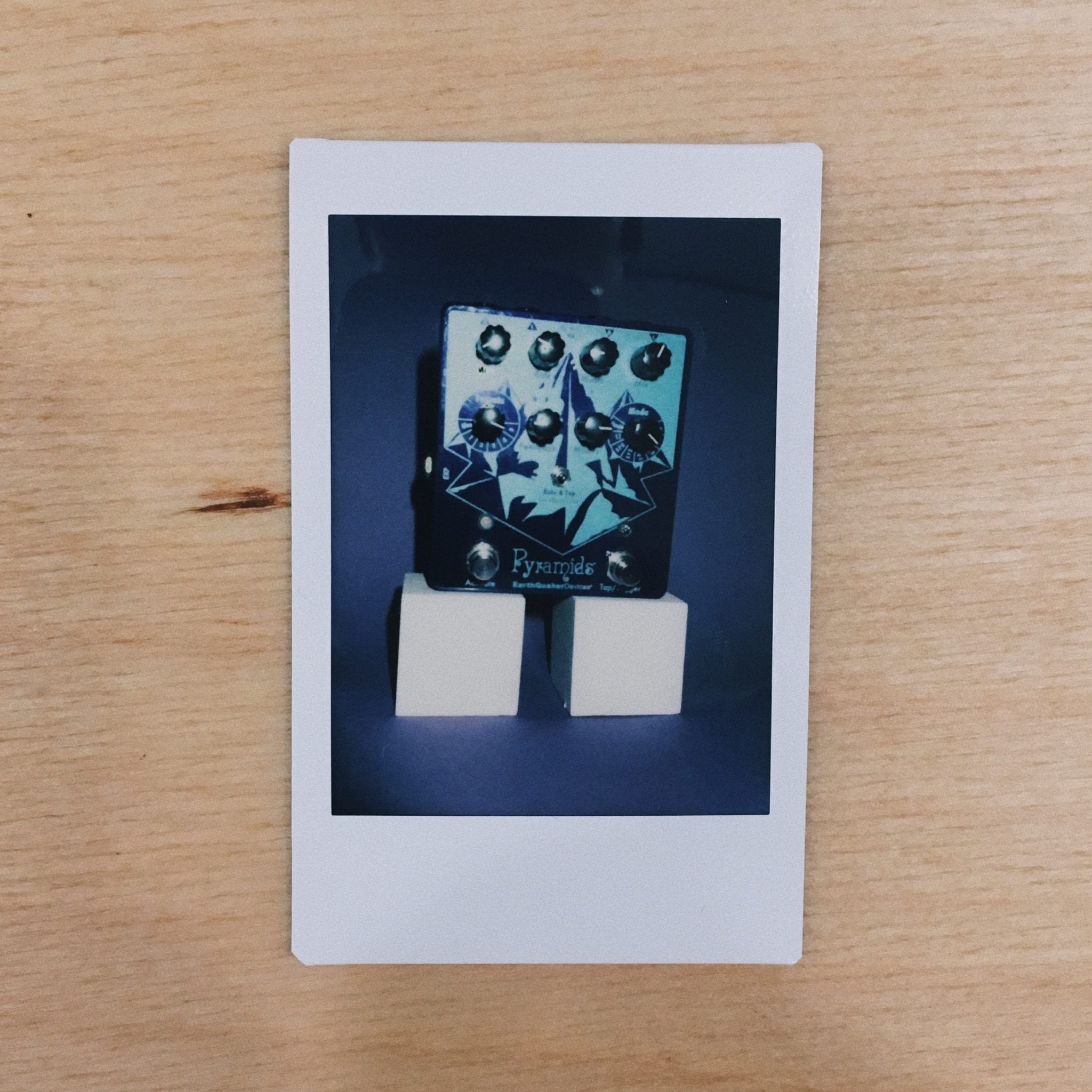
Eight flanger modes with what seems endless routing possibilities? Yes please. For the modern guitarist, the Pyramid Stereo Flanging Device by EarthQuaker gives you the flexibility and functionality that will elevate your sound. We even tested it out, and to be honest, were wildly impressed.
Check out a full spec sheet on the Pyramids Flanger Device and enter to win one for yourself below!
Rules:
Winner will be e-mailed on Monday, June 25th. If you don’t live in the USA that’s ok! You can still enter to win but you’ll have to pay shipping price (sorry!) so enter at your own risk!
Originally, the flanging effect was produced by recording two identical tracks simultaneously; during the playback of these two tracks to a third, a finger would be lightly placed on the rim of one of the reels which resulted in a sound that is most commonly described by the term “jet plane.” The sound seems to swell in and out or up and down as the tracks move back into sync. If you’re unsure about what it sounds like, check out the killer intro to Heart’s “Barracuda.” I’m sure you’ve heard it a billion times before, but this time, listen for the flange!
For guitarists, EarthQuaker Device’s Pyramids provides the versatility and functionality to take that sound to the next level.
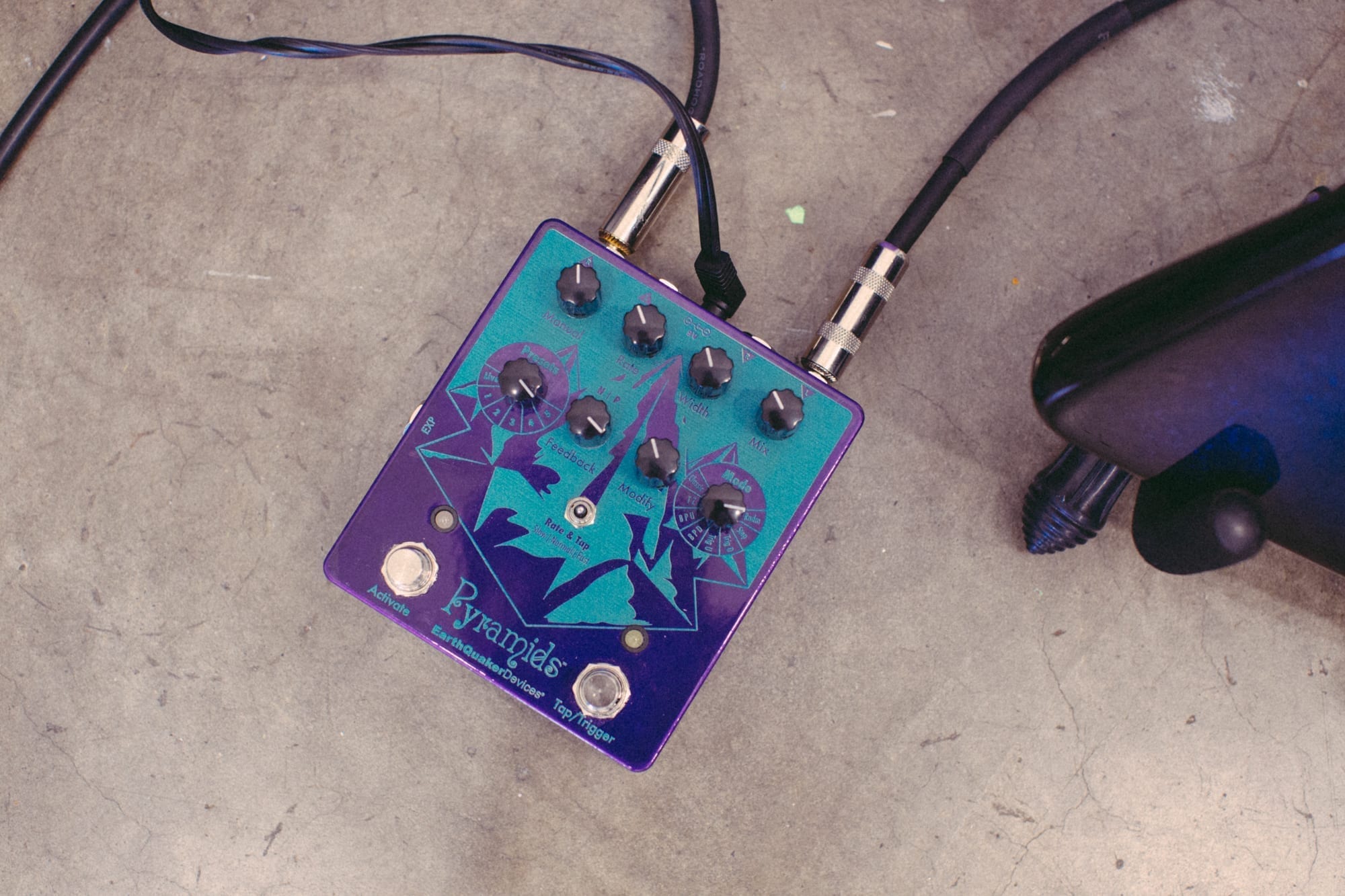
The Pyramids offers eight different flanger modes and five user-definable presets. It also features:
Tap tempo: overrides the rate control and allows you to set the speed of the effect using a footswitch.
Mini Tap toggle: small switch located underneath the rotary switches that moves the tap tempo from slow (left) to normal (center) to fast (right) in an easy flick of your finger.
Modify: control knob that essentially adjusts the responsiveness of the effect. This varies from tone control to delay time to sensitivity control depending on which mode it is in.
Feedback: control that allows for the effect to regenerate, or in other words, feed the signal back into itself.
Mix: lets you blend in as much or as little of the effect on the signal as you’d like. This is definitely something you don’t see in flange pedals everyday.
Width: allows for you to change the frequency range of the LFO (low-frequency oscillation).
Footswitch: Flexi-Switch Technology equipped. Allows for momentary or traditional latching operation.
Manual: allows for control of delay time of the modulated signal. This is controlled via knob, or you can use an expression pedal through an input on the side.

The user-definable presets option is a first for any EarthQuaker pedal. You can save any settings you like and recall them by the rotary switch. It is also equipped with EarthQuaker Devices’ Flexi-Switch Technology. To momentarily engage the pedal, hold the switch for as long as you want the effect, and simply release when you want it to end (it’s super duper cool).
If you want to switch on the effect the traditional way, just tap it on like you would with other pedals and tap again to bypass. Another buzzed about feature is the variable Mix Control. I think this is a feature that is just what I needed to slowly ease into the flange game. Easily blend in as little or as much flange as you want. All hail mix control!
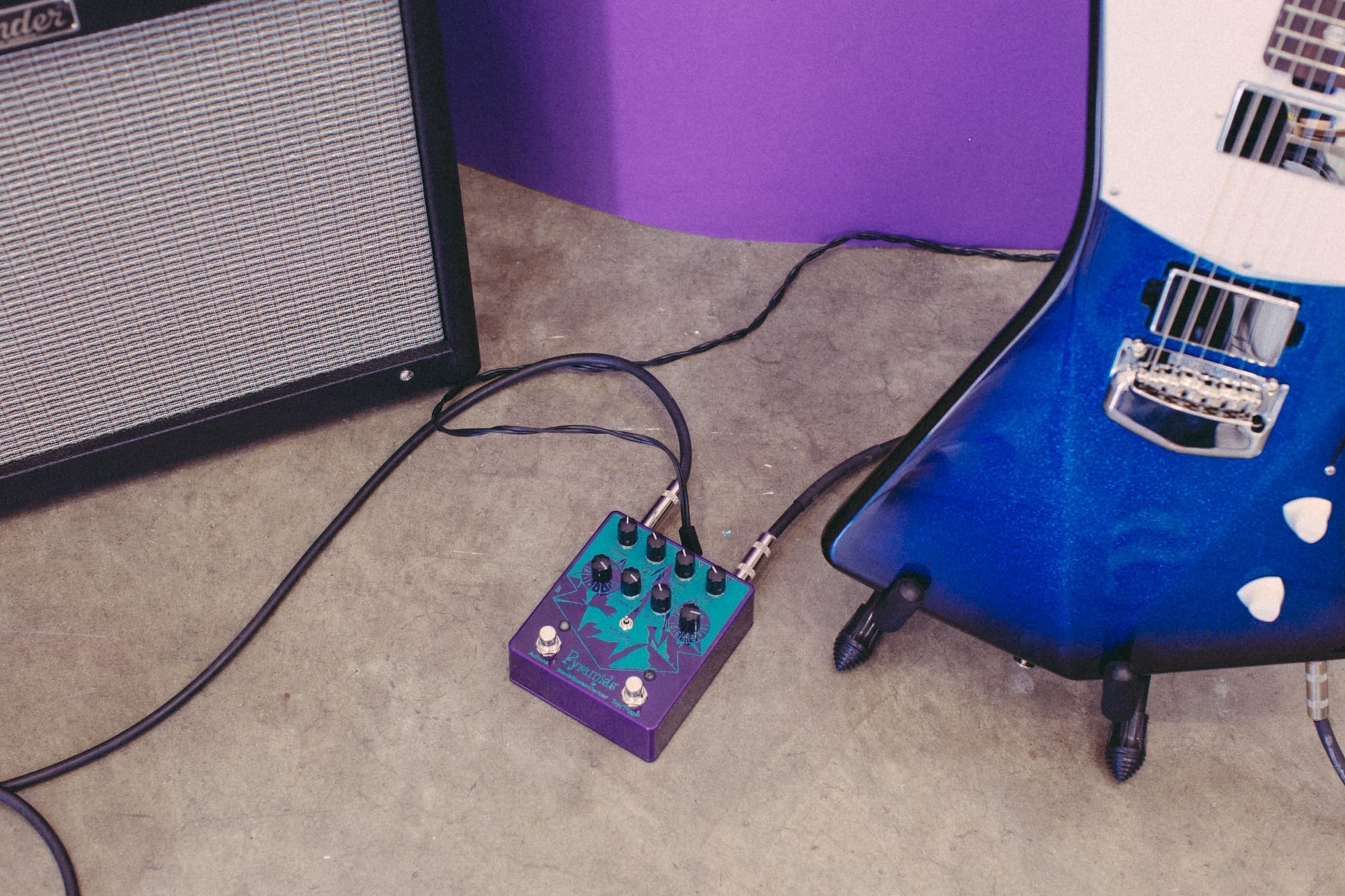
It should also be noted that Pyramids has a range of routing options that make this pedal a dream in studio. Mono in/mono out? It does that. Mono in/stereo out? It also does that. Stereo in/stereo out? You guessed it—it does that, too. This gives you the the flexibility to vary your output anyway you’d like.
There is also the option to use two inputs, or two instruments to the output route of your choosing. In trigger up and down modes, side chain flanging is an option. This allows for the effect to be triggered by an external source. The instrument is routed through right input/right output while the control source is patched through the left input/left output.
Classic: Classic “jet-plane” flange sound. Your instrument will swirl in and out forever through space and time.
Through-Zero: This swirly, flanging mode is phase cancellation and comb-filtering effects at its best and in stereo!
Barber Pole Up: This effect is best defined as an infinite sweep upwards with no discernible end.
Barber Pole Down: This is just the opposite; it is an infinite sweep downwards.
Trigger Up: This provides an infinitely upward sweeping effect that restarts the flange cycle with each new pick attack or by pressing the Tap/Trigger footswitch.
Trigger Down: Alternatively provides an infinitely downward sweeping flanger that restarts the flange cycle with each new pick attack or by pressing the Tap/Trigger footswitch.
Step: In this mode, Pyramids sweeps up and down in stepped increments, producing a rhythmic flange effect similar to an arpeggiator and/or sequencer on a synth instrument.
Random: This mode sweeps up and down in random intervals, creating a chaotic flange effect similar to a synthesizer or envelope filters “sample & hold” function.
From user presets to the Flexi-Switch technology to the mix control, I’ll confidently say that flange effects users have not seen a device quite like this before. If you have never tried a flanger, or you have tried one but you weren’t blown away by the effect, I would urge you to plug into Pyramids—I’m willing to bet you’ll be wildly impressed.
Pyramids boldly goes where no flanger has ever gone before.
I had no idea that I even needed a tremolo pedal until I took the Expression Tremolo for a spin.
At a Glance:
Easy on the Eyes
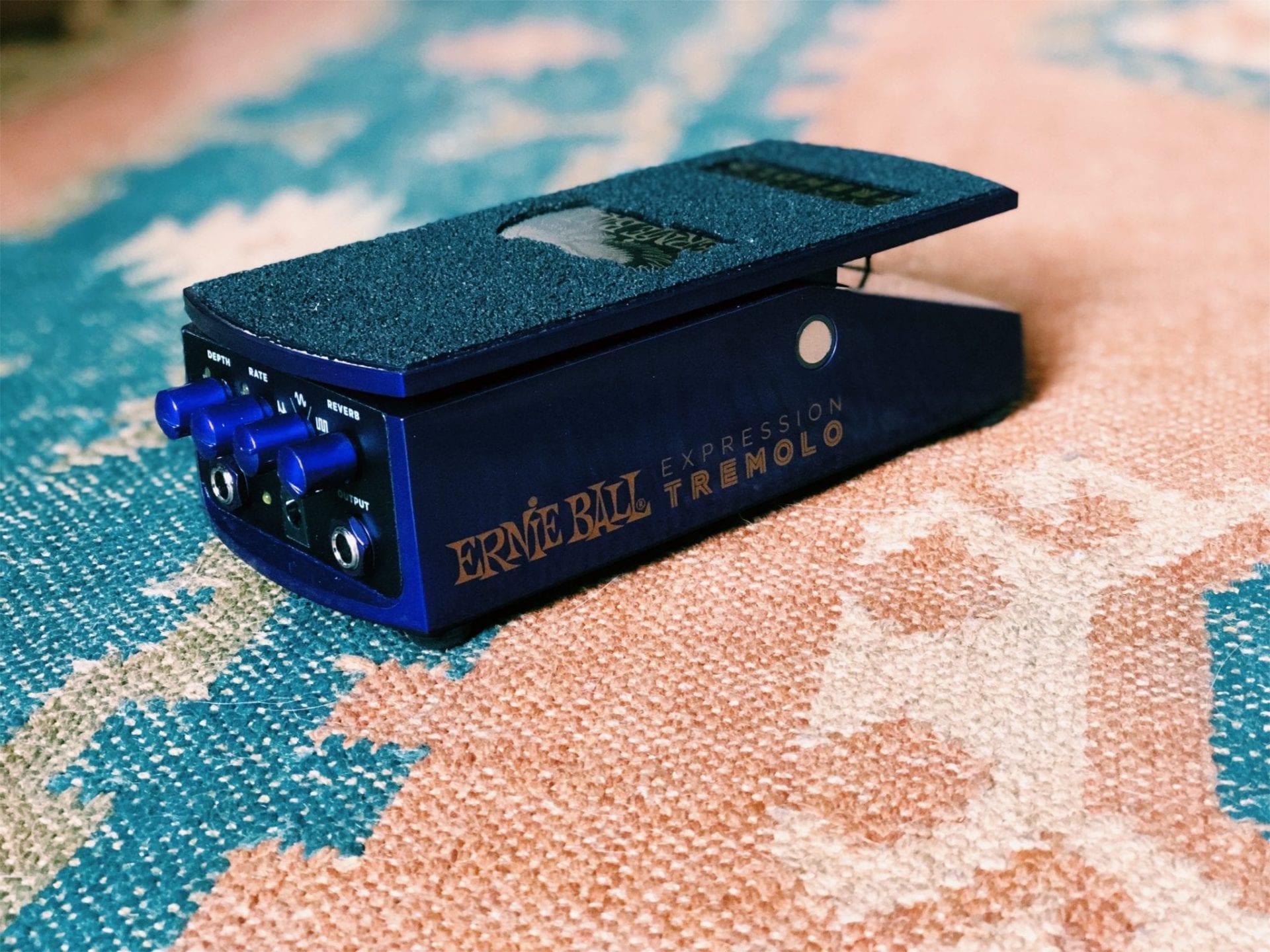
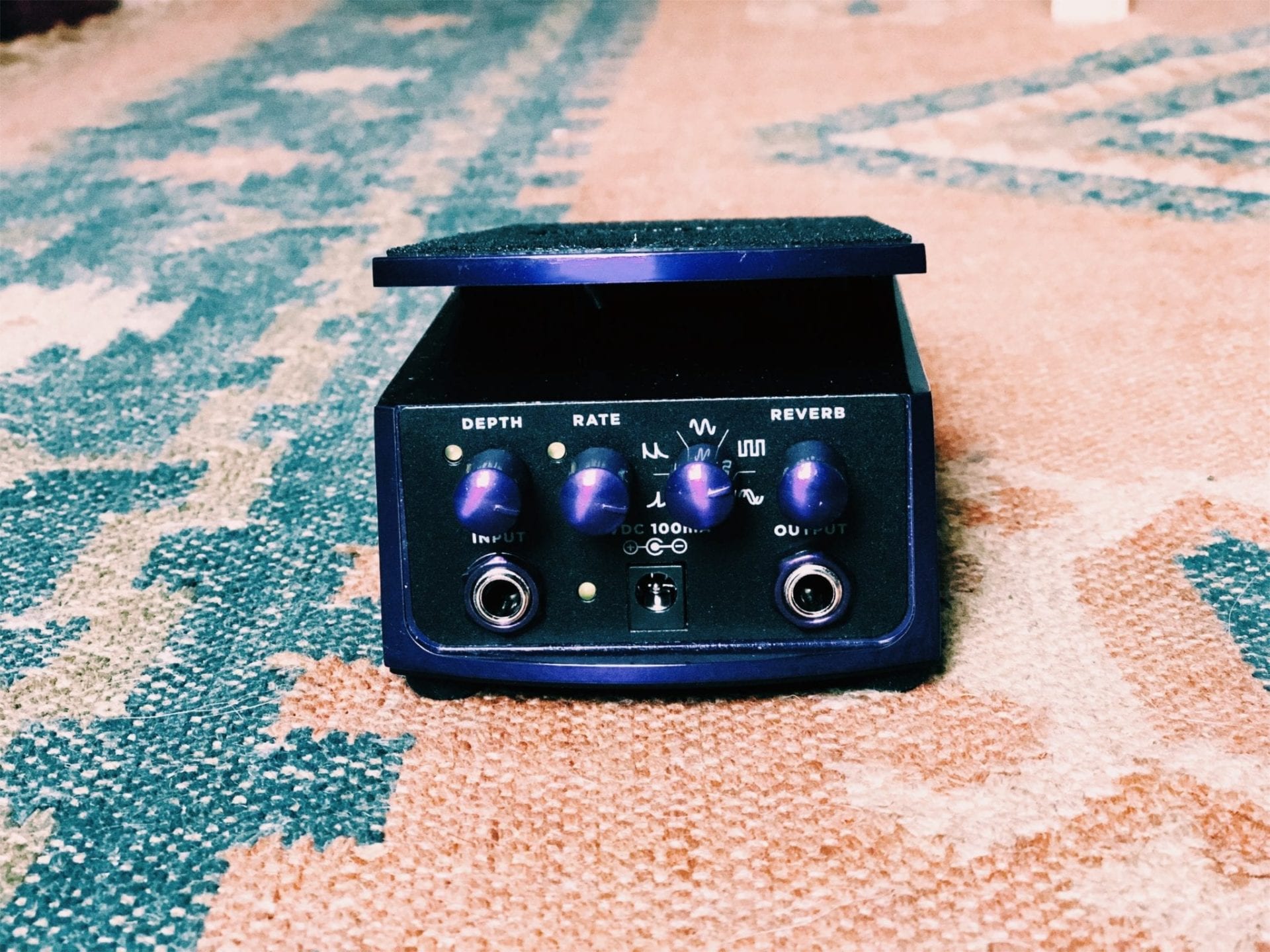
Just like its predecessors, the Expression Tremolo is housed in a sleek, metal enclosure. This means it weighs a little on the heavy side, but it is the same heft that makes it withstand so many miles, which has been proven by the famous Ernie Ball volume pedals. The knobs are on the back of the enclosure which are clearly marked and accompanied by LEDs. While the design of this pedal is rather large to accommodate the rocking foot pedal, having the power to move in and out of effects seamlessly makes the bigger foot print on your pedal board completely inconsequential.
Performance Practicality
Your classic tremolo waveform found in most pedals is usually the sine wave. The Expression Tremolo, however, offers five different waveforms by way of a selector knob: slow rise, slow fall, sine wave, square wave, and harmonic wave. All of these can also be paired with spring reverb which has its own knob for level adjustment. The pairing of the Tremolo and spring reverb are really quite harmonious and, at times, even psychedelic.
One of the coolest features of this pedal is that you can create sweeping tremolo effects just by rocking the foot pedal back and forth. The depth and rate knobs on the back are easily pushed in and then set to the desired levels. Moving in and out of effects could not get any easier; not only do you have an effect without a click, but the abrupt on and off isn’t an issue since the effect swells in and out.
The Expression Tremolo—along with its Expression series companions—is a step ahead in terms of pedal performance and function, and it’s definitely the first tremolo to ever catch the attention of my eye (and ears). Its limitless potential in sonic variation and revolutionary design for ease of use, has ushered in a new (and much needed) standard, not just for the tremolo pedal, but for effects pedals in general.

ACCESSORIES
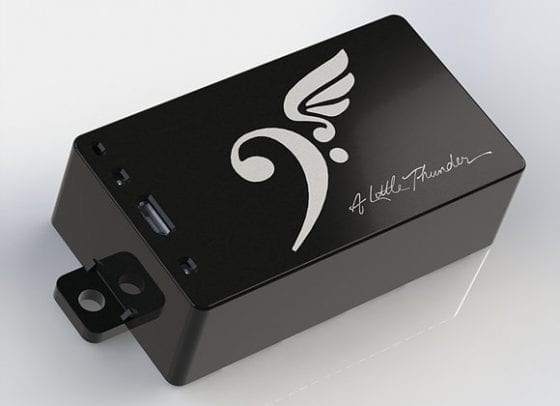 image courtesy of A Little Thunder
A Little Thunder Pickups
Here’s something I’ve never seen before: a humbucker pickup that adds bass tones to your guitar. A Little Thunder Pickups take the bottom two strings and downpitches them 1 or 2 octaves. It’s a great solution for playing with just guitar and drums. It may even work better than playing with an octave pedal because you still have the clarity of the high strings and the Little Thunder Pickups have never zero latency. The octave effect easily switches on or off and you can still use the effect when you’re switched to other pickups on your guitar!
NS Micro Soundhole Tuner by D’Addario
If you’re an acoustic player and shred on anything with a soundhole, the NS Micro Soundhole Tuner by D’Addario is a great alternative to a satellite dish you clip on to your headstock or pedal tuner. This tiny clip on tuner fits snugly inside the bottom curve of your soundhole. It’s ridiculously easy to install—you literally just slip it into place. There’s no need to plug anything in since the battery-powered tuner picks up the string vibration from inside your guitar. It’s hardly noticeable from anyone’s perspective except the player, who can look straight down and easily see the tuner’s light-up screen. It’s easy to read and is entirely accurate, even in a live setting.
~Best in Accessories~
Temple Audio Design Pedalboards (Templeboards)
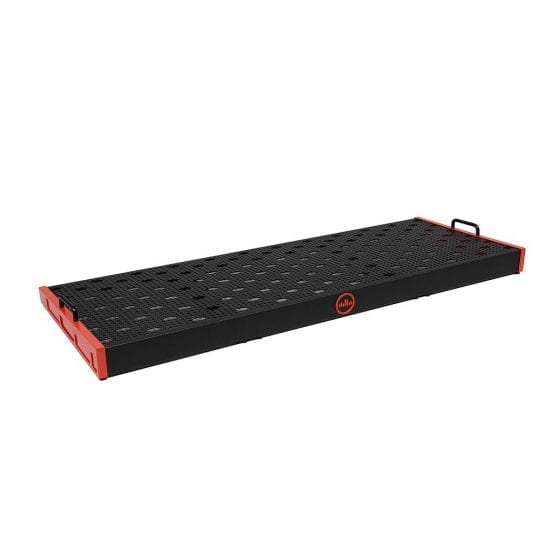
There’s nothing that triggers my ocd more than my pedalboard being a chaotic, sticky, spaghetti mess of cables and velcro, and that hard to get around because the options for organizing them are limited. The Temple Audio Design booth at NAMM immediately grabbed my attention. Basically it’s a pedalboard with large, medium, or small sized plates that stick to the back of your pedals and fit onto the pedalboard like Lego bricks with a single easy screw to keep them in place. The pedalboard has a helpful design that makes it easy to route your cables in an organized way and keep things looking nice and clean. You can also install an IEC Power Module on the side of the board for convenient access to power.
PEDALS
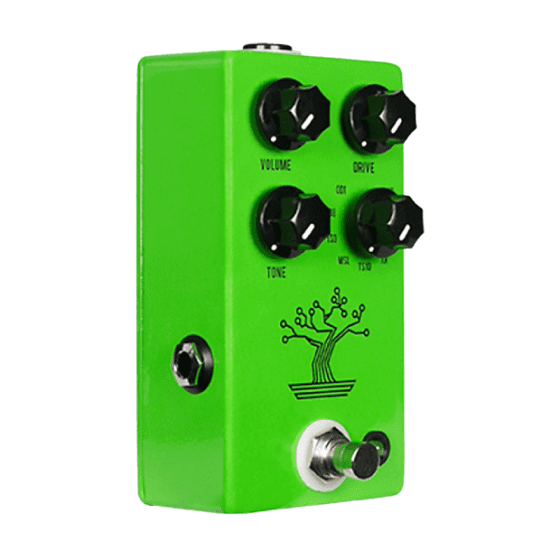 image courtesy of JHS
Bonsai by JHS Pedals
The Bonsai by JHS pedal combines NINE classic and rare overdrive effects into one piece of gear. Guitarists search high and low for the perfect tube screamer, and there are many different versions of this pedal. Josh Scott from JHS decided to take the Tube Screamers from off his shelf and put them into one pedal. Each vintage TS was disassembled, measured, and perfectly replicated, including how the capacitors and resistors have aged over time and drifted from their original values. No modeling, nothing digital, only analog switches.
OD-1 – 1977
TS-808 – 1979
TS-9 – 1982
MSL – 1985
TS-10 – 1986
Exar OD-1 – 1989
TS-7 – 1999
Keeley Mod Plus – 2002
JHS Strong Mod – 2008
Fathom by Walrus Audio
Fathom is the newest multi-function reverb by Walrus Audio. I personally own this pedal and I’m obsessed with it. It has 4 different reverbs; Hall, Plate, Lo-fi, and Sonar. Every reverb is customizable with decay, dampen, mix, and an x knob that adjust different things for each reverb setting. A couple things stand out to me in this pedal. One of my favorite features is the decay knob. Crank it and it will sustain for eternity until you’re completely hypnotized. Ooo man. Fathom also has a sustain switch you can press to sustain the reverb for a lengthy, swirly, slow decay.
~Best in Pedals~
Colour Theory by Alexander Pedals
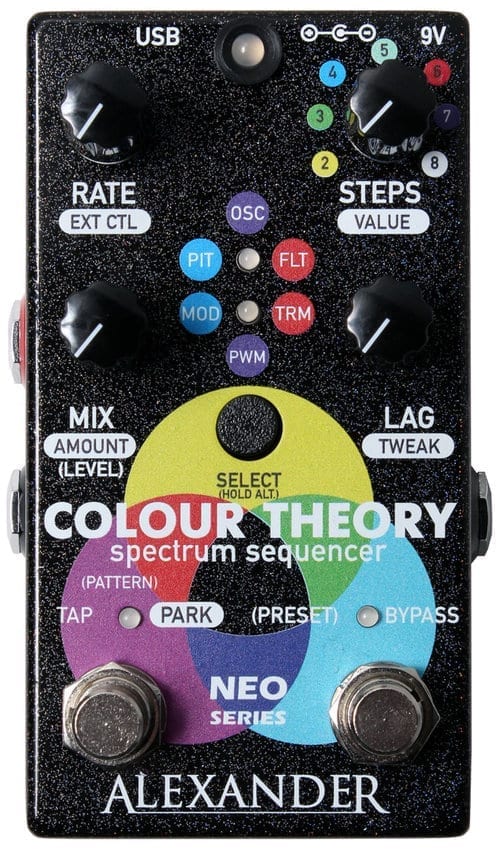
Matthew Alexander doesn’t target your traditional guitar player and I love that. I don’t know if I have a wide enough gamut of language to describe the Colour Theory, except that it’s one of the most unique pedals I’ve ever played. It has the ability to be a sequenced pitch shifter, delay, filter, oscillator, tremolo, and a PWM mode which is a sort of insane octave synth sound that you’d have to hear to understand. Every mode is customizable and you can get a pretty standard sound out of it, or you can make it sound like there’s something seriously wrong with your guitar. Matthew puts it, “We like our pedals to be capable of something normal, but we thrive on the edge of order and chaos.”
Our first giveaway is a double feature: the Sneak Attack and Lil’ Buddy from Portland boutique effects company, Malekko Heavy Industry. The Sneak Attack is a digitally controlled analog VCA pedal, that features an attack/decay envelope generator with length and curve controls for each segment. In addition to digital control, the Sneak Attack can be manually triggered or used in tremolo mode. It can be used on its own, or with the the Lil’ Buddy foot switch, an expander that includes tap tempo and even more control over the attack and decay effects—which is pretty amazing!

Full info on both pedals is available here. Enter to win below, and make sure to check back each week this month for more killer gear giveaways.
EarthQuaker Devices president, product designer, and legendary pedal builder, Jamie Stillman, calls the Erupter “the ultimate classic fuzz tone.” Don’t be fooled by the simplicity of its design—thanks to the two years of experimenting, tweaking, and hunting for the perfect tone balance, EarthQuaker has designed a new standard for fuzz pedals with more capabilities than meets the eye.
The goal of the Erupter is to have an explosive fuzz tone that screams at any pickup position and crisply cuts through at any point in your effects chain without any impedance mismatch. Basically, you can play it anywhere, with any gear and it will still rage; no weird oscillations, just explosions of tone. This pedal delivers fuzz with a massive low end that isn’t too mushy, and a high end that is clear without being too harsh. Can something be dirty and clean at the same time? Yep.
Let’s talk about the most blatant feature of this pedal. The knob. This is called the bias knob. It’s not a volume or gain knob (the Erupter has a fixed volume/gain level just above unity gain). The bias knob adjusts the amount of voltage being fed into the transistors. Meaning, you will always get the richest fuzz possible but as you roll the knob up, the characteristics of the fuzz change.
Exploring the full spectrum of fuzz from the Erupter’s bias knob is a colorful journey. Let’s check it out!
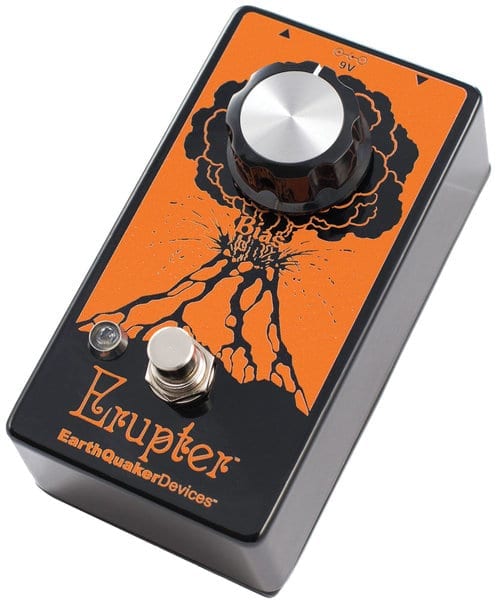
Lowest…
At its lowest setting, the Erupter produces a gated, thick tone with slightly less out. It transforms clean tone into a spongy, bee-buzz sound. An almost synth-like tone. Think of an old video game, chords sound very broken with a lot of air and you can almost imagine the notes of your guitar ripping through a piece of paper. The Erupter somehow manages to retain a natural decrease without having that dying battery, velcro-like decay. Its an interesting and odd setting, and I had a lot of fun toying around with it. If the Erupter was a normal pedal, it wouldn’t be an EarthQuaker.
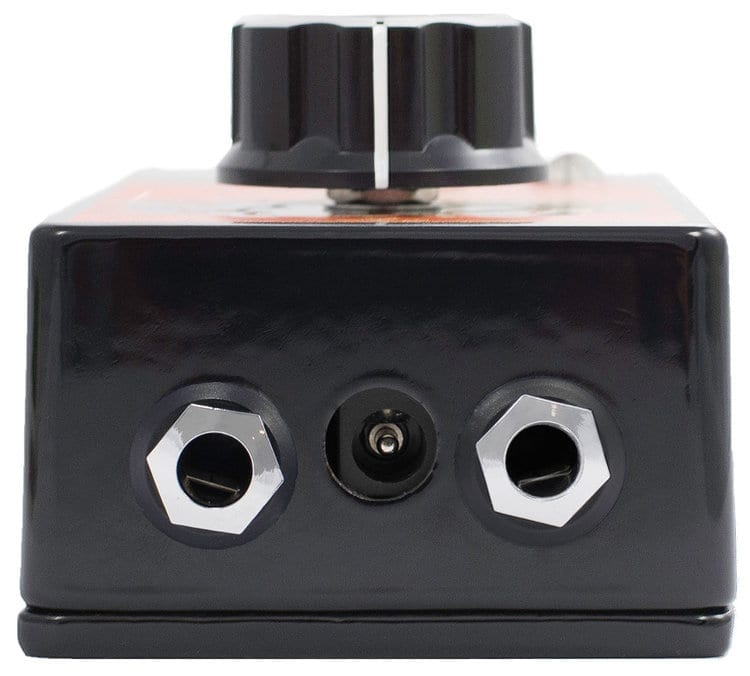
Halfway…
When the bias knob is pointed straight up (noon), the sound starts to thicken up a bit, and some additional harmonics are added to the signal. At this setting, the output has a little more definition and the mids come in beautifully. Try messing around with the volume knob of your guitar and the level of Erupter to throw in a little clean up where you want it, and add another adjustable parameter. There are more layers to unlock.
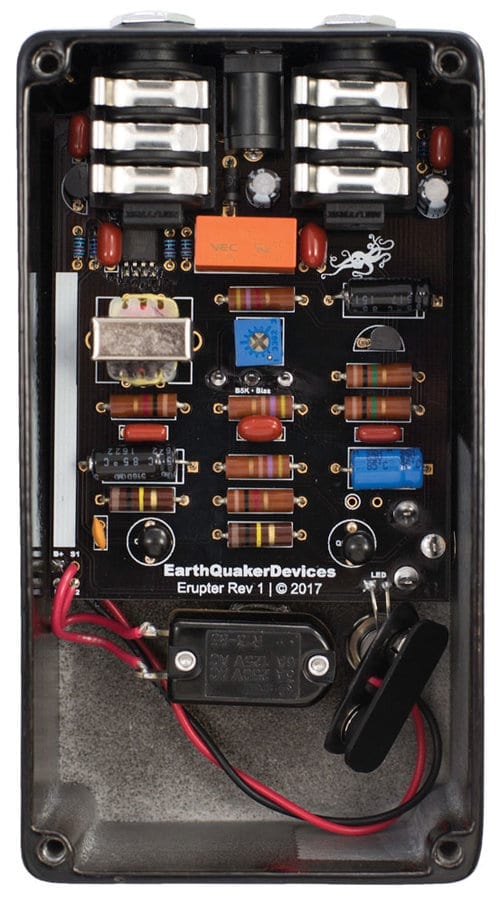
All the way up…
Turn the bias knob all the way up and its name suddenly makes sense: It erupts! Who could have predicted this? You now get all the loud, gnarly, nasty, fuzzy, crazy stuff. Technically speaking, more harmonics are stacked on top, the response is tighter, the definition is incredible, and the sustain lasts for days. It is refined and loud without being too muddy or harsh. Just a thick, burly fuzz you can use to chug heavy, surging power chords or tear through the air with full, crisp leads.
For having been built with a single purpose, the Erupter has an incredible amount of depth and variety. As a fellow shredder friend of mine said, “It sounds like what I wish my fuzz pedal sounded like.” I think that sums it up perfectly.
The Erupter is available now.
To begin, you really need to have some basic knowledge of electrical components and their functions to safely build electronics. Next, you will need a soldering iron and some other basic tools. If you don’t have these items on hand, there’s no need to fret! The Internet provides, and at totally reasonable prices. On the Build Your Own Clone website, you can find a beginner’s tool kit that will equip you with everything you need to get started. The company also offers an easy project called the Confidence Booster so you can start to get your hands dirty. You can also find any of these tools at your local hardware store.
As for me, I learned how to solder using YouTube and buying electronic projects off of Amazon by companies like Arduino and Elenco. These are very cheap options, so it won’t be too much of a bummer when you (inevitably) mess up. Once you complete a successful build, that is when you can move onto more challenging DIY kits such as the Lil’ Reverb kit that She Shreds received from Build Your Own Clone!
Companies like BYOC are giving musicians the chance to own and operate comparably inexpensive clones of their favorite, classic pedals. No matter how you go about it, building and working on your own pedals is challenging, fun, and extremely satisfying! It also allows you to conquer that tone that you have been chasing down.
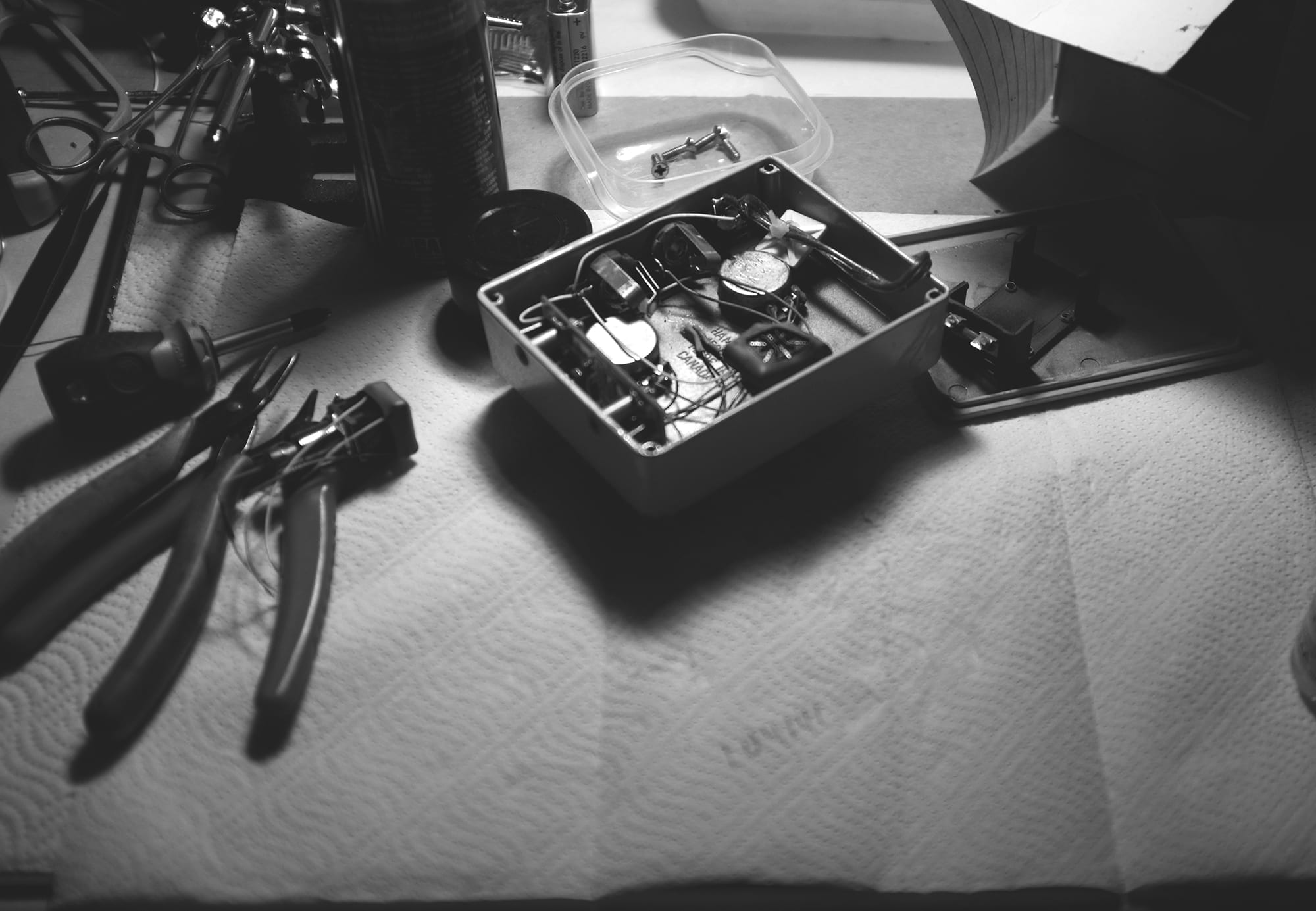
Tools You’ll Need:
Soldering iron
I recommend starting with a 25-30W basic soldering iron with a point tip. There are ones that come with a whole station set up that has a holder and a tip cleaner. These are nice, but they aren’t necessary. You will need a stand, however, to place the iron when not in use. A brass scouring pad or a wet sponge work very well for cleaning the tip.
Solder tube
The most recommended solder is a 60/40 rosin core solder. This means that it is 60% tin and 40% lead.
Small pliers
I like to have a variety of pliers on hand for builds. Needle nose pliers and those on the smaller side work very well.
Wire cutters
Wire cutters are a very important tool to become comfortable with. I like the cutters that have an adjustable screw for wire stripping as well as cutting.
Desoldering braid
If you’re going to be soldering, you’re going to need to desolder eventually. The desoldering braid will help you reverse all the crappy soldering you might be doing at first. Don’t worry; mistakes are part of the learning process!
Soldering safety and tips
Make sure you have a sufficient amount of work space. You will need adequate lighting and ventilation; wearing eye protection is a good idea. You do not want to breathe in solder fumes! They can cause irritation to your eyes, nose, and lungs. It is even known to cause headaches after prolonged exposure. Make sure you never touch the tip of your soldering iron. It is helpful at the beginning to hold wires with pliers as not to burn yourself. Wearing gloves is a good idea if you are going to be touching the solder wire directly. I like to slowly pull the solder out of the tube with pliers and hold the tube to apply the solder.
Make sure you pay attention to the directions/schematics. Some components have very specific placement!
Here are some helpful links to get you started:
Build Your Own Clone’s video on how to solder
Just search “helpful tips for soldering” on YouTube or Google. Read and view as much instruction as you need to feel comfortable.
Build Your Own Clone Beginner Tool Kit $44.73
Helping Hands $9.99
The only tool not included in the beginner’s kit that I use fairly regularly during builds.
Build Your Own Clone Confidence Booster kit $14.99
This kit does not come with an enclosure or foot switch. It will still give you a good idea of what it takes to populate a PCB.
Elenco Digital Bird Sounds Soldering Kit $10.20
I put together an Elenco Bird Sounds kit because nothing says electronic mastery quite like cheap, crappy tweeting. Super fun!
Electronic Projects for Musicians by Craig Anderton $19.28
I own this book, and it has a comprehensive review of all the foundational knowledge you need to get started.
Beatbox Drums by Beatbox Drums
In a touring vehicle, drums generally take up the most space. Even without drum cases, if you play a decent sized kit, drums are going to dominate the space in your touring vehicle. This product is a drum kit that fits into a box. This is all possible because the box itself doubles as a resonator. It would definitely look unconventional onstage, but big ups to anyone making moves on economizing the amount of space that gear takes up. Playing Tetris with musical equipment every night does indeed get old. Leah Wellbaum / Slothrust
Fretwrap by Gruv Gear
This little accessory is great for muting the strings while you do tapping and also in a recording context when you what to avoid unwanted resonance and noise from the strings you are not using. -Laura Klinkert

Mega Bass Strap by Neotech
This memory foam guitar and bass strap is the perfect thing for someone who gigs a lot, but also suffers from back problems. The internal-control stretch system reduces the weight of the guitar on your shoulders by up to 50%. The people working their booth even had a complicated scale / pressure measuring machine to prove it. It is also more adjustable than straps I have encountered in the past, and caters to people who like to play their guitars higher up. -LW

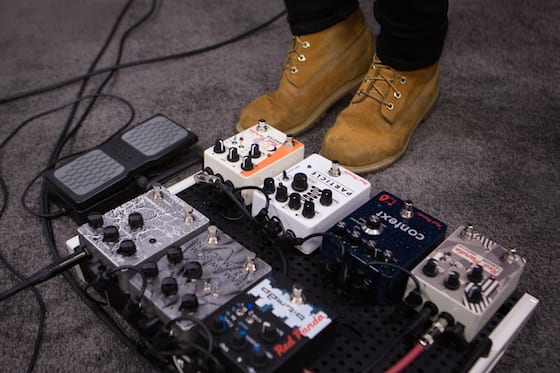
The Particle by Red Panda
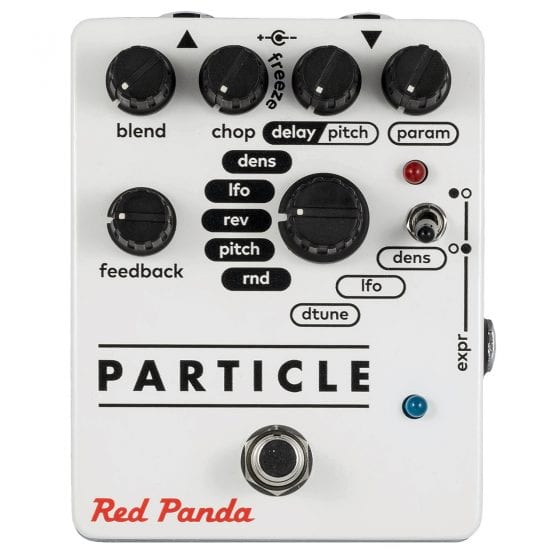
The Particle pedal by Red Panda is a granular delay and pitch shifting pedal with a ton of other things going on. Depending on the settings, this pedal can be well controlled, or incredibly unpredictable. Sonically, I do not know its limits. It can sound like a video game underwater, like a creature about to attack you in the forest, or like a fairy flying toward you, about to kiss your nose. And of course, it is capable of the psychedelic flip-it and reverse-it madness you might imagine. -LW
The Squaver by Sonicsmith
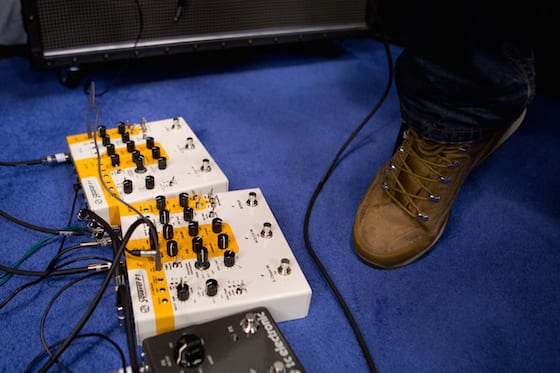
As someone who does not venture far from stringed instruments, it is rare that a synthesizer would catch my attention, but Sonicsmith’s new device definitely had me excited. The Squaver P1 is a semi-modular, audio controlled, analog synthesizer. It turns any audio input (vocals, guitar, bass, you name it!) into analog synth waves. It allows you to mix between square and sawtooth waves. It has the capability of extracting envelope, pitch, and trigger CV from the input audio. The possibilities seem endless with this synth, and it definitely seems like a groundbreaking product in its realm. Go get weird with the Squaver P1 for $730. –Laurence Vidal
Tempest Analog Drum Machine by Dave Smith
This drum machine has one of the best quality sound I’ve ever heard, It’s easy to use and super easy for editing the inbuilt sounds in any context, studio or live. The building and the quality of the hardware seems to be really well done and resistant. You can get all of the most common techno and electro sounds out of it and way more by editing the inbuilt sounds. -LK

TriplePlay by Fishman
The Fishman TriplePlay is a wireless MIDI guitar controller. Whether or not this product is for you, it certainly demonstrates where we are at with music and technology. With the TriplePlay, you can select a variety of instrument plugins and play them via your guitar. It is an ambitious product that I think will evolve with time, and with the development of new plugins and latency solutions. To me, the TriplePlay almost feels like a prank. If you want to play a digital-sounding clarinet on your telecaster, welcome to it. -LW
Ultex Jazz 3 Guitar Picks by Jim Dunlop
This picks are sharp-pointed and also 2.0MM thick. This allows you to have a lot of control over the dynamics, rhythm, and intention. I recommend this picks for sweep picking players because since it’s super thick and sharp it will not blend at all when you sweep. Also, because of the material (ultex) I feel like it is not that bright as common picks and that it will keep it sharpness for longer. -LK

Here are eleven more classic pedals and under-the-radar gems that would make great gifts for you or any other tone freak in your life:
Crowther Hot Cake, $179.99. A nice bright overdrive with equally beautiful harmonics but a more distorted character than the Tube Screamer, the Hot Cake gives you a clean boost with only the Level knob in play, and great controlled feedback as you crank the drive and presence. Beloved of Nels Cline and members of Sonic Youth, it sounds pretty much perfect before the top boost of a Vox AC 30.
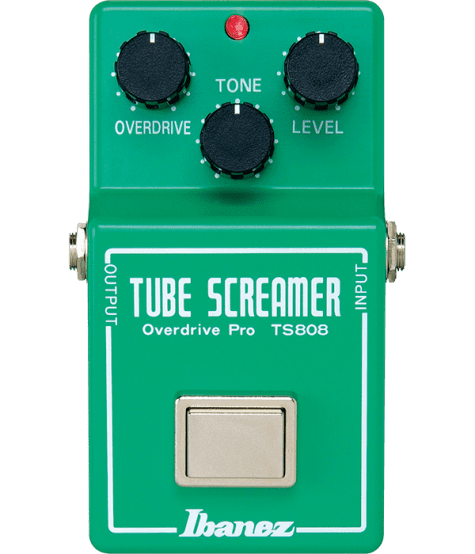
Ibanez Tube Screamer TS808, $179.99. See The Guide for more on this reissue of the classic pedal.
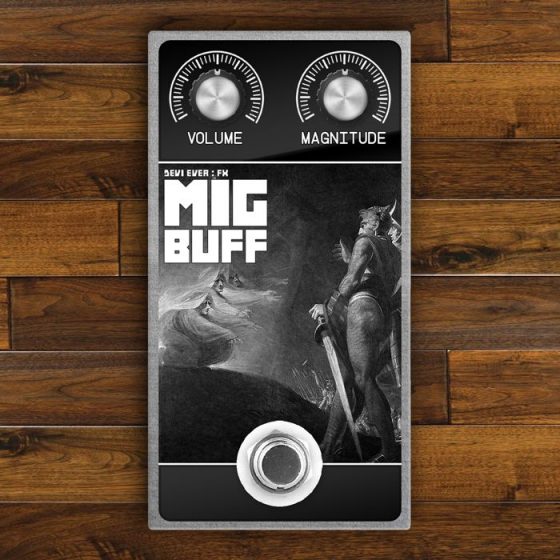
Fuzz Goddess Mig Buff, $85. So much more than a Muff-killer, the range of fuzzes available in the Mig Buff is best described by the Fuzz Goddess, Devi Ever, herself: “gated and woolly, traversing through the land of classic with character, settling into some scrambled octavia fun, and then ending with intense and biting power. I wouldn’t say this is the end all be all of my fuzz designs, but it’s close.” Added bonus: the name’s dig at the misogyny of pedal names like Big Muff. With a price tag of only $85, this one’s a no-brainer.
WMD Geiger Counter distortion, $299. Billed by WMD as a collection of “entirely new face melting sounds,” the Geiger Counter can serve up anything from beautiful, harmonically rich drive to “total madness (impossible amounts of gain, multiple octave foldover, harsh digital data errors, and piercing sculpted noise.)” It’s got Bit Depth and Sample Rate controls, Gain and Tone controls and a Tone Enable/Disable switch, Bit Depth control and a Bits/Mask switch. The Geiger Counter also features an extensive wave table control and display, which “takes your signal and destroys it with math” and always remembers your last setting. This is one for the distortion-obsessives who appreciate an envelope filter and love sputter and annihilation.
Frantone Cream Puff and Peach Fuzz, $295. The Cream Puff is adorable but ferocious. High gain with “full fat” harmonics, it’s perfect for thick rhythm playing. It’s freaking adorable (pink, with a “fluff” knob) but built like a tank and hand wired, like all of Fran’s creations. See The Guide for more on the Peach Fuzz.
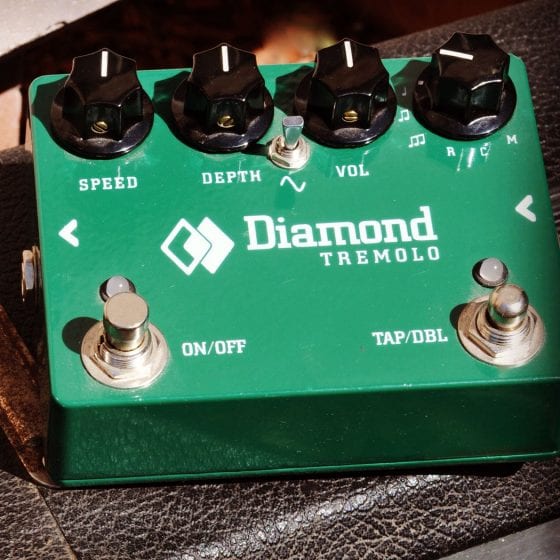
Diamond Tremolo, $239. An all analog tremolo that will comply to your every whim, Diamond’s TRM1 boasts a tap tempo with foot-switchable double speed mode, sharkfin, sine, square, and “chop” waveforms, timing accents, rhythmic trem mode, and “chaotic” mode for random speeds. You can get anything from a vintage amp trem sound with the sharkfin to a sputtering ring mod-like effect with “chop.”
DLS Versa Vibe, $259. Practically indestructible and with seemingly unlimited headroom, the all analog Versa Vibe yields gorgeous, dynamic chorus and vibrato effects. A Modern/Vintage switch lets you choose fatter or brighter tones in both the chorus and the vibrato setting. With waveform, bass throb, and wet-dry pots, you can dial in some really exciting vibes. Sounds great dirty or clean—particularly killer on fuzzed out, melodic leads.
Death by Audio Robot, $320. This one’s a lo-fi analog 8 bit pitch transposer/re-synthesizer which, according to DBA has “absolutely no feelings what-so-ever.” It’s hard to disagree: with four modes (Normal, Octave Down, Octave Up and Arpeggiator) this fucked up fuzz obediently serves up a variety of beautifully decimated tones with impressive precision.
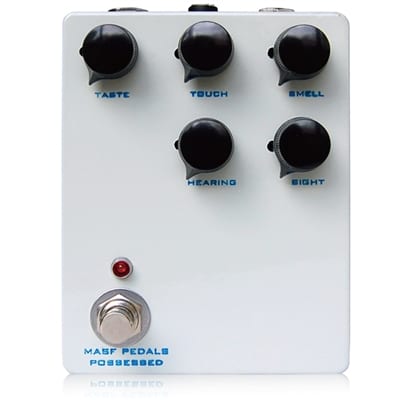
MASF Possessed, $269. If you’re a guitarist who loves the beautiful, glitchy sound of folktronica (The Books, Lucky Dragons, etc.) but also wouldn’t mind your guitar becoming an a laser gun with a mind of its own when you switch on the distortion, this is the pedal for you. This beautiful offering from MASF will truly possess you, bringing an ecstatic tear to your eye one moment and cracking your head open the next. Sturdy construction and an effortlessly cool, minimalistic design, to boot.
Mid-Fi Clari(not), $225. When you first get your hands on the Clari(not), you might audibly say, “what the hell is this?” From the Mid-Fi website: it’s “an Envelope controlled vibrato/chorus/wow and flutter simulator, with the ability to modulate over an octave.” Its controls are Delay, Depth, Blend and Tracking. It’s available in a 4-knob “Clean” or a 5-knob “Fuzz” version, which adds a volume knob. If you’ve scanned this entire guide, you can probably guess that the fuzz comes highly recommended. The Clari(not) will take your leads to a new level. It’s as much of a showstopper as the Versa Vibe: more wild and perhaps less versatile, but with a sharper bite and a cool, minimal design.
Red Panda Particle Granular Delay, $275. This may be a case of “Save-The-Best-For-Last.” Particle is a granular delay and a pitch shifter that chops up your signal and spits it back out, pitch shifted and delayed using granular synthesis. The “grains” are super short segments of the signal you feed Particle, and in return you can get back anything from shimmering echo clouds to stuttering glitch collages. This offering from Red Panda is so much more than a delay. Nor is it an all-or-nothing beauty vs. rage machine like the Possessed or an unapologetically uncontrollable beast like the Clari(not). Particle is a subtle machine with something for everybody.
UPDATE: Congrats to Tilda Bergsten from from Sweden for winning the Ernie Ball Expression Series Pedals!
She Shreds’ 2016 Shred Guide will be available December 12th in a physical version for subscribers and a free digital version for everyone. In addition, we’ll be announcing a new giveaway each week for the next four weeks with some of our favorite products from the guide, starting with the Ernie Ball Expression Series Ambient Delay and Overdrive pedals. Full info on both pedals is available here.
To enter, fill in the submissions form below and follow these three rules:
1. Follow @sheshredsmag and @ernieball (Twitter + Instagram)
www.facebook.com/sheshredsmag/ (Facebook)
2. RT(Twitter) or Repost (Instagram) or Share this link (Facebook) + Tag a friend + #SheShredsGiveaways
3. Enter to win at sheshreds-staging.jzck3hem-liquidwebsites.com/EBGGG
The winner will be announced on December 13th.
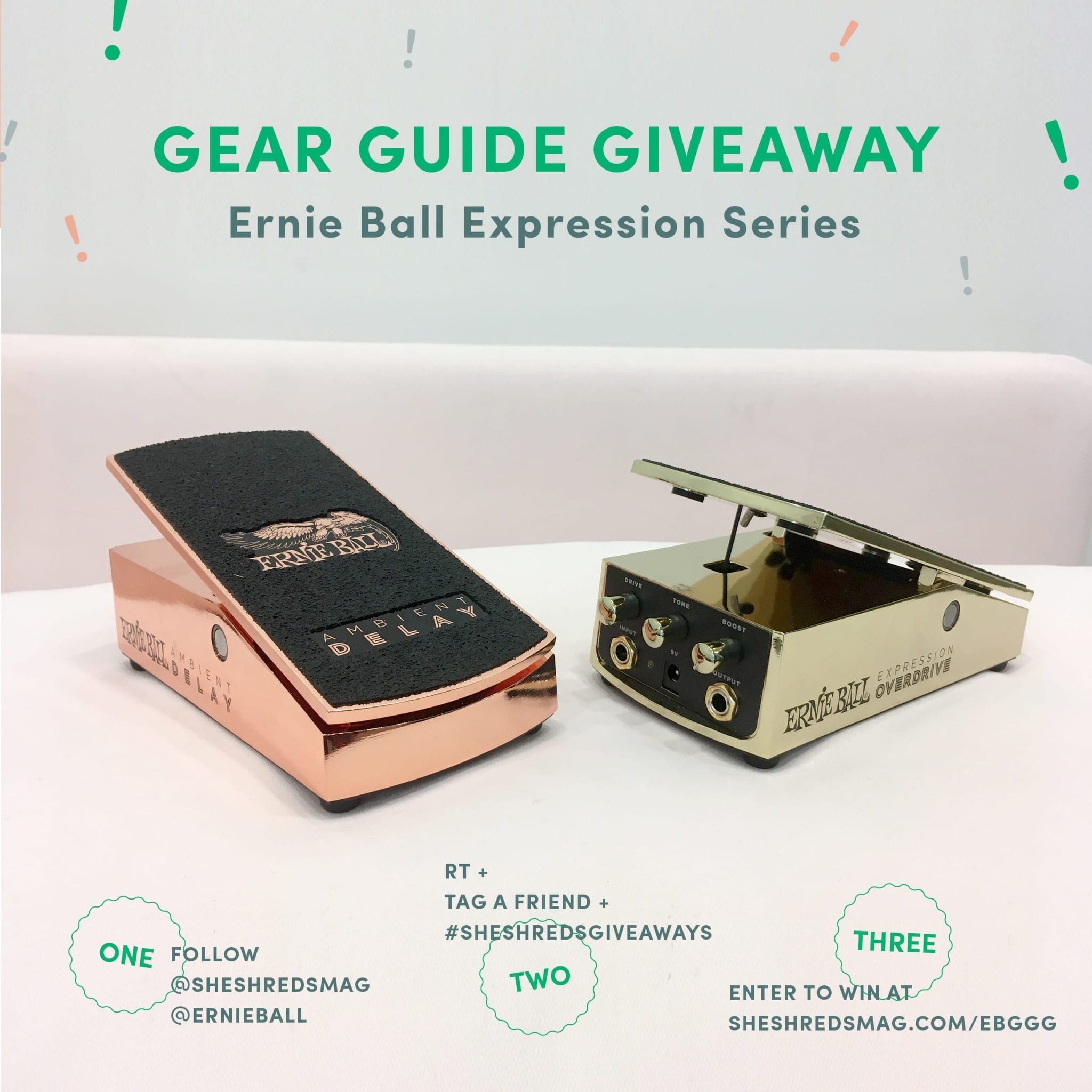
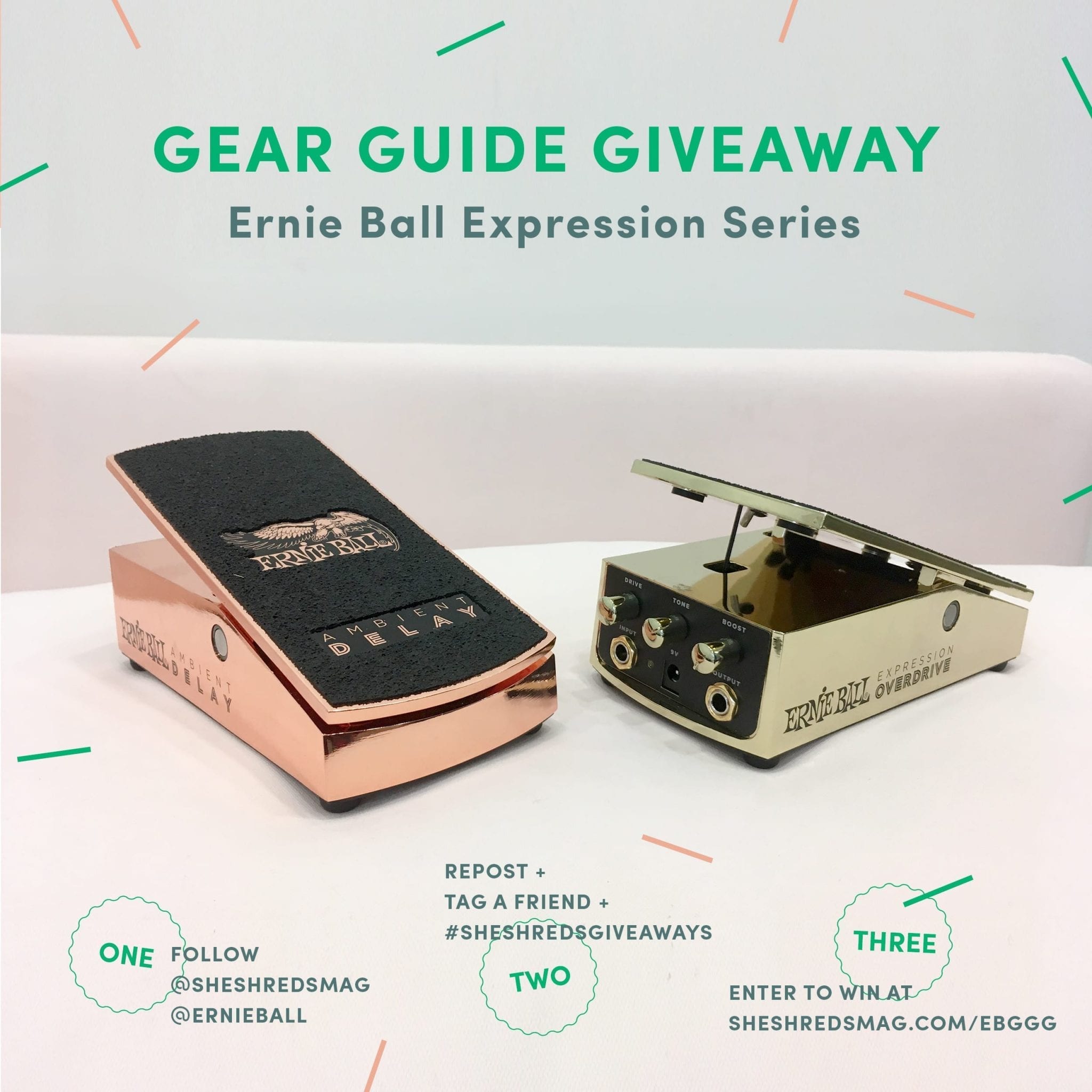
While they have a reputation for being near indestructible, they have been the only pedals Ernie Ball has produced since they were introduced in 1975. That is why I felt a bit skeptical when I first laid eyes on the company’s new pedal line, the Expression Series. It features two pedals, the Ambient Delay and the Expression Overdrive. My major question seemed to be, while they look totally stunning, do they stand up sonically to the competition? After trying them out, I can confidently say that Ernie Ball’s first offerings in the realm of effects are equally successful and impressive.
AMBIENT DELAY
With digital delay and plate reverb, Ernie Ball has successfully engineered a highly-functional 2-in-1 hybrid pedal. Its rose gold encasement features a foot-sweepable design just like their Volume Pedal series. You have the ability to control the delay time (50ms – 1s), reverb level, and feedback level. Tap tempo is only accessible by the addition of an external footswitch (not included). The delay pedals I have owned in the past conveniently have the tap tempo built-in, but I understand that the foot-sweepable control function would not be accommodated with an integrated tap tempo switch.
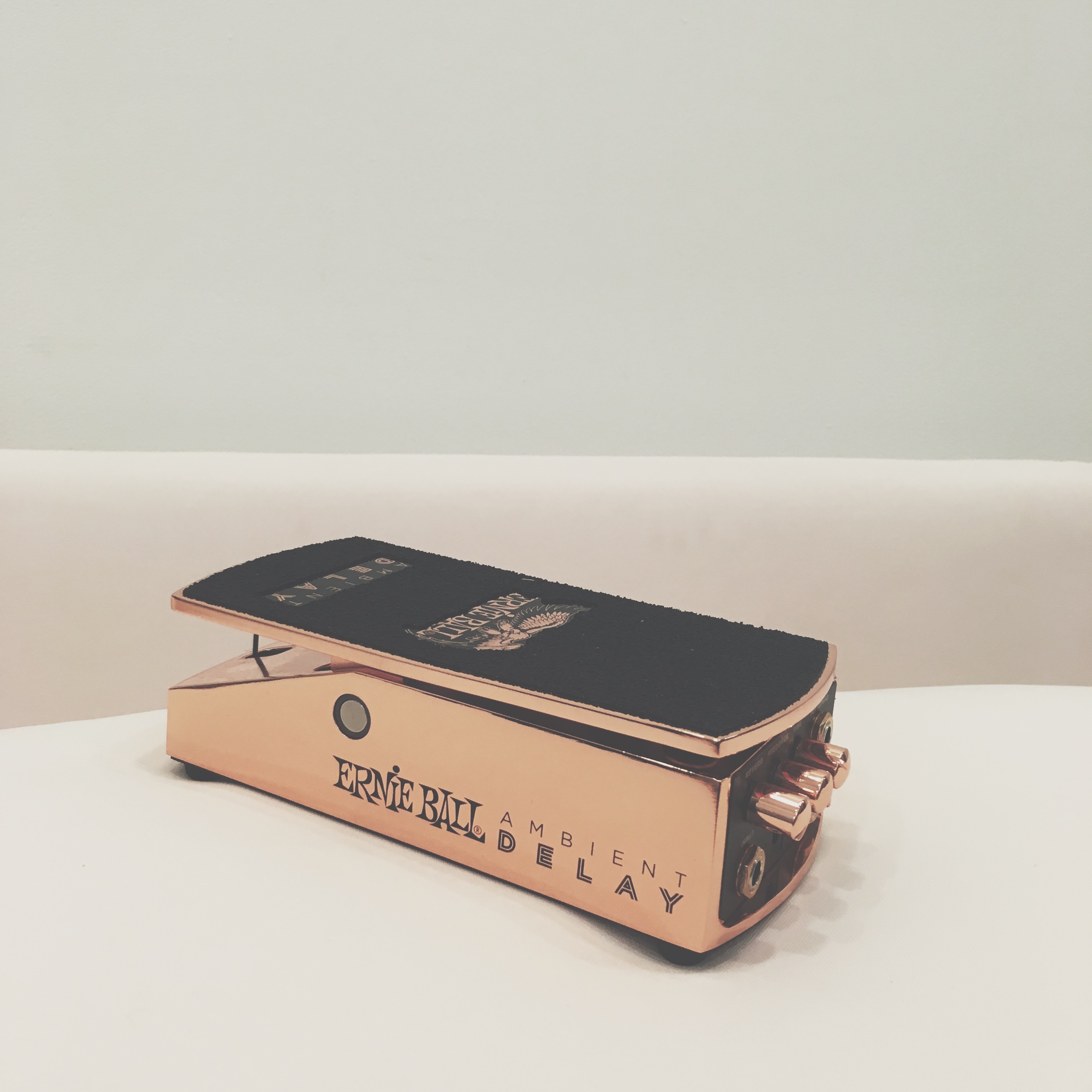
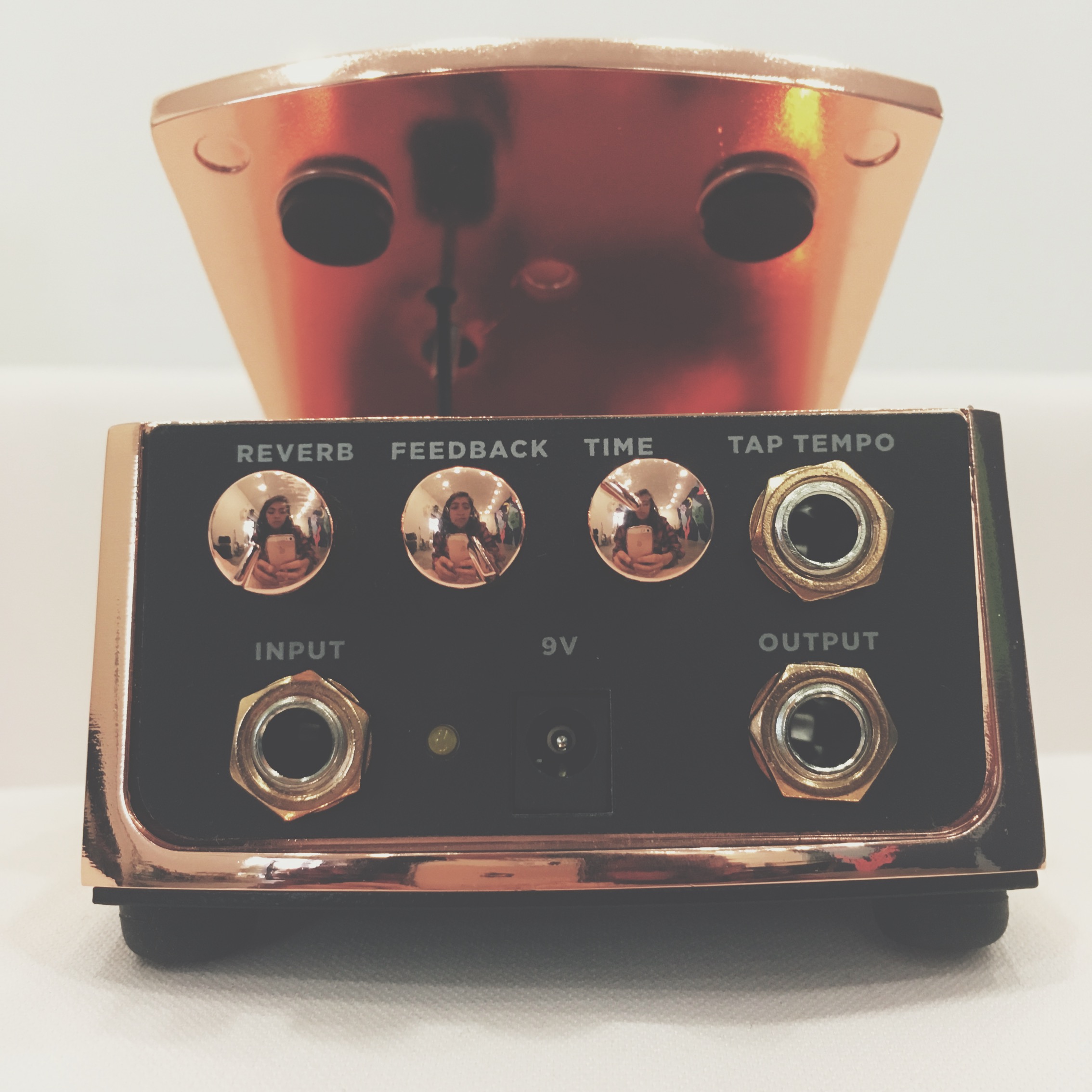
While most delay and reverb pedals are controlled by simply switching the effect on and off, this pedal has the ability to swell into the effect. This allows for a seamless transition into warm, textured delay making the Ambient Delay extremely unique.
EXPRESSION OVERDRIVE
Just like its sibling, the Expression Overdrive offers the same foot-sweepable design but in gold housing. Ernie Ball engineered this pedal to make the transition from rhythm to lead guitar as easy as possible. With three simple settings, boost, tone, and drive, the ability to go between minimal, tube-like drive to grunge crunch was very easy. Integrating the Expression Overdrive onto your pedal board also makes your boost pedal unnecessary.
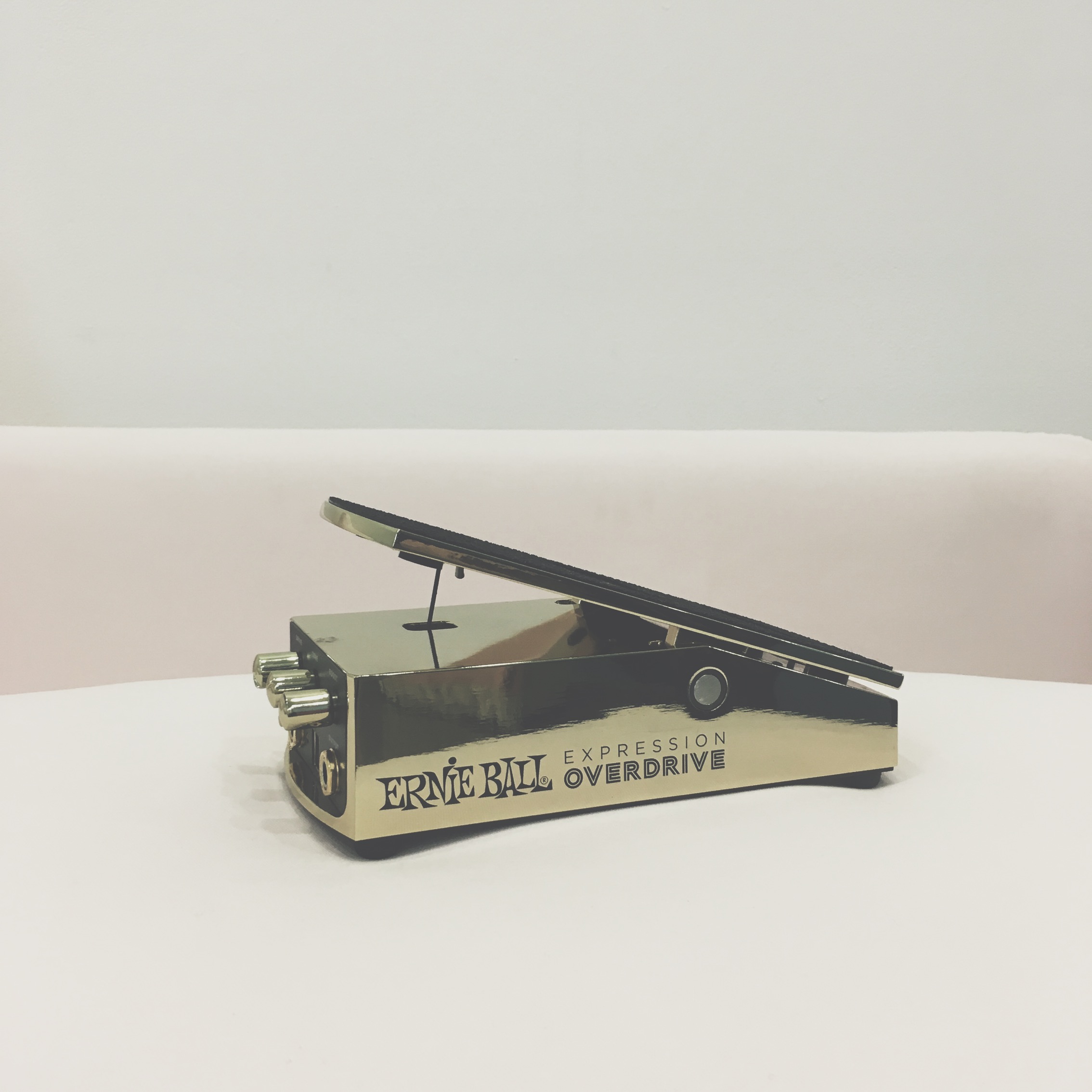
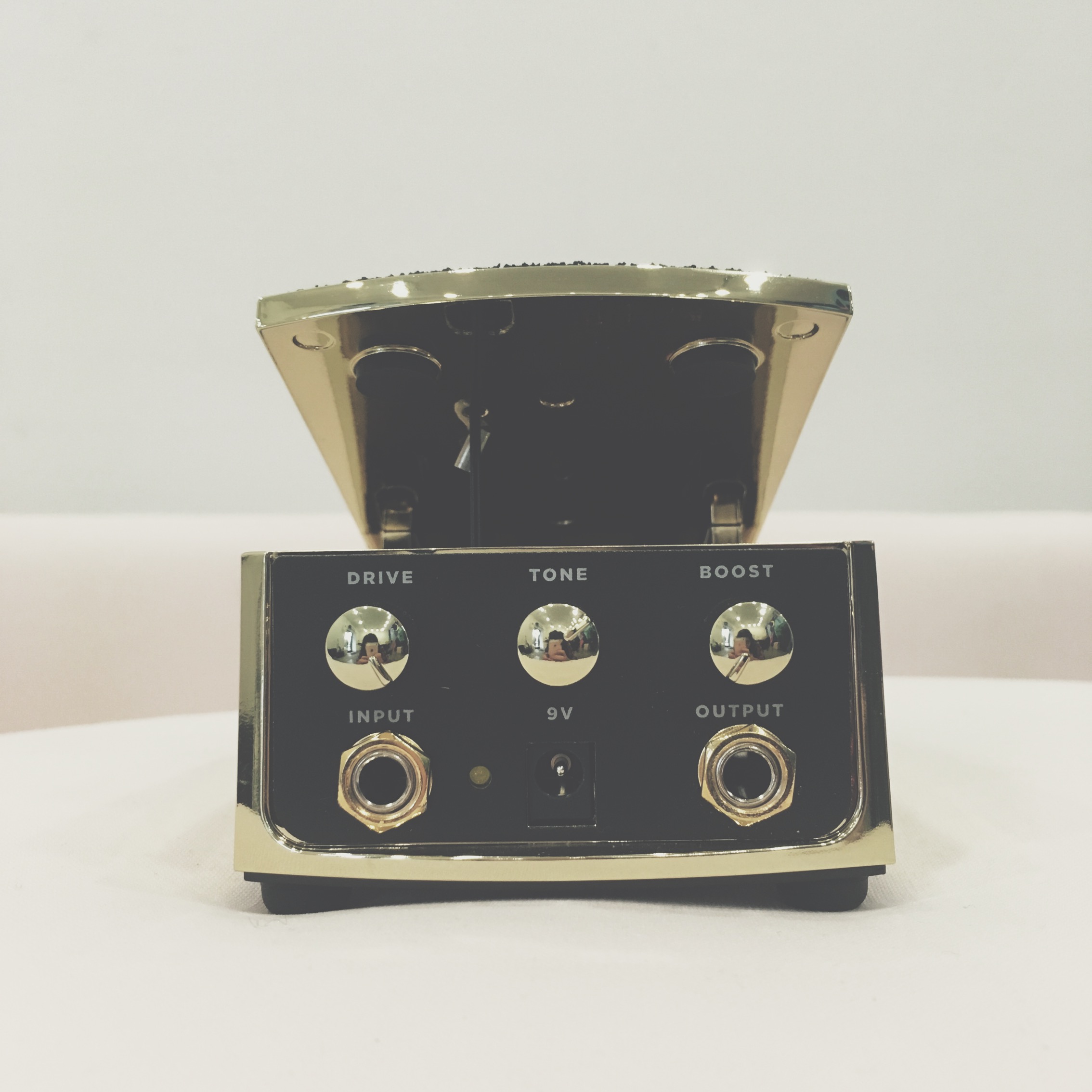
While the design of the pedals is completely efficient, they are a quite larger than most pedals. At first glance I found myself wondering if their footprint on my pedal board would be worth my making room for them. Once I tried them out, I found that was not even a question. Each pedal eliminates the need for at least one other pedal. These hybrids are incredibly adaptable while offering sincere, quality texture to your sound.
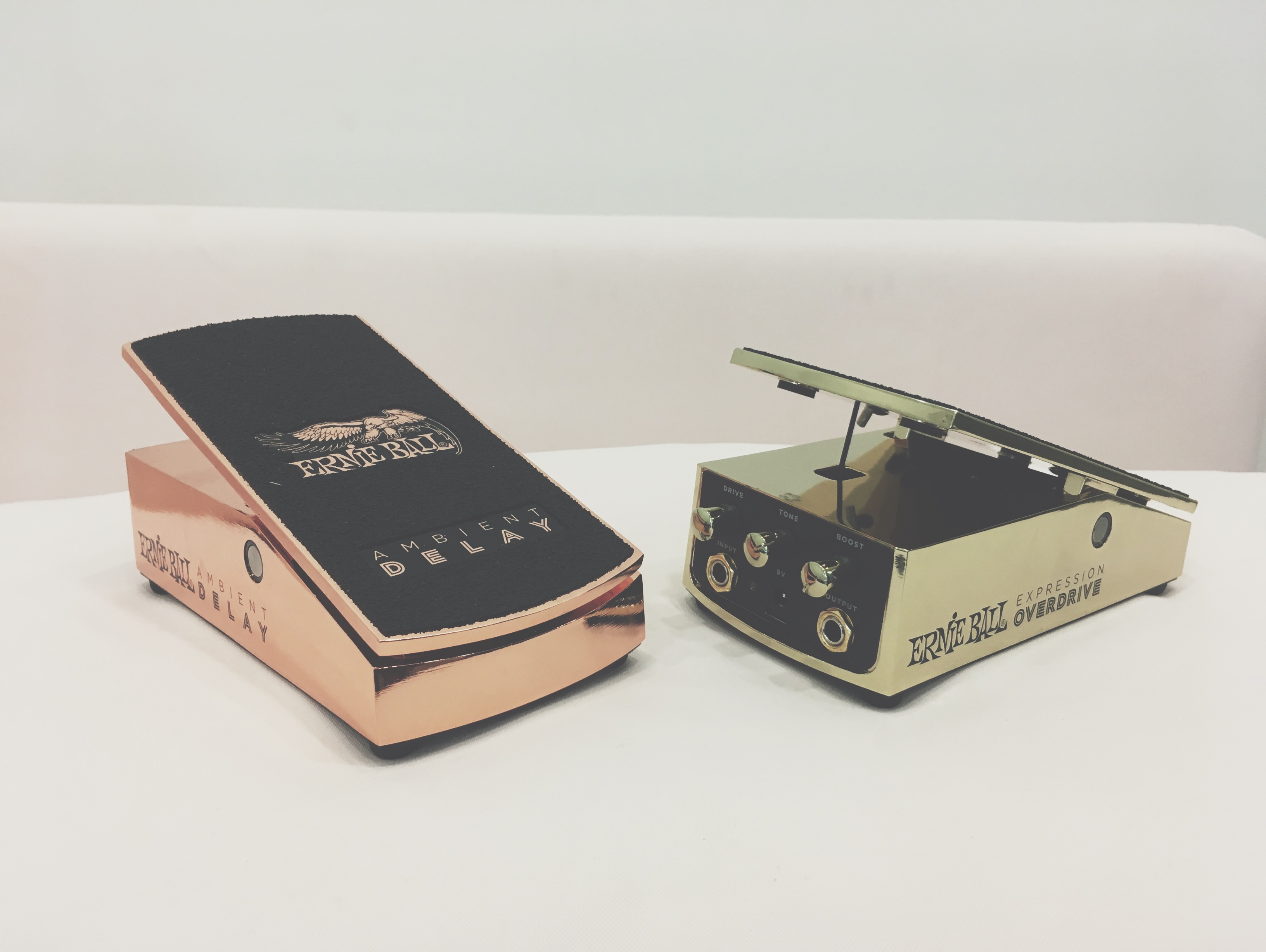
Bravo, Ernie Ball. You have managed to blend both auditory and mechanical ingenuity to create a highly desirable effects series. The Ernie Ball Expression Series pedals are available now.
We reached out to a few boutique pedal companies, owned and/or operated by women, to ask about their experiences and to offer advice to demystify the world of designing and building.
Louise Hinz / Dwarfcraft Devices
dwarfcraft.com
Ben Hinz started Dwarftcraft in 2007. He couldn’t afford his own gear, so he took the DIY route and engineered his own. The company exploded as guitarists caught wind of their flagship product The Great Destroyer, a heavy fuzz pedal with rhythmic oscillation. When Ben couldn’t keep up with building, his wife Louise stepped in.
Gear forums were particularly helpful to Louise when she began. “The problem for a woman is that forums are tremendously unfriendly,” she says. “It’s really hard to not be intimidated, because the place you go to learn is intimidating all on its own.” She says that new boutique companies are way more supportive and want more women involved.
Advice: “Read forums about building. Get kits and schematics and keep trying. If you want to design, work on an idea that is original, because that is how you rise to the top. You need armor with the bullshit that is going to come at you. ”
Adrienne Wisok / Red Panda
redpandalab.com
Red Panda may not be owned by a woman, and the pedals may not be designed by one either, but this company is all-lady. Curt Malouin, founder, is currently the only male. “We joke around that we should do reverse sexual harassment, like putting up Playgirl calendars,” says Adrienne Wisok. She mentions that there are a lot of women in the music industry who work behind the scenes and always have, but you just don’t hear about them as much.
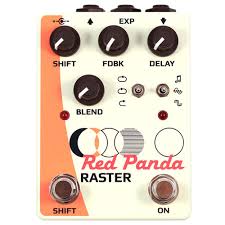
Adrienne was initially hired to do the final assembly—after the circuit boards were programmed she would assemble them into the metal enclosures, attach hardware, and make sure they were ready to go—but she has since started taking on more extensive roles, including prototype soldering. Red Panda’s most notable pedal is the Raster, a digital delay with a pitch shifter integrated into the feedback loop.
Advice: “If you want to know what a pedal does, crack it open, take it apart, and look up what the parts do. People are going to assume that you don’t know what you’re doing, but being underestimated is really valuable.”
Tara Pattenden / Phantom Chips
phantomchips.com
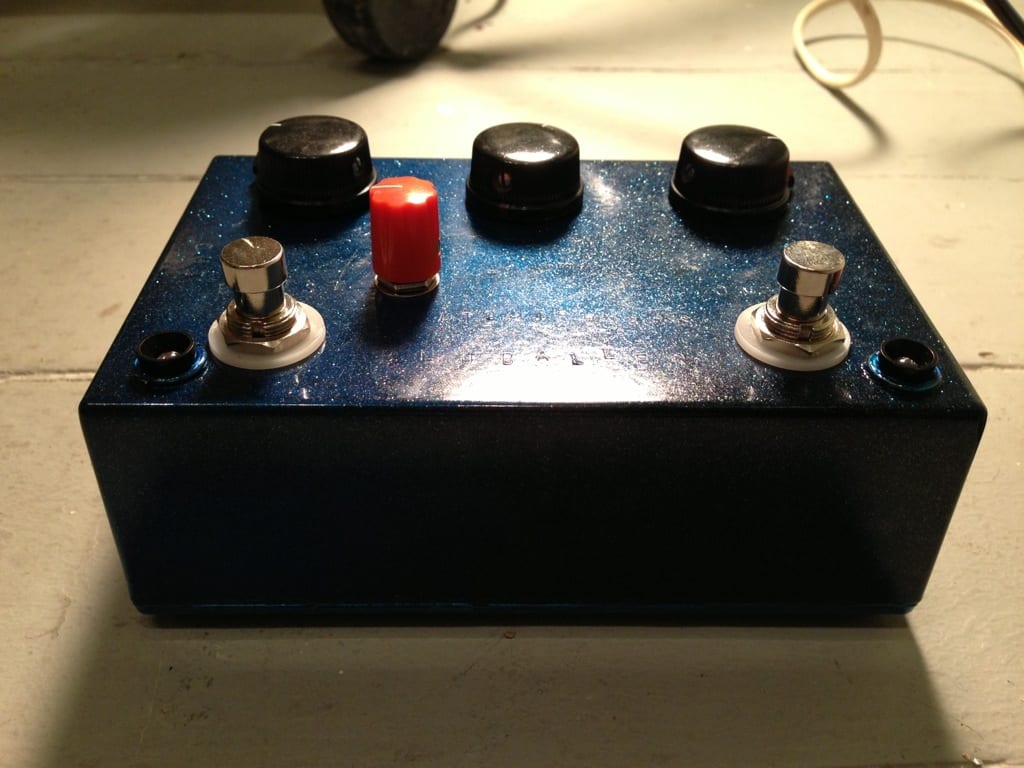
In her solo noise project Phantom Chips, based in Bristol, UK, Tara Pattenden builds all the devices and wearable instruments she performs with. She also works as an assistant for the audio device company BugBrand, and has built her own drone pedal, the Lerango, that she sells on her website.
In 2014, Pattenden co-hosted the workshop Infinity +1 for teen girls alongside multimedia artist Kate Geck. Participants developed many things, including a soldered oscillator, knitted stretch sensors, and a costume-based instrument. The workshop was developed when the two were brainstorming ways to get girls more involved with electronics and sound. “I think there are often less expectations for girls to become good at certain technologies,” Pattenden says. “It’s just part of a much bigger picture, but one we wanted to change by demystifying electronics.”
Advice: “Ask lots of questions! Take some workshops to get hands on experience soldering. Learn to read schematics and experiment with a breadboard. Take a practical approach.”
Carissa Spatcher / Snatchtronics
snatchtronics.com
Ten years ago, Carissa Spatcher started taking apart broken pedals. She found herself fixing them and learning what all the components did. Shortly after, she started doing repairs for a local music store in Massachusetts and someone asked her to clone a very popular boutique pedal at the time—she did, and realized that building was something she could do.
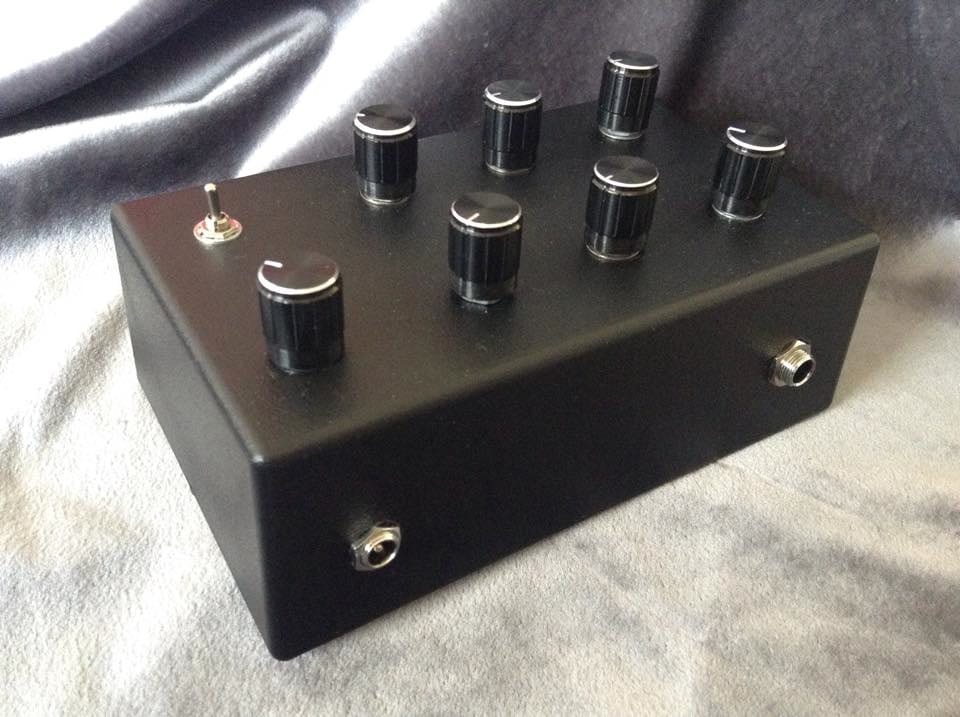
Spatcher started Snatchtronics in 2004. Currently based in Brooklyn, NY, the company is known for its Ovadrive pedal and it’s bass brother Bluballer. As far as women in the pedal business go, Spatcher says, “I think the more women who follow their technical inclinations, the more there’ll be.”
Advice: “Find someone who knows a little about electronics and have them show you something they know. Then you can build your confidence and know that it is possible to build your own effects or fix your own gear.”