
Betsy Wright exudes pure energy. Her conquering guitar solos and tenacious vocals in Bat Fangs emanate the classic rock she grew up with and continues listening to. “Oh yeah, it was all the big guys,” say says. “Led Zeppelin, Jimi Hendrix… It’s such a male-dominated genre, but it’s the music that I love. I want to take all that stuff and make it my own, from my perspective.”
Wright started playing music at six years old, learning the piano but eventually switching to the guitar. She began borrowing her dad’s acoustic at the age of nine, and eventually got her own guitar—a Takamine Taka-mini acoustic—when she was 12, and taught herself how to play by learning Ani DiFranco songs. As a teen, Wright stole her brother’s ‘90s Stratocaster when he left for college, teaching herself songs by The Beatles—“The Beatles are my music foundation of anything”—and listening to a lot of guitar-driven ‘70s and ‘80s rock. “I love the Stratocaster, it’s just so easy to play… but with Bat Fangs, it’s just not a Fender sound,” she says about eventually switching to a Gibson. “The twang isn’t where it’s at for this type of music.”
In college, it made more sense to Wright to study classical piano over the guitar. “When you are playing piano, you are playing the bass line and the chords and the melody sometimes,” she says. “So it’s like having an entire band in one instrument. You have to think of all the different parts.” She studied jazz piano at Bard College, but dropped out in her third year and transferred to the music program at George Mason University. And while she still teaches piano at a school in DC, she admits, “I don’t feel creative on piano when I write because I’ve studied it a lot. Guitar has always been more fun and creative. ”
In the past, Wright has played Wurlitzer in The Childballads with the late Stewart Lupton, as well as guitar in the experimental, Sonic Youth-esque The Fire Tapes. These days, she’s singing and playing guitar in Bat Fangs with Laura King (Flesh Wounds) on drums, as well as playing bass in Ex Hex with Mary Timony (Helium) on guitar and Laura Harris (The Aquarium) on drums. With Ex Hex, Timony writes the songs, and for a while Wright just wrote along with the guitar but has started adding her own embellishments. As Bat Fangs started in 2016 while Ex Hex caught their breath after an extensive tour cycle, Wright has returned to the guitar and is the primary songwriter. “The guitar part will come first, or a beat on my drum machine, and then I layer on vocals for a melody,” she says of her songwriting process. “Once I have a good start, I can jam on it with Laura, and we arrange the songs together.”
With their self-titled debut album, released this past February on Don Giovanni Records and recorded by Mike Montgomery (R. Ring, Ampline), Wright wrote the 9-song album with her classic rock inspirations in mind. “Okay, what kind of music do I really love? What would I put on?” she asks herself. “Big Star or something. That’s fucking rock ‘n’ roll. That’s just what I want to play. I just want to have fun. I don’t want to cry; I’m too old.”
We spoke with Wright about some of her favorite gear before Bat Fangs’ set at Sled Island this past June.
“I used a Orange Terror Bass Head 500 with an 1×15 cab, but I just got a 2018 Orange OB1-300 head, which is even better than the Bass Terror! I’ll be using that from now on.”
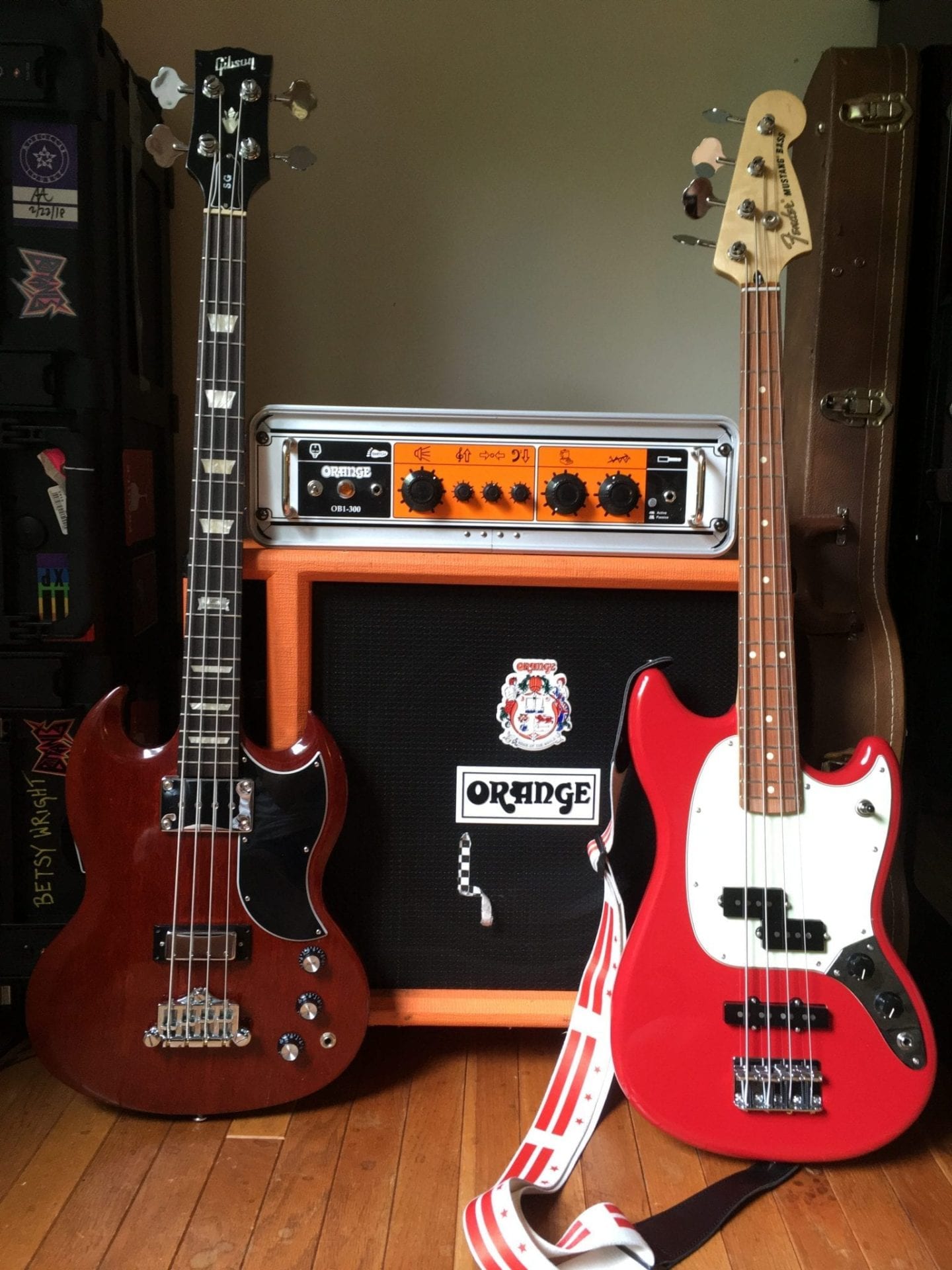
“I was playing the SG bass, but I just recently started playing a 1978 Fender Mustang, and I like the way it sounds better. It’s clear and has more of a mid-trebley thing that I like—it sounds more guitar-ish. I didn’t even own a bass until I started playing in Ex Hex.”
For their live sets, Wright plays a 2017 Gibson SG Standard electric guitar with humbuckers, an Orange Rockerverb 50 MKIII with a 2018 2×12 Marshall cab, a Fulltone GT 500 F.E.T. Distortion and Booster overdrive, an Electro-Harmonix Stereo Pulsar tremolo, an MXR Carbon Copy analog delay, and a BOSS TU-3 Chromatic Tuner.
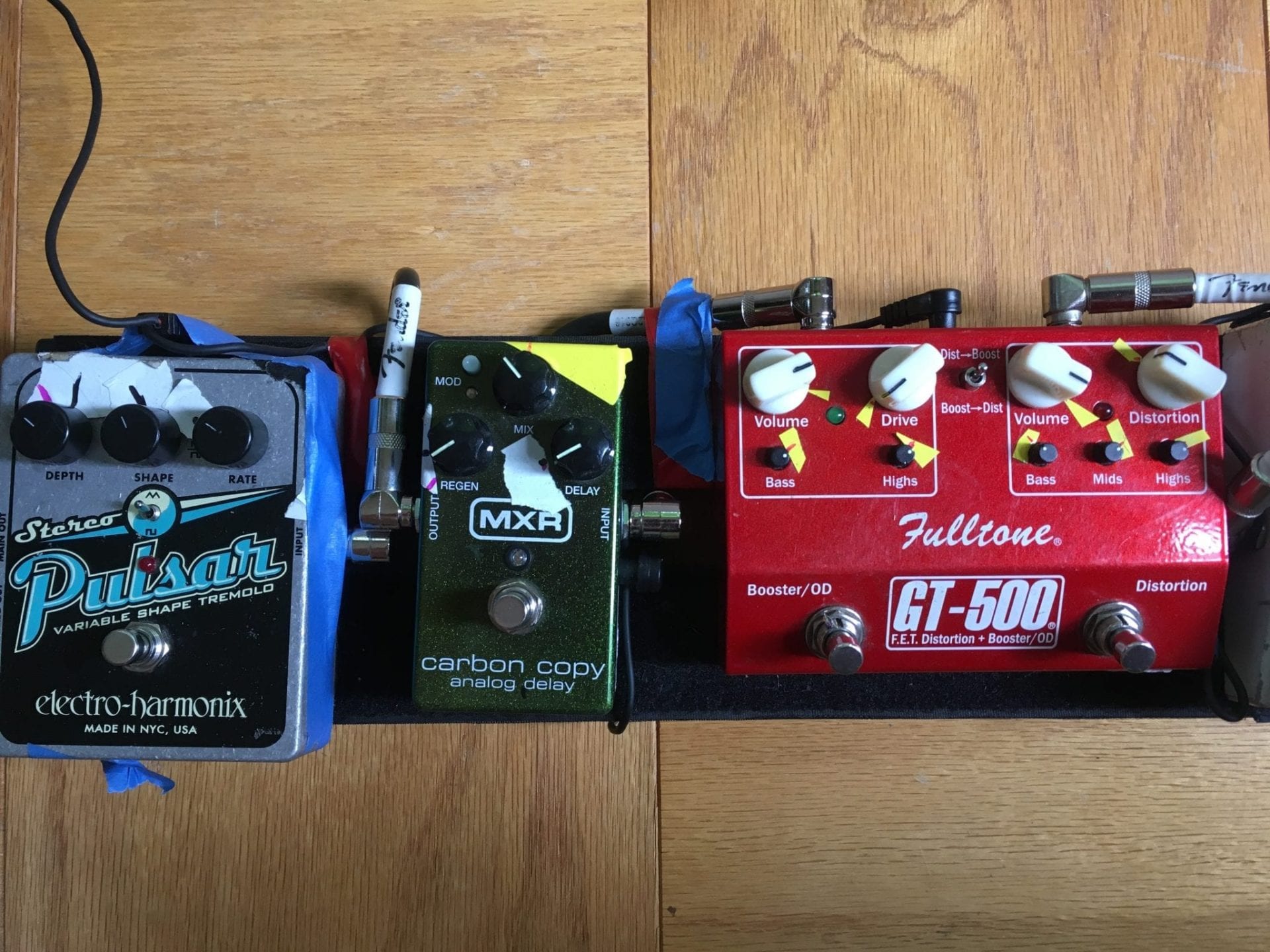
“I set my Rockerverb on the dirty channel and give myself enough headroom where it’s not super blown out distortion, but where it sounds good for rhythm.”
“The Fulltone pedal has the distortion side and the boost side, so it’s basically two pedals in one, but I mostly I use the boost side. The cool thing about that pedal is it has EQ, which allows it to cut through instead of getting fuzzed out. When it’s too fuzzy, the sound disappears. It’s not as expressive, it’s just so compressed.”
“With the MXR I set it at a super short delay, super short regenerations. The mix is pretty low.”
For recording Bat Fangs: “I did a lot of double tracking, and used a Les Paul from the ‘90s and a 1965 SG Special with P-90s. I played them through an ‘80s Marshall combo JCM800 with a 1×15 speaker. I used the MXR Carbon Copy Analogue Delay, and I just used the distortion from the amp. I prefer to use the amp itself as my distortion pedal. The only problem with that is, in a live setting, if you want to boost your signal for a solo, it just hits the front end of the amp harder, which causes more distortion and not necessarily a lift in volume. I have spent the last two years really honing that, and figuring out a way around that.”
When the original St. Vincent Signature guitar by Ernie Ball Music Man made its debut in 2015, it did more than just excite fans. The guitar quickly made headlines across both the internet and mainstream news, becoming one of the most discussed releases of the year within the guitar industry. Annie Clark, who performs as St. Vincent stunned her fans on Instagram when she mentioned that not only had she designed her new guitar with Ernie Ball Music Man, but that it also had “room for a breast or two.”
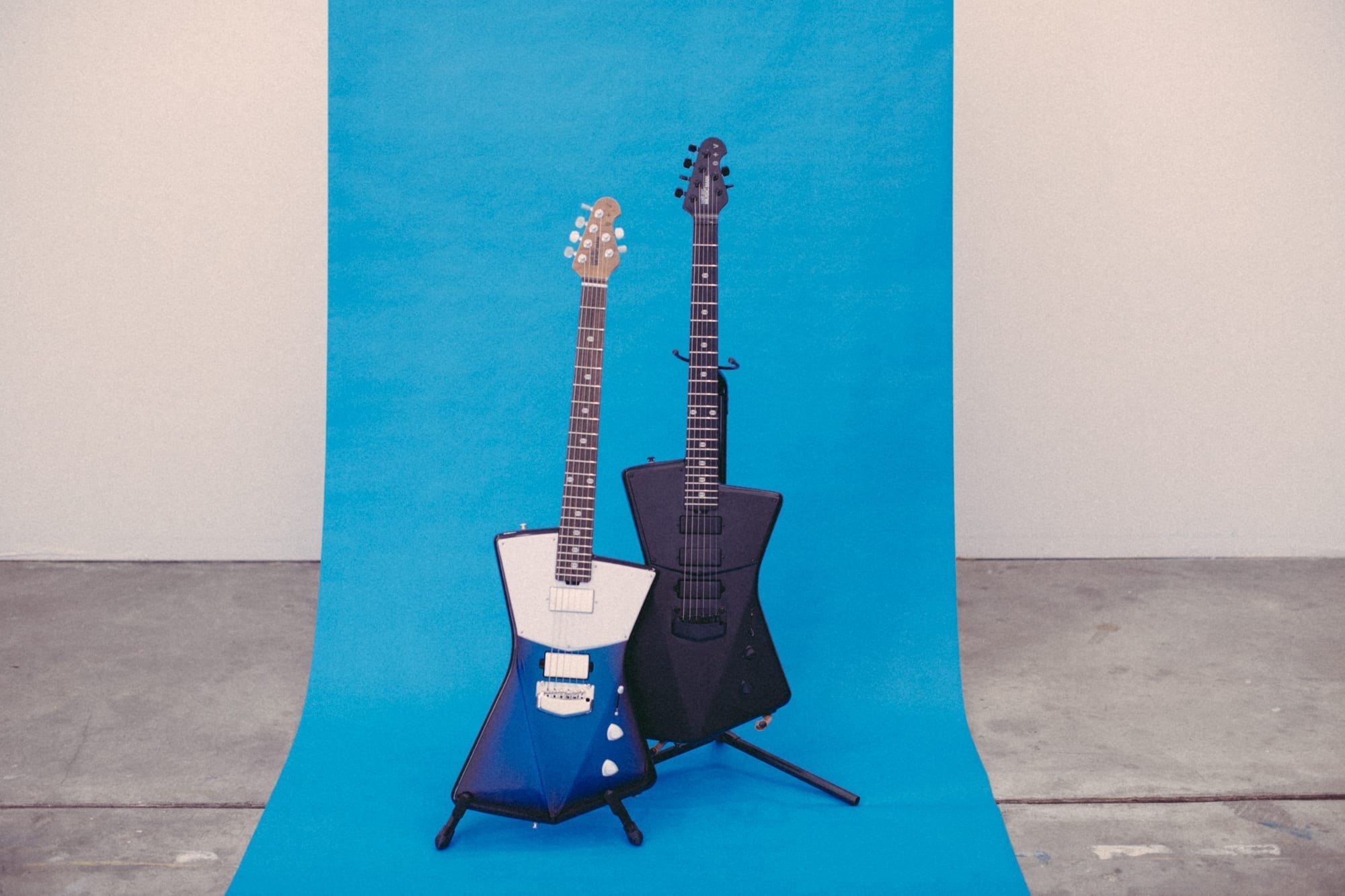
Almost immediately, the instrument became typecast as a guitar made only for women despite Clark making it clear during an interview with VICE that the design was inclusive of all genders. Quite surprisingly, none of the major guitar companies had ever released a woman’s signature guitar that was a completely original design from the artists themselves, making Annie the first woman to do so. The result was a guitar that was as comfortable to play standing up, as it was sitting down; offering a huge pallet of timbres to choose from. Three Dimarzio mini-humbuckers wired to a five way switch within easy reach of its volume and tone controls.
Each contour carefully selected to be as ergonomic as possible for every player that held one, and strikingly finished in a shade of blue that Annie herself mixed specifically for the guitar. Suitable for recording and touring on a professional level, it became quickly adopted by fans and professional musicians as a quality guitar.
Recently, the guitar has become a favorite among a number of other famous guitar players like Omar Rodriguez Lopez who quickly made use a custom left handed version on tour with At The Drive in, and most notably Jack White who performed with it on Saturday Night Live praising it during several an interviews.
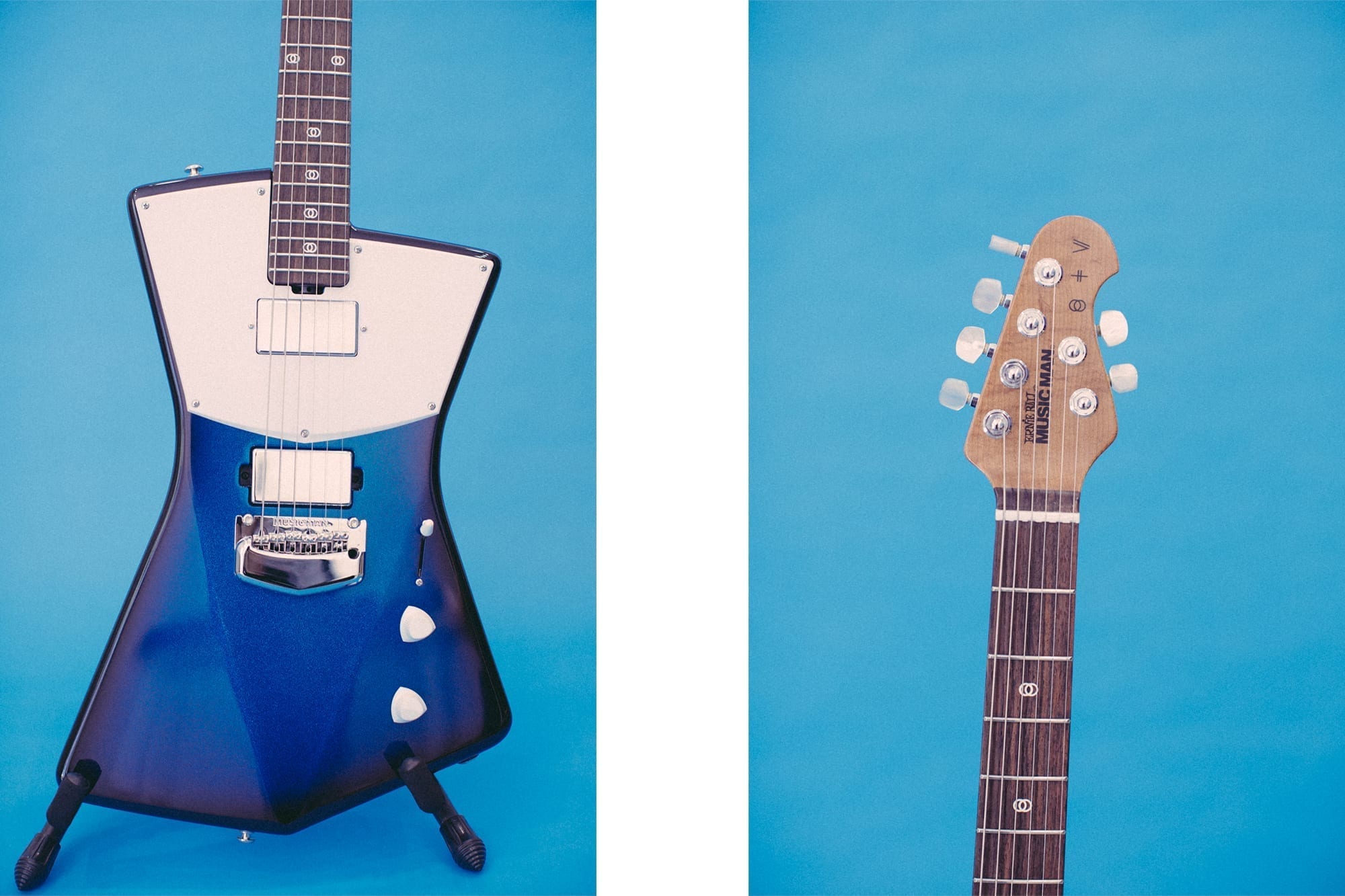
Arriving in a heavy duty hardshell case, the guitar makes a strong first impression with its new beautiful “blue dawn” sparkle, offset by a large white pick guard. Refreshingly unique in its angular design, the guitar takes advantage of one’s natural posture and balances easily in your lap. The back and top of the guitar’s clever contours make it feel quite comfortable in a wide variety of positions. Ernie Ball states that on average the guitars all weigh about seven and a half pounds making them light enough to play for many hours with relative ease. Twenty-two high profile medium with frets lay across a rosewood fretboard on a highly figured roasted flame maple neck with compound radius and compensated nut. The back of the neck, slightly narrower near the nut with a round profile and hand rubbed with satin like gunstock oil finish is smooth to the touch and non sticky.
A five bolt sculpted neck joint joins an African Mahogany body with easy access to the upper notes. Schaller locking tuners adorned with pearl buttons combined with the straight string pull of the clever “4/2” headstock design keep the guitar shockingly in tune even after repeated multiple dive bombs; allowing the strings to go entirely slack via the guitars custom tremolo bridge. The ability to do this without the use of a locking nut and micro tuners is simply outstanding and it keeps the guitar easy to restring and maintain.
Separating itself from the previous model, the St. Vincent HH sports two custom full size humbucking pickups designed in house by Ernie Ball Music Man.
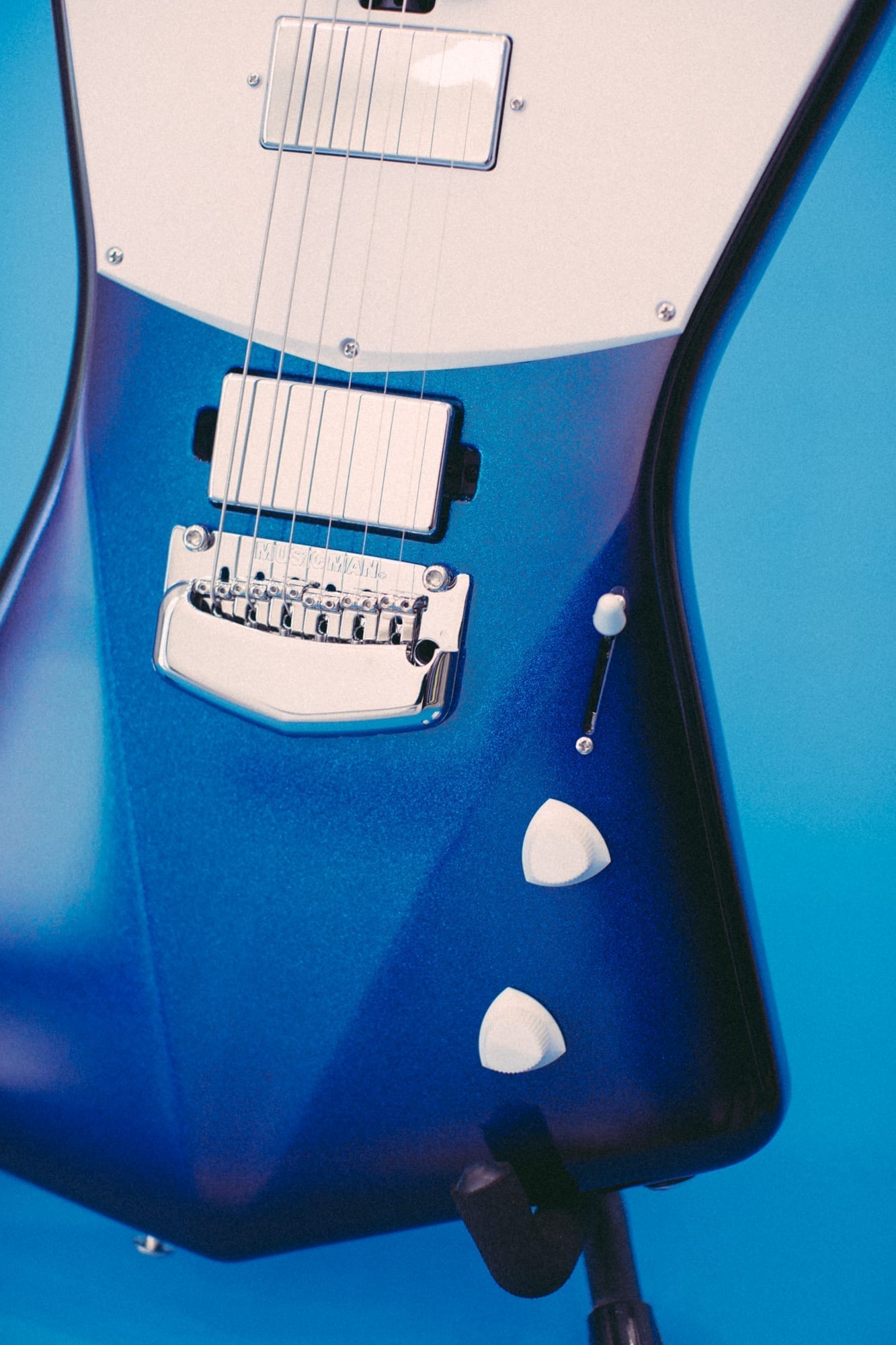
Capture all of the sustain the guitar has to offer with a thicker timbre that welcomes more aggressive styles of music such as metal and punk, while still maintaining enough clarity and sparkle for any aspiring dream pop band. Like its predecessor the pickups are wired to a five way switch for the most versatility available. Two separate positions of the five way toggle-switch which allow both the inner and outer coils of the pickups to be combined stand out from the standardized wiring scheme of neck alone, bridge alone, neck and bridge together that most guitars with dual humbucking pickups come equipped with.
When Annie Clark first set out to design her guitar, she landed her sights beyond her own individual needs and took the opportunity to create something entirely new. The iconic guitar could become a more welcoming modern alternative to the classic designs that remained largely unchanged since the 1950s that dominated the landscape of guitars in music retail. It’s easy to get hung up on the idea that a signature model guitar can only represent the music of said artist, but it’s also easy to forget that the Gibson “Les Paul” was first and foremost a signature guitar designed from the ground up by the very artist who played them. So, it’s safe to say that the STV HH is for anyone and everyone ready for something light, versatile and creative.
Sleek. Flexible. Innovative. What better way to shred this summer other than with the Ernie Ball Expression Tremolo Pedal? It’s designed to not only minimize footprint on your pedal board, but also has FIVE different tremolo waveforms. Can’t forget to mention, its limitless tonal palette just can’t compare to the traditional “on/off” stomp boxes.
If you’re too excited and want to learn more, here are the specs!
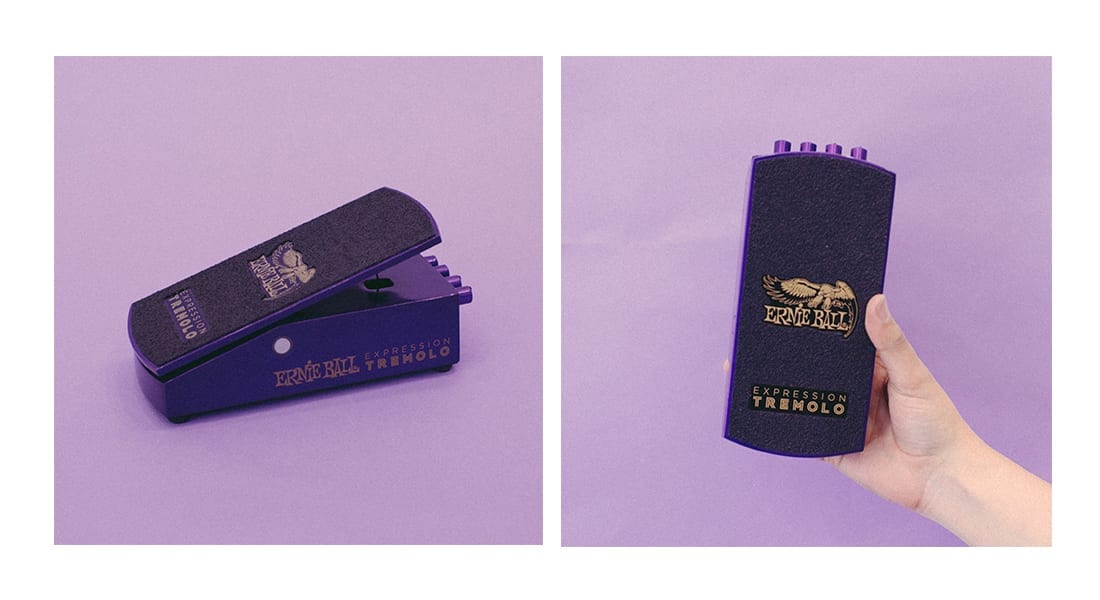
The winner of our giveaway contest will get one of these pedals, courtesy of Ernie Ball…so that’s your cue, go and enter to win this already!
Rules:
Winner will be e-mailed on Monday, July 2nd. If you don’t live in the USA that’s ok! You can still enter to win but you’ll have to pay shipping price (sorry!) so enter at your own risk!
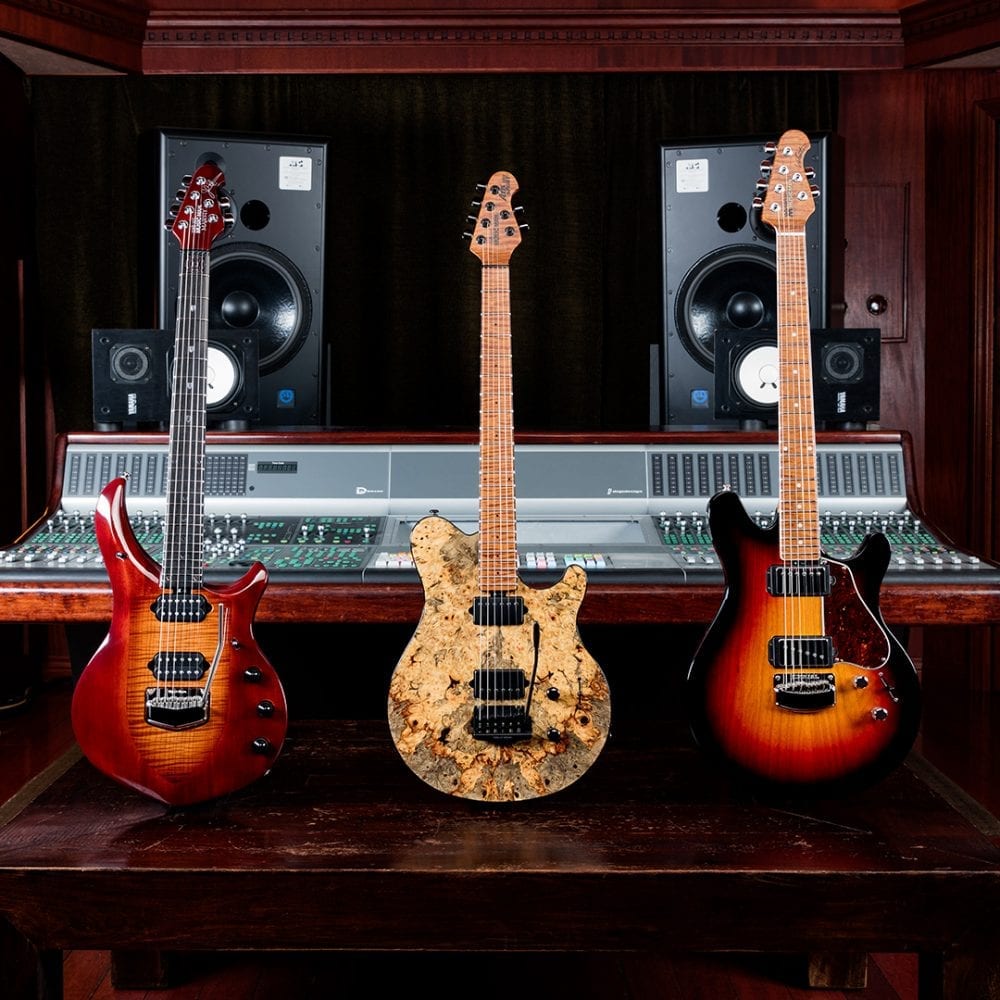
BFR guitars are produced in super-small quantities (think dozens, not hundreds or thousands) using carefully selected tone woods and finishes that add to their sound and overall appeal. The models and looks change each month to fit a variety of personalities and playing styles (last fall they even produced two limited-run St. Vincent guitars).
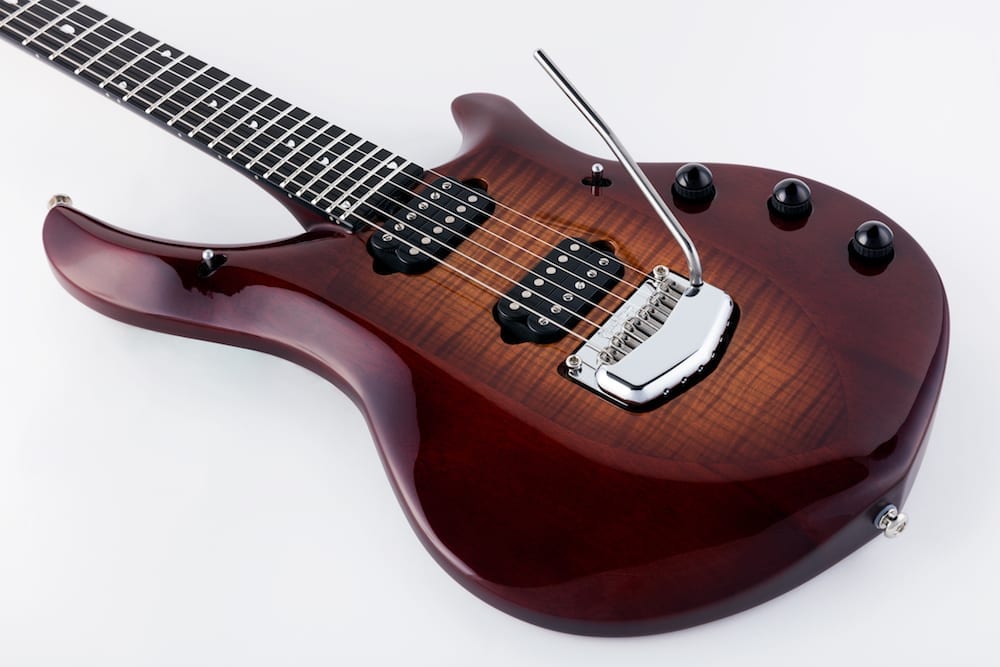
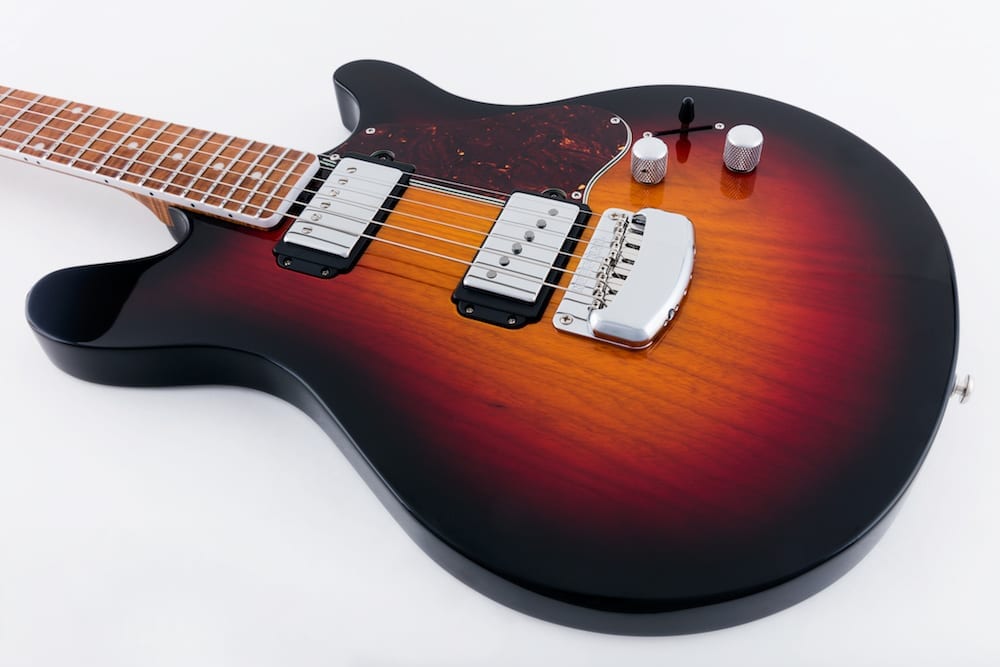
All three of April’s instruments—the Axis Super Sport in Buckeye Burl, the Majesty in Sahara Burst, and the Valentine in 3-tone Sunburst—embrace the eye-catching qualities of natural woods and vintage-style finishes, and come with a number of unique features:
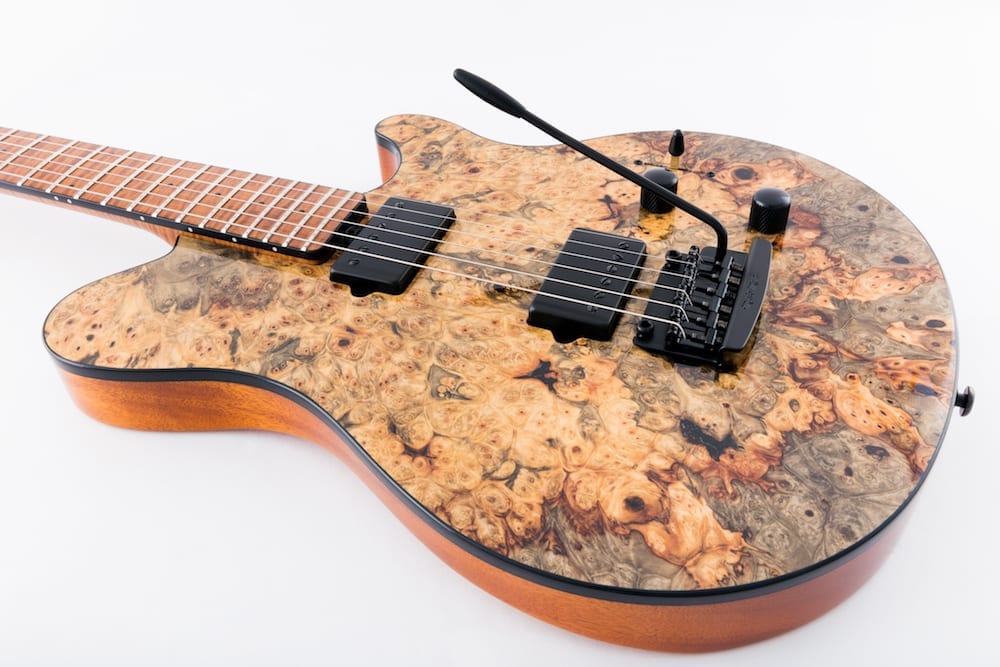
Majesty – Sahara Burst
This BFR John Petrucci Majesty has a translucent burst finish that sets off the look of its roasted top and roasted flame maple shield. The 41 guitars in this style are made from deep-hued African mahogany and feature ebony fingerboards with Majesty inlays and stainless steel frets, as well as all-chrome hardware.
Roots/rock musician Erica Blinn, who was sitting in with bands on harmonica in bars around her hometown, Columbus, Ohio, at age 14 and—after adding guitar to the mix—launched her first band two years later, began learning about cars nearly as early in life as she started developing her musical chops. “I’ve always been a person who likes to take things apart and see how they work—it’s part of my personality,” she says. “A lot of people don’t care to learn, but I want to do everything. We always had old vehicles that needed work, too. I couldn’t afford to pay someone to do it, and the fact that my dad had the skills, he was always like ‘we can fix that,’” she says.
Blinn’s DIY mindset and hard-working ethos have served her well as a musician. After playing with a few local bands, she turned her attention to recording and performing under her own name, and after finding regional success with her 2014 debut album, Lovers In The Dust (Curry House Records) she and her bandmates relocated to Nashville in 2015. Blinn says they’re all digging their adopted home base and musician-saturated community, but their recording and touring schedule hasn’t left them with all that much time to explore it. “We’ve lived [in Nashville] for two years, but it still feels like we don’t know that much about it because you live here, but you’re touring.”
In her years on and off the road, she’s encountered a variety of auto-related mishaps from minor issues such as oil leaks to major repairs such as replacing her van’s starter. Once, she and her band even traveled home from a gig in Arkansas with a dead battery and had to ask fellow travelers for a jump every time they stopped for gas (Later I was like, “why didn’t we just buy a battery in Arkansas?” she laughs).
Now that Blinn’s released her second album, Better than Gold—a mix of jagged, earthy blues rock, rootsy ballads, and a hint of new wave a la the Pretenders or J. Geils Band—it seems likely that she’ll be racking up more tour mileage than ever. She Shreds recently caught up with her at home to learn more about how any musician can prepare their vehicle for tour, and get her tips for troubleshooting auto issues from the road. “I’m no expert; everything I’ve done, I’ve only done a couple of times,” she notes. “[but] it’s always cool when you can do something yourself.”
Find out more below. Better Than Gold is available for purchase now.
Before you go:
Give yourself time to prepare
I’ve totally gone to get an oil change two days before tour to hear “you need a new radiator,” and having to call my dad frantically, “Dad, I’m leaving for tour in two days and I need a new radiator.” He said, “Ok, bring it over,” but he wasn’t happy about it. If you’re going to get an oil change before you go out on the road, don’t wait until the day before. Make sure to choose a place that will give you the courtesy check and have them look over everything else for you. They want to sell you a service, of course, but if you go far enough ahead you can have them print you out a list so you can decide “what can I do myself, and what do I need to pay them for?”
Get to know your van
The best thing you can do is to really pay attention. What does your car sound like normally when you’re driving? What does it feel like? Try to memorize that stuff, and that way when something is different you notice… Checking your tire pressure will help with safety, and also with gas mileage and not wearing our your tires. Also, check your coolant level—you can carry a little coolant and oil with you.
Pack supplies
You can’t be prepared for every situation, but when we’re on the road, we carry a pretty good-sized jack, some jumper cables, and maybe some random zip-ties, bunjees, and heavy-duty tape (You never know what you can do with that kind of stuff). And a small socket set, a screwdriver, and a tire iron.
Bring a spare
A full size spare is so much better than one of those small ones. We once had a blowout and only had one of the small ones, and you can’t drive on those for more than so many miles, so we had to find someone to change it for us. With our van, we have a full size spare.
If something does goes wrong:
Use those Internet skills!
YouTube is a really great resource [for auto repair tips], and just Googling things. We just got back from a two day run, and when we got off the highway in Lexington, Kentucky, the van was making a really weird noise. So, we started going through “well, could it be this?” I just got on Google and started plugging in questions.
Doing some parts of a task on your own can save you money
Our friend, Jerry, who is a mechanic, came to see us in Nashville, and when we were moving the van it made this big clunk sound. He said “Your drive shaft is about to fall out.” So I called some auto parts stores and asked, “If I pull the drive shaft out, can somebody put some universal joints on it?” That step required tools I don’t have. So I saved myself a bunch of money by removing the drive shaft, taking it to the shop and having them do the work, and then putting it back in—and that wasn’t that hard.
Don’t take unnecessary risks
If you feel like there’s a problem with the brakes, don’t try to drive your van. Just don’t risk it. You could hurt someone, or you could get hurt.
If you’re planning to buy a new vehicle, find a balance
There’s always the question of “I don’t want to spend all my money on a brand new car—they lose money, and depreciate so fast.” But you don’t want to buy the cheapest thing either because you’re going to dump a lot of money and time into it. I’m so sick of working on vehicles; I’d rather be practicing and writing songs and singing than working on cars.
So, buy the most vehicle you can afford, so it is the most reliable and requires the least amount of maintenance for the longest period possible. Even if you have to take out a loan to buy this mid-range vehicle, would you rather have a car payment, or would you rather drop a thousand bucks for repairs every couple of months?
ACCESSORIES
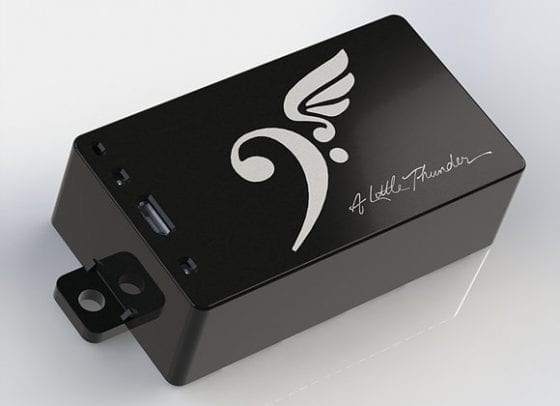 image courtesy of A Little Thunder
A Little Thunder Pickups
Here’s something I’ve never seen before: a humbucker pickup that adds bass tones to your guitar. A Little Thunder Pickups take the bottom two strings and downpitches them 1 or 2 octaves. It’s a great solution for playing with just guitar and drums. It may even work better than playing with an octave pedal because you still have the clarity of the high strings and the Little Thunder Pickups have never zero latency. The octave effect easily switches on or off and you can still use the effect when you’re switched to other pickups on your guitar!
NS Micro Soundhole Tuner by D’Addario
If you’re an acoustic player and shred on anything with a soundhole, the NS Micro Soundhole Tuner by D’Addario is a great alternative to a satellite dish you clip on to your headstock or pedal tuner. This tiny clip on tuner fits snugly inside the bottom curve of your soundhole. It’s ridiculously easy to install—you literally just slip it into place. There’s no need to plug anything in since the battery-powered tuner picks up the string vibration from inside your guitar. It’s hardly noticeable from anyone’s perspective except the player, who can look straight down and easily see the tuner’s light-up screen. It’s easy to read and is entirely accurate, even in a live setting.
~Best in Accessories~
Temple Audio Design Pedalboards (Templeboards)
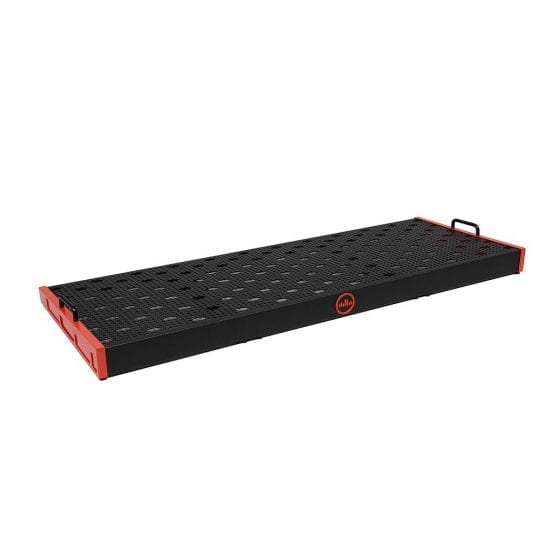
There’s nothing that triggers my ocd more than my pedalboard being a chaotic, sticky, spaghetti mess of cables and velcro, and that hard to get around because the options for organizing them are limited. The Temple Audio Design booth at NAMM immediately grabbed my attention. Basically it’s a pedalboard with large, medium, or small sized plates that stick to the back of your pedals and fit onto the pedalboard like Lego bricks with a single easy screw to keep them in place. The pedalboard has a helpful design that makes it easy to route your cables in an organized way and keep things looking nice and clean. You can also install an IEC Power Module on the side of the board for convenient access to power.
PEDALS
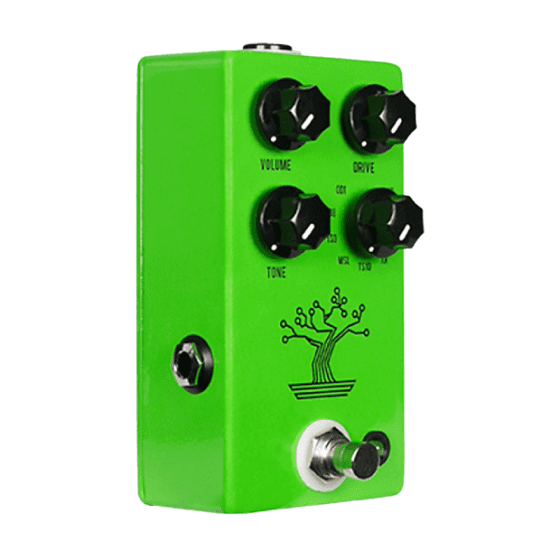 image courtesy of JHS
Bonsai by JHS Pedals
The Bonsai by JHS pedal combines NINE classic and rare overdrive effects into one piece of gear. Guitarists search high and low for the perfect tube screamer, and there are many different versions of this pedal. Josh Scott from JHS decided to take the Tube Screamers from off his shelf and put them into one pedal. Each vintage TS was disassembled, measured, and perfectly replicated, including how the capacitors and resistors have aged over time and drifted from their original values. No modeling, nothing digital, only analog switches.
OD-1 – 1977
TS-808 – 1979
TS-9 – 1982
MSL – 1985
TS-10 – 1986
Exar OD-1 – 1989
TS-7 – 1999
Keeley Mod Plus – 2002
JHS Strong Mod – 2008
Fathom by Walrus Audio
Fathom is the newest multi-function reverb by Walrus Audio. I personally own this pedal and I’m obsessed with it. It has 4 different reverbs; Hall, Plate, Lo-fi, and Sonar. Every reverb is customizable with decay, dampen, mix, and an x knob that adjust different things for each reverb setting. A couple things stand out to me in this pedal. One of my favorite features is the decay knob. Crank it and it will sustain for eternity until you’re completely hypnotized. Ooo man. Fathom also has a sustain switch you can press to sustain the reverb for a lengthy, swirly, slow decay.
~Best in Pedals~
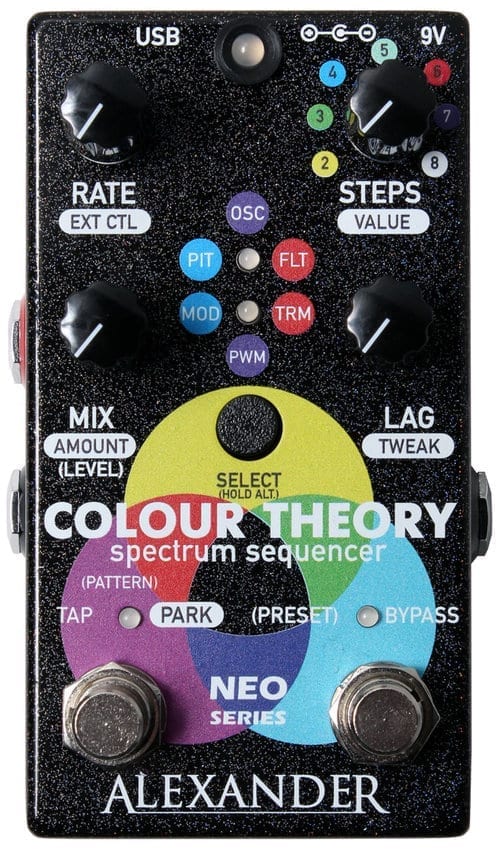
Colour Theory by Alexander Pedals
Matthew Alexander doesn’t target your traditional guitar player and I love that. I don’t know if I have a wide enough gamut of language to describe the Colour Theory, except that it’s one of the most unique pedals I’ve ever played. It has the ability to be a sequenced pitch shifter, delay, filter, oscillator, tremolo, and a PWM mode which is a sort of insane octave synth sound that you’d have to hear to understand. Every mode is customizable and you can get a pretty standard sound out of it, or you can make it sound like there’s something seriously wrong with your guitar. Matthew puts it, “We like our pedals to be capable of something normal, but we thrive on the edge of order and chaos.”
LeatherMan WingMan Multi-Tool — $39.95
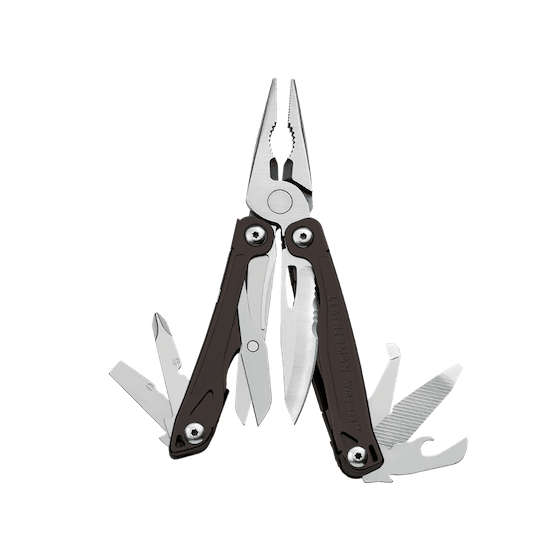
The matriarch of multi-tools, the LeatherMan WingMan puts the “fun” in functional. Whether you’re snipping excess guitar string, using the needle nose pliers, stripping a wire, or slicing an avocado to make guacamole while on tour, it’s got your back. And it’s always handy to have a Phillips-head screwdriver on the go! LeatherMan’s newer models include spring-loaded action, which makes squeezing it a lot easier on your hands, and an engraving option, which might score you some bonus points with your loved ones. Pro-tip: if you’re flying, pack the Wingman in your check-in bag—otherwise it’ll get confiscated at the airport. Get it here.
Alchemy Audio “Dead Bat” Dying 9-Volt Battery Simulator #2 — $29.95
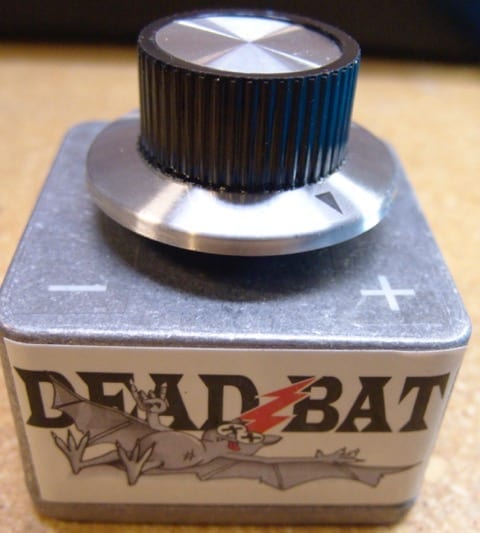
File this Dead Battery Simulator under “cool gadget for the holidays.” Alchemy Audio’s husband-wife team Johnny Balmer and Victoria Thiede hand wire these tiny devices in their boutique workshop in Chicago and make ‘em affordable for your special someone. Plug the Dead Bat between a pedal and its power supply to manipulate the sound with a decaying effect. Many gearheads hoard 9 volts that have been used for different extents to create a spectrum of variant tones from their effect pedals for this very purpose—this process creates what is considered the euphoric, sonic equivalent of an aurora borealis. Just adjust the voltage knob, and lose power instantly. Get it here.
Steve Clayton Custom Picks — $24.99 and up
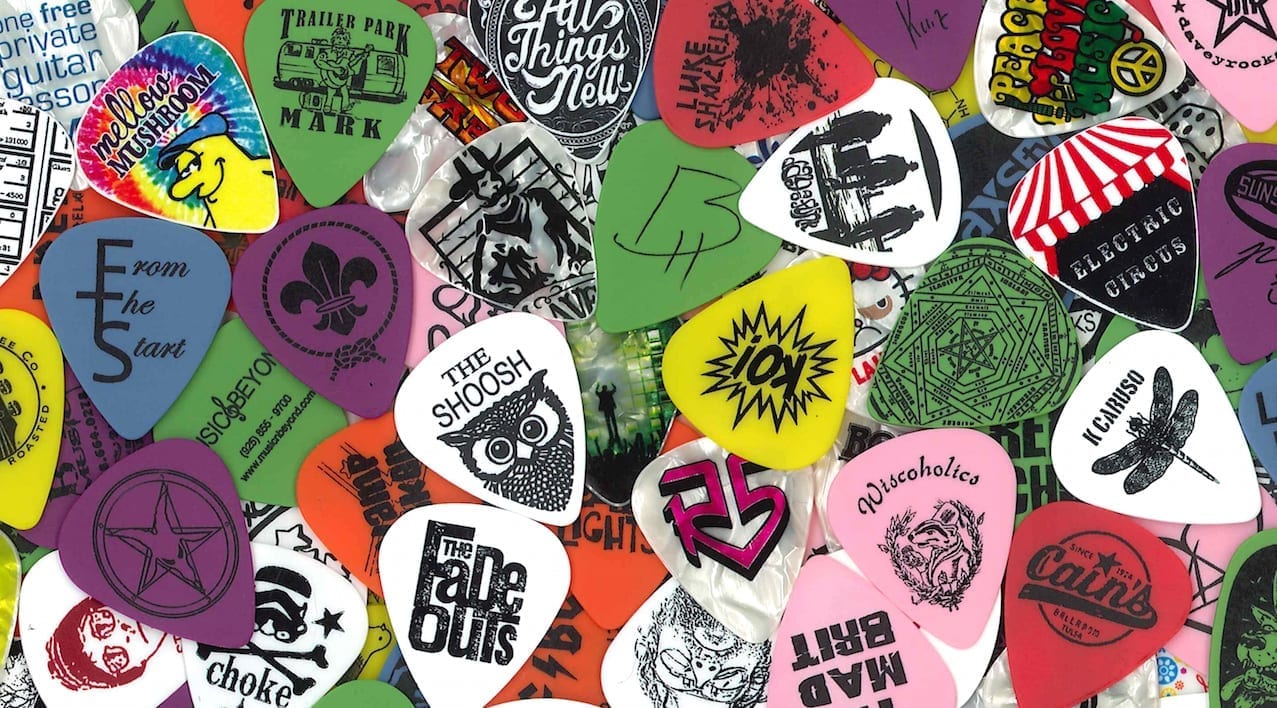
How cute and awesome is it to give your bestie or bandmate a baggie of cool custom picks? The Steve Clayton “Custom Guitar Picks” interactive design tool allows you to “pick” (pun intended) from 17 materials including glow-in-the-dark plastic, Dunlop-like delrin, metallic foil, or plain ol’ acetate. Then select a bass or guitar plectrum shape, and the quantity. Upload the image or the text you want printed on the surface, like a drawing, logo, or inside joke, and order away! Get them here.
SLDR Guitar Strap from Souldier — $24.99
Souldier Straps have become absolutely iconic stage wear for bands worldwide. They are easily identified by their retro patterns and seat-belt backing. Founded by Jennifer Tabor, the straps come in artistic designs with bright colors and they can even be customized per order. Along with guitar and bass straps, Souldier also offers fancy straps for ukuleles, banjos, cameras, belts, and headbands. Recently, Tabor introduced a new wallet-friendly model to her product line, the SLDR, which is handmade in Chicago. Leave it to a femme-owned business to develop a perfect strap with non-slip rubber ends and eye-candy quality accentuation for any guitar or bass. The vibrant style of the SLDR is bold and strong (just like you!). Get it here.
Tornado Extended U-Hook — $14.99
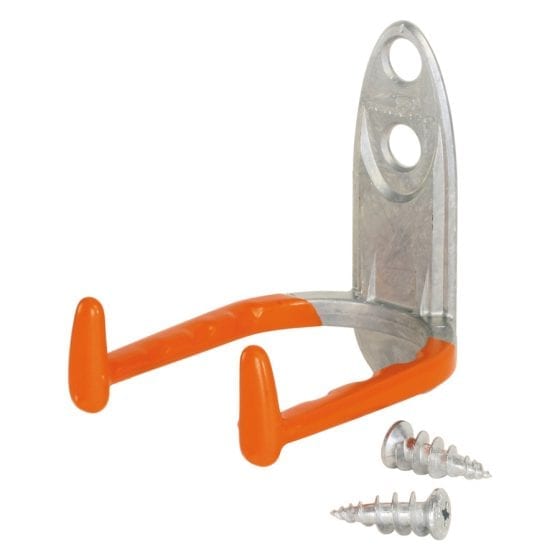
Ok, can you keep a secret? Promise? The Tornado hooks by Racor are the best solution for “hanging anything anywhere” with minimalist style, and “anything” includes music gear. These heavy-duty wall hooks are common for industrial tools, but they are also perfect for supporting your guitars in your home or practice space. I started buying them years ago for their super mod orange and steel color combo, versus the boring wood and grey guitar hangers available at most big box stores. It’s the Apartment Therapy approach to displaying your favorite axes, and the price is right so you can buy a few for ultimate impact. Get them here.
Dunlop String Winder — $1.95
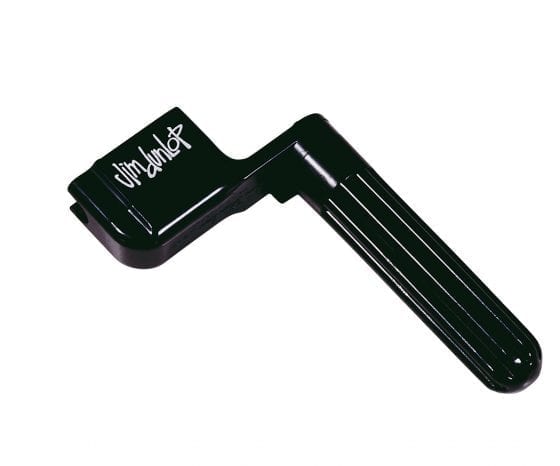
According to manufacturer’s studies, a string winder allows you to unwind a string 70% faster than the manual approach. Imagine having all of that extra time, and multiply it by six strings (or four, for you bassists out there)! You can buy the Dunlop string winder super cheap online, or at the counter of your local music shop. Charm it up in a jewelry box, or get crafty and incorporate it into the gift wrap of a larger present. The point is, this winder is very affordable and shows the strings-player in your life that you care about their time, and their fingers. Get it here.
Fender Strap Blocks — $3.99
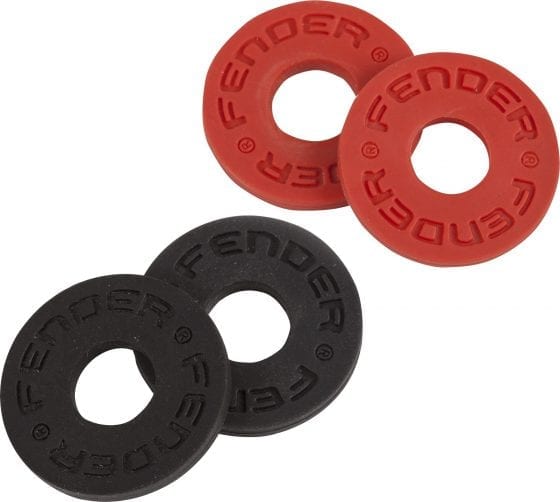
Ok, so you can either buy four bottles of Grolsch for $13, or gift a 4-pack of strap locks from Fender for $3.99 here. The point is, the rubber rings that famously line the beer caps of certain booze brands have been replicated to slip over the peg of your axe and secure the strap in place. You know when you see someone’s guitar strap slip off during a show? Give your friend the gift of being about to focus on rocking instead of adjusting their strap. Your other options are duct tape (nope) or strap locks that require hardware swapping or drills, so these are a nice, easy solution. Get them here.
DR Neon Multi-Color Acoustic Strings — 2 packs for $8.49

Strings are the musician’s equivalent of giving socks for the holidays—they’re necessary, sensible, and you’re always happy to have new ones. Well, maybe you would like to spice up your life with these neato, fluorescent-color coated acoustic strings! The novelty is that they are color-coded for each note, and they glow under black light. While serious players have their preferences for GHS, Ernie Ball and Pyramids in to maintain tone and resonance, these rainbow strings are fun to rock onstage, or in a music video or photo shoot. Get them here.
Love and gratitude are their own ultimate rewards, but these accessories are must-haves for string-queens who have been both naughty and nice this holiday season.
For more budget friendly gifts for guitar and music enthusiasts, check out She Shreds’ online store.
That’s it actually. Of course, before we move on to some of our favorite deals from awesome companies, we should mention we’re having our BIGGEST sale EVER (literally, everything must go) of 30% off your entire order with checkout “ushred”. So, if you don’t have $$ then good for you because you’re probably enlightening yourself with a day of relaxation and art. If you do, however, you might want to spend some of it on the links below.
Reverb.com: new and vintage gear: Yes, you can get up to 20% off on a TON of awesome gear from vintage to new. You have your choice of hundreds of pedals, synths, guitars, amps, and more. It’s kind of overwhelming actually but hey, you asked for it.
Original Fuzz Straps: Up to 15% off straps. Original Fuzz is not only an amazing company but their straps are beautiful, comfortable, ethically sourced and even made by local Nashville heroes in their hometown factory. Highly Recommend.
EarthQuaker Devices: 15% off EarthQuaker Devices at participating local dealers. It would be remiss to not show our love for our besties at EarthQuaker Devices. They need no explanation really except that if you don’t already know, EQD is top notch and providing classic and futuristic sounds to your pedal board. Only catch here is that you have to close your screen and call your local music shop to find out if the deal applies!
Moniker Guitars: 20% off with code “BlackFriday17” at checkout. This company employs awesome people who make their guitars in Austin, TX. We most recently spotted a beautiful custom guitar made for Sadie Dupuis of Speedy Ortiz/ Sad 13. These are high-end guitars starting at $875 going all the way up to $2k+ AND they offer monthly payments.
Hologram Electronics: Free shipping all weekend with code “BlackFriday” at checkout. This is for the noisemakers. Crazy, weird and out of the ordinary effects from Konxville TN. They will take you to a new dimension and we specifically recommend the Infinite Jets Resynthesizer for all you synth guitar freaks.
Old Blood Noise x Chicago music exchange: 15% off with code “GEAR4U” tonight until midnight only. Honestly, we saw this and thought about how much we loved Old Blood Noise then thought about how dope Chicago Music Exchange is and just couldn’t resist.
Walrus Audio. 20% of (minus limited edition pedals)+ Free shipping on orders over $50 (domestic only). Last year we featured Walrus’s Julia chorus/vibrato pedal in our gear guide.
Moog Music: Up to 30% off select instruments and 20% off merch. This is one that we’re really excited about. There’s not much out there in the world of synths that competes with the tools Moog has historically and currently puts out. So, if you got the cash and looking to up your synth game, we highly recommend spending it here.
Sub Pop: 20% off all Megamart orders over $25. Subpop hosts bands such as Bully, Sleater-Kinney, Beach House and many many more. Buy more music.
Father/Daughter Records: 20% off Everything online. One of our favorite record labels right now who put out records from Vagabon, Shamir, Soar, and T-Rextasy. You’ll definitely want to get to know them.
Brujas: Free Shipping until Monday with checkout code “FRYED. We couldn’t be more obsessed with a clothing line the way we are with Brujas. Maybe it’s the Mexican-American teen living my dream through their syllabus but their community is one that is just as equally beautifully expressed through their fashion.
Tom Tom Mag: 10% off site wide. Duh.
Wildfang: 25% off sitewide + Free shipping on orders over $125. For all you Tomboys out there, Wildfang is dropping some crazy deals this week and we suggest keeping your eyes peeled.
Tuesday Bassen: Up to 40% off site wide. We’re huge Tuesday Bassen fans and have been for quite some time. One of LA’s most amazing local artists who works with a range of musicians and produces clothing that literally just make you feel like the badass motherfuckin babe that you are.
Let’s start by getting the terminology straight: tremolo/vibrato/whammy bar/arm, and tremolo/vibrato system/tremolo bridge all refer to the same things. Technically, the effect is vibrato, because manipulating the bar changes pitch. Tremolo, on the other hand, refers to a change in volume. But the two terms have come to be used almost interchangeably.
How does it work?
There are two types of bridges: a fixed bridge does not accommodate a vibrato system, but a moving bridge does. A moving bridge allows for a change in string tension when the arm is pushed or pulled. Pushing the arm lowers tension, thereby lowering the pitch. pulling up on it increases string tension and raises the pitch. All vibrato arms are able to be pushed down, but not all can be pulled up.
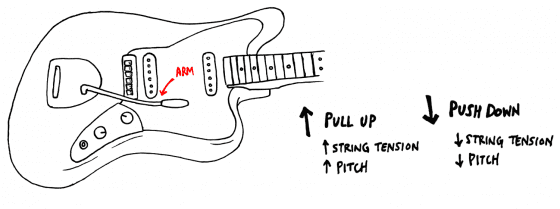
Types of Vibrato Systems
Two of the more common vibrato systems are synchronized tremolo and floating bridge.
Synchronized Tremolo
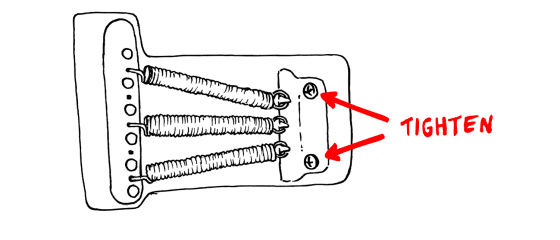
The Fender synchronized tremolo system—also known as the “strat trem” because of its origin as a part of the Stratocaster design in the early 1980s—utilizes springs in the body of the guitar. The bridge is anchored to these springs, and manipulating the arm will stretch or compress them in order to change string tension. You will seem them if you remove the backplate of your guitar (it’s easy, it just requires a Phillips-head screwdriver).
The floating bridge design is found on offset Fender guitars including the Jaguar and Mustang. The main advantage of floating bridge designs is that they allow for both pushing and pulling, so you can raise or lower your pitch. The “stang trem’s” has a reputation for being impossible to use without it detuning the guitar, but we won’t get into that here. The “jag trem” has its own set of issues, too, but it’s significantly less of a nightmare to set up.
Setting Up Your Vibrato System
There’s more than one way to set up a vibrato system, but anything you do will be specific to both the tuning and string gauge you use. The methods below are intended to avoid the all-too-common problem of the guitar falling out of tune after use of the vibrato arm.
Synchronized Trem
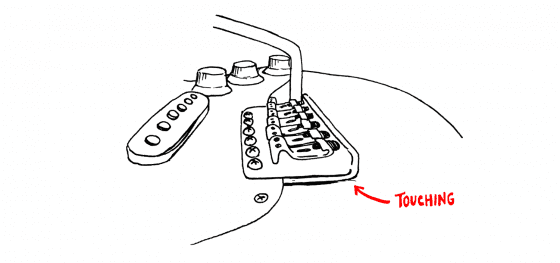
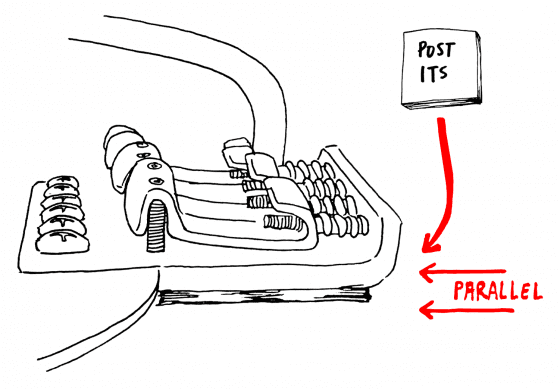
This is a quick method for setting up a strat trem to be “somewhat floating,” so that when you are finished you will have a pitch range of 1.5 steps on the G string, 1 step on the B string, and .5 on the E. I learned it from a brief YouTube video by luthier Galeazza Fruduo.
All you need is a tuner (even an app on your phone will work since there’s no need to be as precise as when intonating), a Phillips head screwdriver and some Post-Its.
Floating “Jag Trem”
These systems are often set up improperly, and even when you have them set up to stay in tune they can create problems—either the arm swings or it falls into the body. Yet you’d be hard pressed to find a Jaguar player who doesn’t want to use the vibrato. Many players (myself included) eventually upgrade their vibrato systems, but there are a couple of DIY fixes that may prove useful, at least temporarily.
First let’s cover the setup. This method takes advantage of the “trem-loc” feature found on the jag trem. It was designed to keep the guitar in tune, but often goes unused. If you look at your bridge plate, you’ll see a button that you can slide toward/away from the arm. The system is locked when the button is pushed towards the arm.
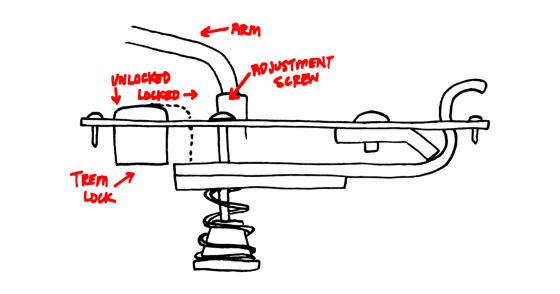
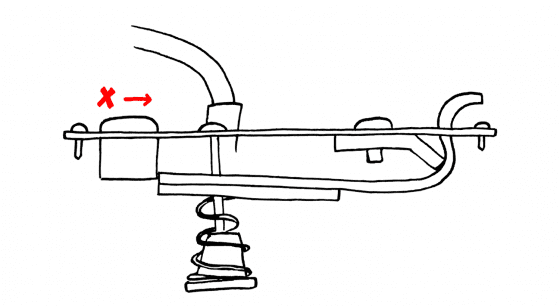
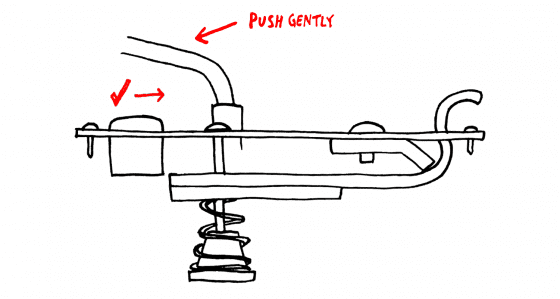
Inside the guitar: the trem-loc mechanism just glides over the piece of metal holding the arm without pushing it down, which would lower the pitch.
This method makes it so that you can only push down on the arm, lowering your pitch. If you also want to be able to pull up without going out of tune all the time, it’s time to think about upgrading your system. I use the Mastery Vibrato in my Jaguar and I love it. Jaguars also have notoriously crappy bridges, and the Mastery is a great solution to another common Jaguar problem; strings jumping out of their saddles. It’s pricey, but your guitar will never go suddenly and wildly out of tune in the middle of a song again. Just make sure you purchase the correct bridge/vibrato for your specific guitar. You can use the serial number to determine where and when your guitar was made.
If you’re not ready to drop $175 on a new vibrato system but you’re having problems with your current one, here are some super quick fixes that may help:
Arm swinging/falling out? If you’re sure you have the right arm for your guitar, take it out and stick the bottom end of it into some potting soil. Then put it back in. The soil should provide more friction to hold it in place. Although you’ll have to repeat this once in a while, it does help in a pinch (If you don’t believe me, look it up). Some models take a threaded arm, which is screwed into the body. Others take unthreaded, which are the ones that tend to benefit from the potting soil move.
Arm falling into body? First of all, it’s worth noting that different models will have different springs, and some are stronger than others. If this keeps happening to you and you’re using heavy strings, you could use lighter strings, .11 or lighter. If you don’t want to use lighter strings, you can superglue it. Use Loctite Blue 242 Threadlocker. Remove the tremolo plate and apply Loctite Super Glue all around the nut that holds the thimble to the metal plate. Leave undisturbed for at least 10 minutes before replacing the plate.
The glue will cure it in 24 hours. Again, this is something you’ll likely have to repeat, but it should hold you over until your Mastery comes in the mail.
By 2003, Dalager had co-founded Now, Now (originally called Now, Now Every Children) with her high school classmate, drummer Bradley Hale. Since then, the group has released two full-length albums, a handful of EPs, and has become a familiar presence on the touring circuit and even late night TV (most recently with an appearance on Last Call with Carson Daly). They released a new single, “SGL,” in May.
Over their career, Now, Now’s lineup has changed several times, but whether playing primarily as a duo, a trio, or any other incarnation, Dalager’s thick guitar rhythms have always been there there to fill out their sound (her keyboards make a big impact, too!). Naturally, her choice of gear was reflected both that penchant for volume and fluctuating number of bandmates to create it.
“Early on, I didn’t understand how to accomplish what I wanted with the amps and pedals I was using, but my goal has always been a little bit the same in terms of the guitar parts I write; I like thicker rhythms,” she says. As Now, Now gears up to release a new full-length album in 2018, Dalager says that element hasn’t changed. “With the new stuff, I have explored a more lead guitar, which I haven’t messed with much before, but it’s always been heavier, thicker rhythm guitar.”
Though she occasionally wonders how different her writing would be if she had classical training, Dalager takes pride in knowing her unconventional approach to playing has helped them forge their unique sounds and textures. “One thing that’s been important to me in terms of playing guitar is to accept that I don’t play guitar like everyone else does and to not feel bad about that,” she says. “There were times where I’d feel, “Wow, I don’t know shit about any of this.” But the things I do know, like I have a good grasp of tone. That’s what matters most to me in listening to something. I haven’t mastered it, but I feel like I’m getting better at the things I’ve set out to get better at.”
Check out some of Dalager’s favorite guitars and guitar gear below. “SGL” is out now.
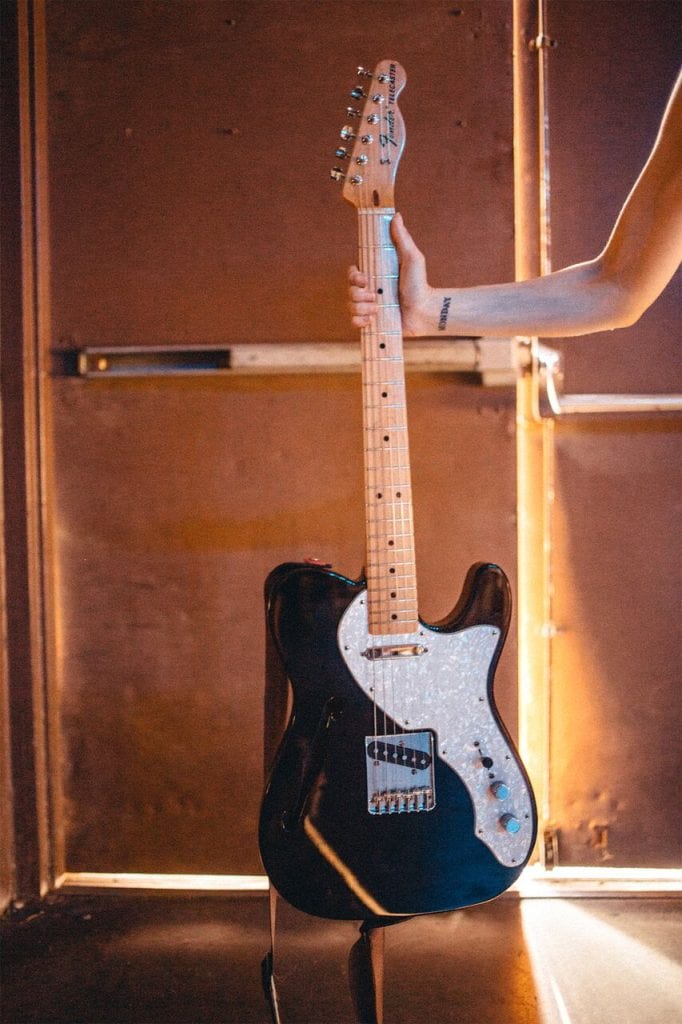
Fender Telecaster Thinline: I don’t know what it was, but something happened where it sounds completely different from any other model of that one that I’ve played. I don’t know if it’s the wiring—it doesn’t make sense, but it sounds different than any other Thinline I’ve played. I picked it up and it felt like magic.
Fender Bassman ’67: That’s nice for that thicker, fuller sound that I really like. I bought that at the same time I bought the Thinline. That combination put me over the edge. It feels almost backwards to have those things paired together. I feel very emotionally attached to that guitar and that amp. I’m trying to not tour with that amp anymore because it gets a little more beat up each time, so I can be like “you can just hang out at home with me and I’ll write with you.”
Little Martin: This is pretty much my favorite thing to play with when I’m at home.
Gretsch Root Series G9210: This and the Little Martin have been my main writing guitars. I have them both sitting next to my bed so I can pick them up at any moment of the day. If I can’t fall asleep I’ll stay up and write. I discovered it at the same guitar shop as my Fender Thinline.

Ernie Ball Super Slinkys: For the thinline and my other electric [a standard Telecaster] I use these. They are thicker than the usual gauge. I use the thicker strings because it gives you a thicker sound. It’s a little heavier, so it beefs up the sound compared to the thinner strings, which do sound a little brighter. This is going for depth, in combination with the Thinline and Bassman.
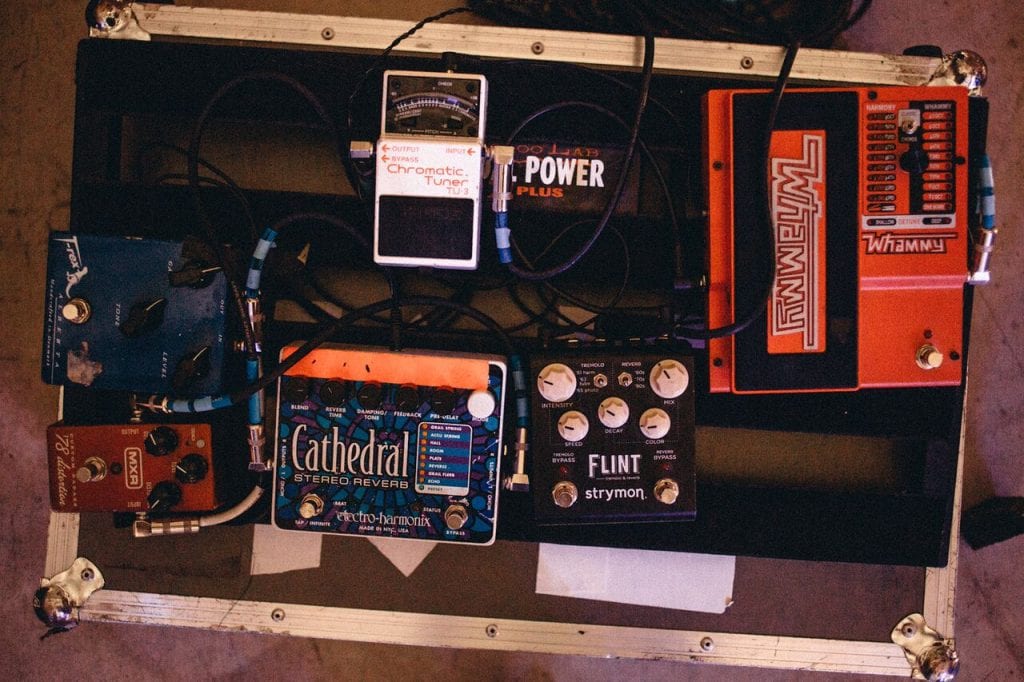
Electro-Harmonix Cathedral, T-Rex Alberta Overdrive, MPX Custom Badass Distortion Pedal: The MPX sounds so massive, it’s crazy. I haven’t tried it in any other context, but it works so well with my setup it’s insane. These are my three go-to pedals live, and I’ve also been using my Whammy pedal on the chorus. We’ve used some chorus plug ins and filters on ProTools for the new songs, but pretty much everything went through my pedalboard.
A part of me wants to tell you that her wisdom exceeds her age, while another part of me sees Creevy’s confident outlook on society and her creative expression as a reflection of a generation that is extremely vocal and active against what we choose to not see rather than that which we’re told doesn’t exist. “I don’t know anything more than anybody else does,” says Creevy. ”But I know that, so I don’t pretend to know what I’m talking about. Because I don’t. I’m just bullshit. I’m just a professional bullshitter.” Creevy says what she feels, does what she wants, takes action, identifies injustices—and then she spits it all out in the rock and roll gems that are Cherry Glazerr.
At 20 years old [19 at the time of this interview], Creevy is quintessential Los Angeles: previously described as a teen fashion queen, rock icon, and actress/model. And yet, none of that matters to her as long as she can play guitar. Clementine Creevy is a guitarist. Her passion for the instrument while using her voice for a greater good is undeniable on Cherry Glazerr’s third album, Apocalipstick. Released by Secretly Canadian on the day of the presidential inauguration and written alongside new bandmates Sasami Ashworth (keys) and Tabor Allen (drums), the subtle genre-blending techniques of hard-hitting power chords met with tasteful upstrokes and nuanced melodic riffs caught our attention. On a sunny day in Los Angeles, we met up with Creevy at Mono Records and experienced a chain of freakish events that involved almost stepping in poop, stumbling upon a lost She Shreds hat (what?!), and talking about being as real as possible over Vietnamese spring rolls.

She Shreds: What’s your relationship with interviews like?
Clementine Creevy: To a certain degree, it’s weird because interviews are so based on authorship, and who you are, when really, I just kind of like people to listen to the music and not worry about who I am. And let the music speak for itself, because that’s where my heart and soul is. I also feel like there’s nothing I can say that will make you understand where my music comes from. Because even if I say one thing, the music is an amalgamation of so many thoughts and feelings and phases of my life that, even if you said, “what’s this song about?” and I told you one thing, it would leave out everything else that also influenced the song.
Why [musicians write songs] is actually kind of the question that can never be answered, because most honest art is made from a place of necessity. Not for any grand plan. Not for any reason than purely wanting to do it.
Do you, as a fan, ever idolize and think of art from that perspective?
I totally do! And I understand it. I fan out super hard on artists. But only in relation to their music. When people start to idealize things that are not the music, I’m like, “I’m just a normal person.” I don’t have anything that separates me from that except I have an ability to be musical. And so, it pisses me off when I’ve had reporters ask me, “So you changed your hair color?”
It’s also a women in music thing, you know? Women in music are looked at for things other than their music more than men are. That’s why I love She Shreds so much because it’s all about women being looked at as musicmakers, with a focus on their music and technique, in a way that men have always been afforded.

Do you actively keep those roles in mind, and present yourself in a specific way because of it?
I just like to question everything. Like, “Why are you asking this? Why are you asking that?” People aren’t used to that because we live in a world where complacency and comfortability is the end goal. Homogeny is the end goal. And when people are so set and comfortable in their roles—gender roles, class, race, or whatever—they start to lose sight of the corruption and bullshit.
We can be any type of society that we want to be if we just change our mindframe. It’s hard to do that. I feel like I do kind of try too hard to be like, “This is bullshit, and I know that,” which is kind of an egotistical thing to do.
Why?
Because I don’t know anything more than anybody else does, but I know that, so I don’t pretend to know what I’m talking about. Because I don’t. I’m just bullshit. I’m just a professional bullshitter.

Have you ever written music with a timeline in mind?
With Apocalipstick I felt there were times when I wasn’t finished with the songs, but I needed to do them because of the timeline. Whenever I’m writing or working I kind of lose sense of everything, so it didn’t really matter. Even though I was doing it fast because of the timeline, I enjoyed every second of the creation. I never felt rushed while I was writing, because once you get into the writing zone, nothing else matters. You don’t feel pressure. You don’t feel anxiety. You don’t see anything except music. So it was actually kind of a fun experiment, because I had to push myself a little bit harder to finish songs. [laughs]
With the new record and switching of band members, what was 2016 like for you?
I practice not taking anything too seriously. Even crazy shit that seems kind of crazy to other people never really seems that crazy to me. Which can be kind of isolating too because I sort of shut down my emotional side and get really rational. I like to think and move through the world rationally, but I’m naturally a very emotional person, so I battle with myself a lot.
Taking things not too seriously was very helpful during stressful times in the band, like when Hannah departed and when Sean left, and I felt like… sad or, you know, weird [laughs]. So it’s helpful in that way to be like, “Look dude, nothing is that serious. You’re still alive and you still have two legs and you have a guitar.” So that’s what I always revert to.

Did you write these songs this year or were they songs you were writing and finishing up for a few years?
A few years, actually. Definitely wrote some of those in 2015 and then 2016. We recorded the album in fuckin’ January of 2016. It’s just coming out a year later. As you know, it takes forever [to get a record out]. The record label is all backed up and blah blah blah. I don’t feel connected to those songs except for a few of them because I wrote them a long time ago. I’m only 19 so I’m always changing a lot, every year, and so I feel like a totally different person who thinks in a totally different way. But that’s why I’m always writing music.
How does the release of the record make you feel?
I’m a little bit excited, but I don’t feel like I can be proud of it and embrace it in the same way I could have six, seven months ago. I can’t totally feel proud of it because it’s just music that I’ve already moved past so much. But I am excited for it to come out because it’s work that we made that hasn’t been released yet.
There’s so much that you don’t see that goes on. It’s just a snapshot of a continuous thing. I try not to be too precious with music—it’ll trip you up. Because no artist is fully proud or finished, if they’re an honest, crazy motherfucker like I am.

What’s your sign?
I’m a Sag. I’m curious and energetic. [A] traveler is definitely true. I feel trapped when I feel any sort of stagnation. That’s why I love being on the road. But it’s also weird because it allows me to run away all the time. Not to get real deep here but to get real deep here, it allows me to run away from constantly reinventing myself all the time. I’m most comfortable when I’m constantly moving, constantly reinventing myself, never feeling like I’m in one place, and that’s just how I function. I’m a happier person when I’m that way. When I have one house, one spot, one boyfriend, I’m like, “Arrrrgh!”
That’s suuuuper real!
It’s very real, and it’s something I’m working on. It’s like, fucked up. It’s definitely one of my emotional walls. I can’t handle tension or fights, and it sucks because that’s the real shit. That’s what makes relationships grow and get stronger even, and I avoid it entirely.
What are you scared of?
I think it’s my rational brain talking. Like, okay, if I’m only here for so long, I may as well have fun all the time. Not allowing myself to be vulnerable and emotional. I don’t want other people to see that, I just want to have fun, and it will distract me from the raw shit.
Do you feel like the raw shit comes out in your music though? Definitely. That’s why all my music is fucking depressing. And I’m not like that in person. My bandmates make fun of me, they’re always like, “Dude, your songs are hella depressing! Like, your lyrics are fucked up!” And I’m like, “I knoooow. What is that?” Every time I sit down at the guitar, I’m like, [singsongy voice] “I feel sad! Alt rock alt rock alt rock…” And I’m like, “Why can’t I stop doing this?!” But I can’t. Anything else feels dishonest. I’ve tried to write other ways. That’s why I really don’t love pop songs. Every time I hear “I Wanna Hold Your Hand” I wanna barf. How does anyone feel that way?! It feels dishonest to me.
What is the fear of? Is it abandonment? Fear of connection?
I think it’s all of the above. I think it’s all of those things, like, we’re scared little animals. It’s hard not to act in fear sometimes, but you do it. I have this fantasy of having like, really close girlfriends and I just don’t have that.
Is that what “Told You I’d Be With The Guys” is about?
Yeah. It’s funny because that’s when I started to get close with girls. I wish I could be as emotionally free as men. Men are conditioned to be emotionally free. Dude, sexism is so deeply ingrained. It’s so deep and everyone deals with ingrained sexism. The people who are able to vocalize what that looks like—Margaret Cho, Sarah Silverman, Ali Wong, Angela Davis, and so many other awesome feminists who are able to put it into words—that feeling that every woman knows but doesn’t understand. And Simone de Beauvoir. To have your experience explained a little bit to you, you’re like, “Whaaaat the fuuuuuck! How did you know that?!?!” It changes your whole life and the way you see the world. I took a women’s studies class and it explained [what] I always knew. Shit is unequal, shit is fucked.
And at the same time it’s difficult, because having that mentality or that idea and being too radical with it is seen as being radical. There’s a certain demographic that isn’t going to listen to you when really it’s the demographic that needs to listen to you most. There’s such a fine line of how you talk about it.
I know. Radicalism versus moderate people—it’s something I talk about all the time. People who are moderate activists try to do small incremental change over a long period of time, [versus those] trying to aggressively change the whole system all at once. MLK was moderate. Malcolm X was a radical. And you need both! I fluctuate all the time between being a moderate and a radical.
The new Cherry Glazerr record came out on January 20th. Was that on purpose?
No. I’m so glad it [came] out that day though, because to me music is what’s going to be the most powerful, effective thing. I feel lucky to be a musician right now because I have an outlet to speak my mind and unleash my anger that I bet a lot of people feel.
I’d kind of like to say that Donald Trump is the best thing to happen to feminism, because it’s going to make people realize that our work here is not done. You have to be loud. You have to be radical. The fact that a rapist is our president just shows you how important feminism is. You could see it as defeating, or you could see it as a newfound need to be even louder and stronger and more radical than you were before.

Tell me about what you were getting into when you first started playing guitar.
I started getting into Jimi [Hendrix] and the Who and the Rolling Stones and all of that shit, and then I sort of moved into funk. I listened to a lot of Parliament Funkadelic and I think that’s where a lot of my style derives from. I’m kind of obsessed with upstroke funk grooves. I was obsessed with Eddie Hazel, Curtis Mayfield, Al Green. Soft R&B, soul, that’s where that shit came from. And then, punk after that. I went from funk to punk, and was listening to Bad Brains on repeat. Dead Kennedys, Misfits, Crass, Red Kross—all that shit.
I can totally hear that collaboration of genres. Listening to different genres is the best thing you can do to your creative brain.
I always loved practicing having an open ear. I could listen to Bob Dylan and I could listen to Slayer. I wanted both. I wanted to be open to all types of music whether it was super poetic meditative minimalist music or aggressive maximalist rock music. I love prog rock, too. I’ve become more into prog rock since I started getting more into technical music. I want to be really technically good, so I’ve started listening to Zappa and King Crimson and shit like that. That was kind of a more recent thing.
Tell me about your Rickenbacker.
I would love to tell you about my Rickenbacker! Ugh, so, my Rickenbacker is from 1966, hollow, a 330. It has a Bigsby bridge and I put flatwound [strings] on it. I just wanted to make it sound even weirder than it already was. It’s warm but twangy at the same time. I recorded with it for Apocalipstick and have been touring with it nonstop for the past two years. I found it at this awesome guitar shop called Old Style [in Los Angeles]. It was expensive as hell. I spent my whole life savings on it. [laughs] It’s a really great fucking guitar. It’s got a thin neck and I’ve got little hands so it’s easy for me to play.
What else do you use?
I usually write on my Mexican Strat, and I just got a gray American Strat standard with two humbuckers. It’s a new guitar but it sounds kind of vintage. I love how vintage guitars sound but not how they travel because they’re fucking fragile. My Rickenbacker has a crack down the middle, the nut falls off all the time, and that’s an expensive studio guitar. I shouldn’t be touring with it, but I do anyway because I love it so much. But I’m gonna start touring with my Standard Strat which I’m a little sad about, but I don’t want to be tied to one guitar, as much as the Rickenbacker is a part of my identity. It’s on the cover of our record.
Imagine losing that or breaking it forever.
That would be the end of my life. I would die. I remember playing with my Rickenbacker for the first time after I had been playing with my Mexican Strat for the beginning of Cherry Glazerr. We played shows with that Strat for like two years and then I finally got a Rickenbacker. And I played with it, and it was like the world opened up. I was like, “Holy shit. This sounds incredible.” But you have to know that something is bad in order to know when something is good, too. I didn’t realize how shitty my Mexican Strat sounded until I started to grow with it, and I was like, “This isn’t what I want to hear. I want something better.”
There are a lot of steps between knowing how to play guitar and knowing how to get good tone. It’s a long journey that can even be physically grueling at times, lugging gear on and off stage, from venue to venue. But we still do it, over and over, for years and years, because it’s worth it. So when I was told I could make one of those steps drastically easier without sacrificing my hard-earned tone, and it caught my attention.
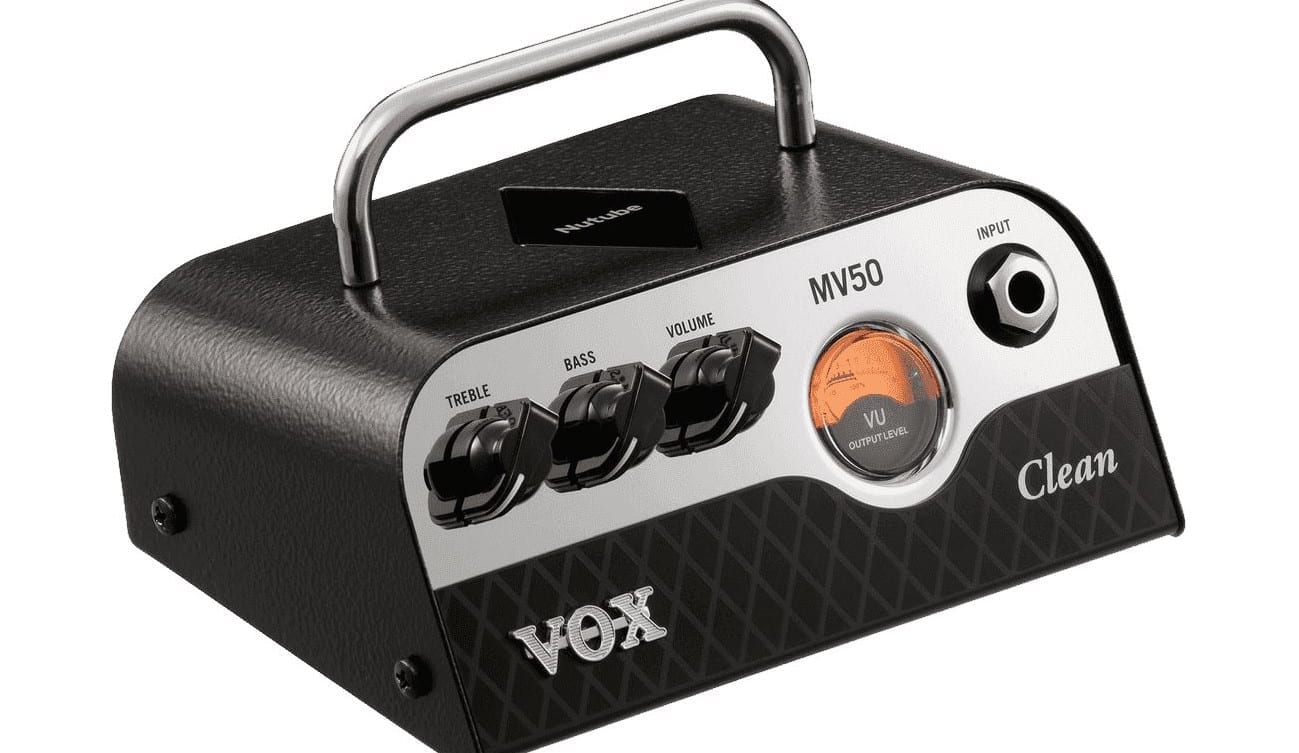
Weighing just over one pound, the Vox MV50 AC fits in the palm of my hand and packs up to 50 watts of power. It’s a micro-sized amp head with analog components and Nutube technology that is said to give you tube warmth, compression, and response. But you really can’t look at this little machine without it raising some questions: How does it work, what does it sound like, what is Nutube technology? Let’s take a look.
Whatchu got:
The features of the Vox MV50 AC are pretty straightforward. On the front panel there are 3 control knobs: gain, tone, and volume. Next to these knobs there’s a volume unit meter that gives off an old school amber glow (a very cool touch). This measures your output level. Last, we have the quarter-inch input/gateway to the magic.
The rear panel has a little more to offer. There are four switches, starting on the left with the Eco ‘off/on’ switch. This gives you the option of automatically powering down after 15 minutes of inactivity. Then we have the “standby/on” switch. Essentially this turns it off or on. Next is the EQ ‘flat/deep’ switch. You can set it to “deep” to get more low end when playing through a small cab. And finally we have the 4/8/16-ohm impedance selector. This is important because the output will change depending on the impedance of the speaker. Basically, impedance is how hard the amp has to push to drive the speaker(s). We measure impedance in ohms. The lower the number, the more power is required. The MV50 AC will give you 12.5 watts at 16 ohms, 25 watts at 8 ohms, and 50 watts at 4 ohms!
Last, we have a headphone/line quarter-inch input, and a quarter-inch speaker output. This makes the MV50 incredibly ideal for practicing with headphones or for a mobile studio setup. You can go into an interface or record straight into your computer. There is also a large metal handle on the top. Seeing as it almost doubles the height, for easier storage this handle is removable with a little surgery.
The Nutube technology is… significant. It is ceramic based and extremely durable. I’m talking 80,000 playable hours before it would have to be replaced. This thing lasts forever! At lower gain, the MV50 AC has a very nice jangly, clean tone. Gain it up a bit and it drives really well, you get a good range of crunch and that snarly, chime-y, British rock tone. And damn does it get loud!
If you’re going to crank this thing all the way up, make sure you have ear protection because it roars. I was very happy to find it works fantastically well with pedals, very effects friendly. Absolutely loud enough for rehearsals and gigging. It’s not a toy, it’s not a gimmick. It’s a real amp head and it packs a punch.
Uses:
Because of its small size, you’ve got some options. You could place it on your cab like a traditional head. But what it really seems suited for is a pedalboard. It would be the perfect travel/fly rig.
This is an extremely versatile device. I think it’s the start of something new, maybe even the end of traditional tubes (Nutube technology uses 2% the power of what a conventional vacuum tube uses). Hopefully this means the end of carrying around heavy amps and at less than 200 bucks, the price point is hard to beat.
The one, and maybe only, challenge I faced with the MV50 was finding the right power supply. It takes a 19v DC power supply which is included when you buy it. I didn’t have the right one but I had a laptop charger that was the right voltage and size. Considering the sound quality and convenience this little machine offers, that effort is more than worth it.
More info on the Vox MV50 AC can be found here.